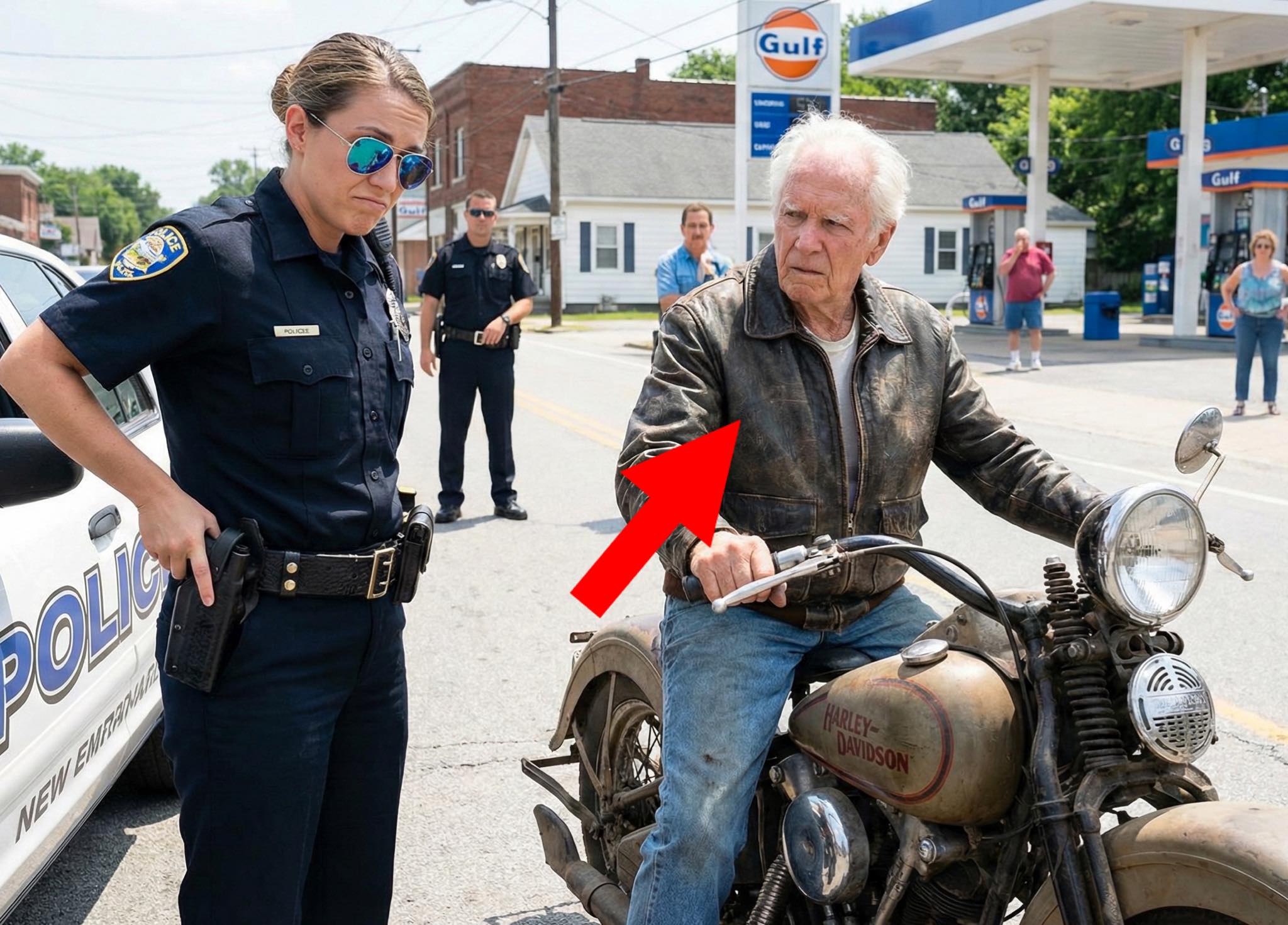
“Is this some kind of joke?” asked the young officer as she stepped out of the patrol car with a mocking look. James Harris, 82 years old, remained still on his motorcycle, hands steady on the handlebars, his calm eyes on the horizon. The officers exchanged impatient glances. “License and registration, and get off the bike now, sir.” Her voice was firm; she wore mirrored sunglasses, one hand already resting on her holstered weapon.
Officer Ava Johnson, twenty-eight, slammed her cruiser door on the dusty shoulder of County Road 340, just outside Ridgeview, Colorado. The high plains stretched endless around them—golden winter wheat fields swaying under a crisp May sky, Pikes Peak looming snow-capped in the distance, and the faint rumble of traffic from the highway two miles west. Ten miles back was Harris’s quiet farm, but right here, beside a stand of cottonwoods and the Ridgeview Fuel & Feed gas station across the road, the morning felt suddenly tense.
Officer David Lopez, her partner, circled the 1970 Harley-Davidson Shovelhead, kicking the front tire lightly. “Man, this thing’s older than my dad. Rust on the pipes, chipped paint. You sure it even runs, pops?”
Harris killed the engine with a deliberate twist but stayed seated for a beat longer, the big V-twin ticking as it cooled. He was in a faded denim jacket over an olive T-shirt, veteran cap low on his silver hair, mirrored aviators hiding eyes that had once scanned triple-canopy jungle for movement. He handed over his documents from a worn brown leather wallet—everything military-neat, no creases, no delays.
Johnson scanned the license and scoffed. “Eighty-two years old? Don’t you think you’re a little too old to be riding a motorcycle like this out here? This road’s no place for Sunday drivers with bad reflexes.”
Harris finally swung his leg over and stood in parade-rest position, hands clasped behind his back. A small crowd began to gather on the sidewalk near the gas station—farmers in pickup trucks, a couple of morning commuters, kids on bikes. Phones came out. Murmurs rippled.
“Mister Harris,” Johnson continued, flipping through the registration, “where do you live?”
“Small farm ten miles back, off 340. Alone,” he answered, voice low and steady like gravel under tires.
She exchanged a glance with Lopez that screamed *confused geriatric*. “Family? Anyone who takes care of you? Because riding something this ancient at your age—”
“I’ve taken care of myself for eighty-two years, Officer.”
Johnson’s tone sharpened. “Don’t you think it’s dangerous? You could cause an accident. Hurt someone. Look at this bike—it’s a hazard.”
Harris stayed silent, eyes fixed on the horizon again, the same thousand-yard stare that had once kept him alive in rice paddies and mountain passes.
“Sir, I’m talking to you,” she snapped.
“I’m listening.”
“Then answer me. Isn’t it irresponsible?”
Lopez leaned in, stage-whispering loud enough for the growing crowd. “I think he might be a little deaf, too. Just standing there, barely responding. Poor guy looks confused.”
The murmurs grew louder. “Poor old man,” someone whispered. “Don’t these cops have real crimes to chase?” another voice shot back. “He does look out of it, though. Somebody should call his family.”
Across the street at the Ridgeview Fuel & Feed, Marcus Williams—fifty-eight, Gulf War veteran, 1st Armored Division—dropped his rag mid-wipe on a fuel pump. He’d known Harris for fifteen years: quiet customer who always paid cash, always said “Thank you, son,” and carried himself like a man who’d already paid every debt the world could ask. The humiliation unfolding made Marcus’s blood boil. He grabbed the shop phone and dialed a number he hadn’t used since 1991.
“This is Marcus Williams, veteran, service number 45-89-22,” he barked. “Patch me to the Officer of the Watch at Fort Carson immediately. Code Red situation—senior officer in distress on County Road 340 outside Ridgeview. It’s Colonel James Harris.”
Back at the stop, Johnson had lost all patience. “Mister Harris, you’re coming with us to the station.”
Harris turned his head slowly. “And what for?”
“Inappropriate behavior, failure to comply, and based on your unresponsiveness, we believe you need a medical evaluation before you get back on this vehicle. Psychiatric hold if necessary—for your own safety.”
Lopez stepped closer, grinning. “Slower reflexes at your age, impaired vision… it’s a safety issue, man. You understand, right?”
Harris could have told them about his flight physical six months ago. About the three-mile runs he still did at 0500 every morning. About the fact that he still taught close-quarters battle tactics to Delta candidates on the base when they asked. But he didn’t. He simply looked at her with the same patient calm he’d once used on terrified eighteen-year-old recruits.
On the phone, Marcus was shouting now. “I don’t care about protocol! Colonel James Harris—the James Harris—is being harassed by local PD right now. They’re treating him like a criminal!”
The voice on the other end went ice-cold. “Did you say Colonel Harris? We’re scrambling a unit. Keep eyes on the target. Do not let them cuff him.”
Johnson reached for her handcuffs. “Get in the car, sir. This is for your own safety—elder protection statutes. Imminent risk.”
“I’m not going.”
“This isn’t a request. It’s an order.”
“Based on what law, Officer Johnson?”
She hesitated, cameras rolling from half a dozen phones now. Backing down meant admitting a mistake. “Imminent risk to yourself and others. Get in the car!”
She grabbed his arm.
The ground began to vibrate.
Not an earthquake. A deep, rhythmic thunder—diesel engines and heavy armored tires pounding asphalt. Twelve Humvees crested the rise on County Road 340 in perfect tactical formation, dust boiling behind them like a prairie storm. They braked hard in a defensive semicircle, blocking both lanes, fifty soldiers spilling out in full battle dress, rifles slung low but ready, moving with lethal, synchronized precision. Combat patches glowed on their shoulders.
From the lead vehicle, Captain George Farrell, fifty-five, silver hair high-and-tight, jaw like granite, emerged and marched straight to Harris. Three meters away he snapped to attention and delivered a salute so sharp it cracked the morning air.
“Colonel Harris, sir.”
The title landed like artillery. Johnson and Lopez froze, hands hovering near their weapons, faces draining of color.
Farrell turned to the officers, eyes flint-hard. “We received a report of a situation involving one of our own.”
Johnson stammered, voice trembling for the first time. “We… we stopped this gentleman because—”
“This gentleman?” Farrell’s voice boomed across the intersection, carrying to the crowd and the gas station. “Colonel James Harris served three tours in Vietnam with the 1st Infantry Division. Led black-ops intelligence in the Gulf. Commanded special forces detachments in Afghanistan that rewrote the urban warfare manual. Two Bronze Stars, two Purple Hearts with four Oak Leaf clusters, and the Distinguished Service Cross. This man trained half the officers who led the soldiers standing behind me right now. He is a national asset.”
The crowd went dead silent. Phones kept rolling—but now they captured reverence, not ridicule.
Johnson looked at Harris again, really looked. The faint scar along his jaw. The steel in his spine. She felt six inches tall. “Colonel Harris… I… I’m sorry. I didn’t know.”
Harris’s voice remained low and calm, the same tone he’d used to steady men under fire. “Officer Johnson, may I offer you some advice?”
“Yes, sir.”
“Never judge a book by its cover. You have no idea what battles people have fought, or what scars they carry inside.”
Farrell stepped closer. “Colonel, do you require an escort home? Transportation back to the farm?”
“No, Captain. But thank you for the rapid response. Tell the men I appreciate it.”
“We watch our own, sir. Always.”
Harris walked back to the Shovelhead, kicked it alive. The big engine roared—defiant, beautiful thunder. The fifty soldiers snapped to attention, forming a corridor of honor along the shoulder. James Harris rode through it, back ramrod straight, eyes on the horizon once more. The Humvees fell in behind him for a mile, a rolling escort of steel and respect, before peeling off toward Fort Carson.
**The reckoning.**
One hour later, Sheriff Tom Smith’s phone rang in the Ridgeview PD bullpen, the old red-brick building on Main Street. The voice on the other end was the Commanding General of Fort Carson himself.
“Sheriff, we need to talk about the incident this morning on County Road 340.”
Smith rubbed his temples, footage already playing on every local news station. “I’ve seen the videos, General. I’ve already spoken to Officers Johnson and Lopez.”
“Colonel Harris is a quiet man,” the General said. “He doesn’t want lawsuits. He doesn’t want anyone fired. But the United States Army does not tolerate our veterans—especially legends like him—being treated with that kind of disdain.”
“I understand completely.”
“Mandatory sensitivity and veterans-awareness training at the base. Your entire department will attend first. Starting Monday. No excuses.”
“It’ll be done, sir.”
A week later, inside the precinct briefing room, fluorescent lights buzzing overhead, Officer Ava Johnson stood at the podium, uniform pressed, eyes tired but clear.
“Last week I made a mistake that could have cost a hero his dignity,” she began, voice steady. “I judged a man by his age and his bike. I assumed weakness when I should have looked for strength. Respect isn’t given because of a uniform or a badge—it’s earned by how we treat people when we think we hold all the power. I learned that the hard way.”
**The farm.**
Three days after the briefing, a single patrol car rolled slowly down the long gravel driveway of the Harris farm off County Road 340. The white clapboard house gleamed under the afternoon sun, two rocking chairs waiting on the wide porch, a massive cottonwood shading the yard. The old John Deere tractor sat half-repaired under the open garage door, grease tools scattered neatly. The Shovelhead rested nearby, freshly washed and shining.
Officer Ava Johnson stepped out, clutching a small bag of fresh coffee beans from the gas station. She took a deep breath.
“Colonel Harris?”
Harris slid out from under the tractor, grease up to his elbows. He grabbed an old rag, wiped his hands, and offered the same small, patient smile.
“Officer Johnson. No problem today, I hope?”
“No, sir. No problem at all. I… I just wanted to talk. If that’s all right.”
“I just put on a fresh pot. Come on inside.”
In the modest kitchen—wooden table scarred by decades of use, photos of fallen comrades on the walls, an American flag folded in a shadow box—Harris poured two mugs of strong black coffee.
“Why did you become a police officer, Ava?” he asked gently, sitting across from her.
“I wanted to help people. Keep the community safe.”
“How many accidents caused by eighty-two-year-olds have you responded to this year?”
She stared into her mug. “None. It’s mostly texting kids and speeders.”
Harris nodded. “Then why assume I was the danger?”
“Because it was easier than looking closer,” she admitted softly. “I’m sorry, Colonel. Truly.”
Harris stood and walked to the window, gazing at the Harley and the tractor outside.
“Respect is a currency, Officer. You spend it to earn it. That machine out there is old. It rattles. It has scars. But it still runs. Still has miles left.” He turned back, a quiet twinkle in his eye. “And so do I.”
Ava smiled—genuine, relieved, humbled.
Outside, the Colorado wind whispered through the cottonwoods. The Shovelhead sat waiting, polished and proud. James Harris had faced worse than two young officers on a dusty roadside. He had faced war, loss, and time itself—and he had never once lost his bearing.
And somewhere on the high plains of County Road 340, the thunder of engines still rolled on—reminding everyone that some heroes never really retire. They just ride quieter… until the moment they don’t.