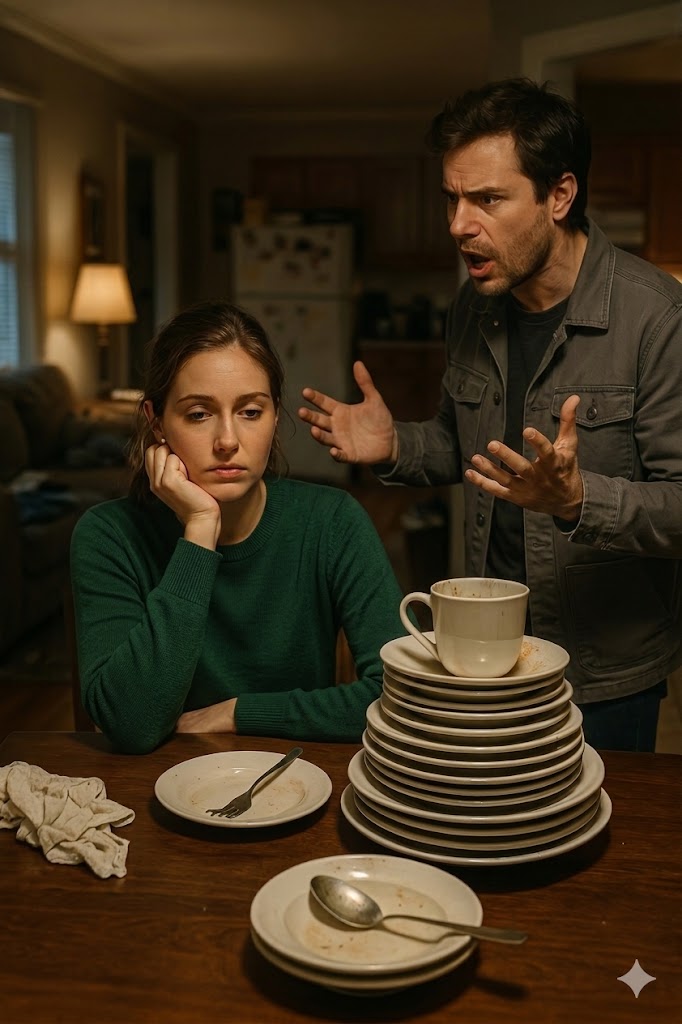
I stood there for a moment, letting the silence fill the room where his words had just landed.
“I don’t care about your job.”
It wasn’t just what he said—it was how casually it came out, like everything I did outside that house had no weight at all. My hands were still holding my bag strap, my body still halfway between exhaustion and collapse, but something inside me stopped reacting the way it always had.
For a long time, I used to explain myself. I used to justify, to apologize, to try harder the next day hoping things would feel different. That night, I didn’t feel like explaining anything anymore.
I slowly set my bag down near the door.
Then I looked at the kitchen. The sink was full again. The table had crumbs from earlier. A school bag lay open on the floor, papers spilling out. The familiar chaos that I always walked into, always fixed, always absorbed into my already tired body.
And I said something I had never said before.
“I can’t do this alone anymore.”
He let out a short laugh, like I was exaggerating. “You always say that. But you still do it.”
That was the moment something shifted—not loudly, not dramatically, but completely.
I walked past him without arguing. I didn’t start cleaning. I didn’t cook. I didn’t rush into fixing anything. Instead, I went straight to the bedroom and closed the door behind me.
For the first time in years, I didn’t try to hold the house together that night.
The silence outside felt different. At first, there was confusion. Then footsteps. The sound of him opening and closing cabinets. A few frustrated sighs. A chair scraping.
Later, I heard the kids asking for food.
And then—nothing got done the way it usually did.
I lay there staring at the ceiling, exhausted but strangely awake. Not from anger exactly, but from clarity. I was used to carrying everything because I had never allowed it to fall.
Hours passed like that.
The next morning came earlier than usual. I got up, but I didn’t rush. I made my own tea. I packed my own things. I got ready for work like I always did—but without fixing the mess behind me.
When I walked out, the house still looked the same as I had left it.
But something else had changed.
He was standing near the kitchen counter, quiet. The frustration from the night before wasn’t as loud anymore. The usual complaints didn’t come.
For the first time, he looked at the house the way I had been seeing it for years—not as something that “just gets done,” but as something that requires constant effort.
I didn’t say much before leaving. Just one sentence.
“I hope today helps you understand what I do here every day.”
Then I left for work.
That evening, I came back expecting tension again. Maybe another argument. Maybe stubborn silence.
Instead, I saw something different.
The house wasn’t perfect, but it wasn’t ignored either. The kids were eating. The toys were gathered into a corner. The dishes were half-done. It wasn’t impressive—it was unfamiliar.
And he was there, sitting on the edge of the sofa, tired in a different way than before.
He didn’t start with excuses. He didn’t start with blame.
He just said, quietly, “I didn’t realize how much there actually is.”
For a moment, neither of us spoke.
Not because everything was suddenly fixed, but because something had finally been seen.
That night didn’t solve everything between us. It didn’t magically erase the years of imbalance or exhaustion. But it opened a conversation that had been avoided for too long.
And for the first time, it wasn’t about who was right.
It was about what it actually takes to keep everything going—and what happens when one person finally stops carrying it all alone.