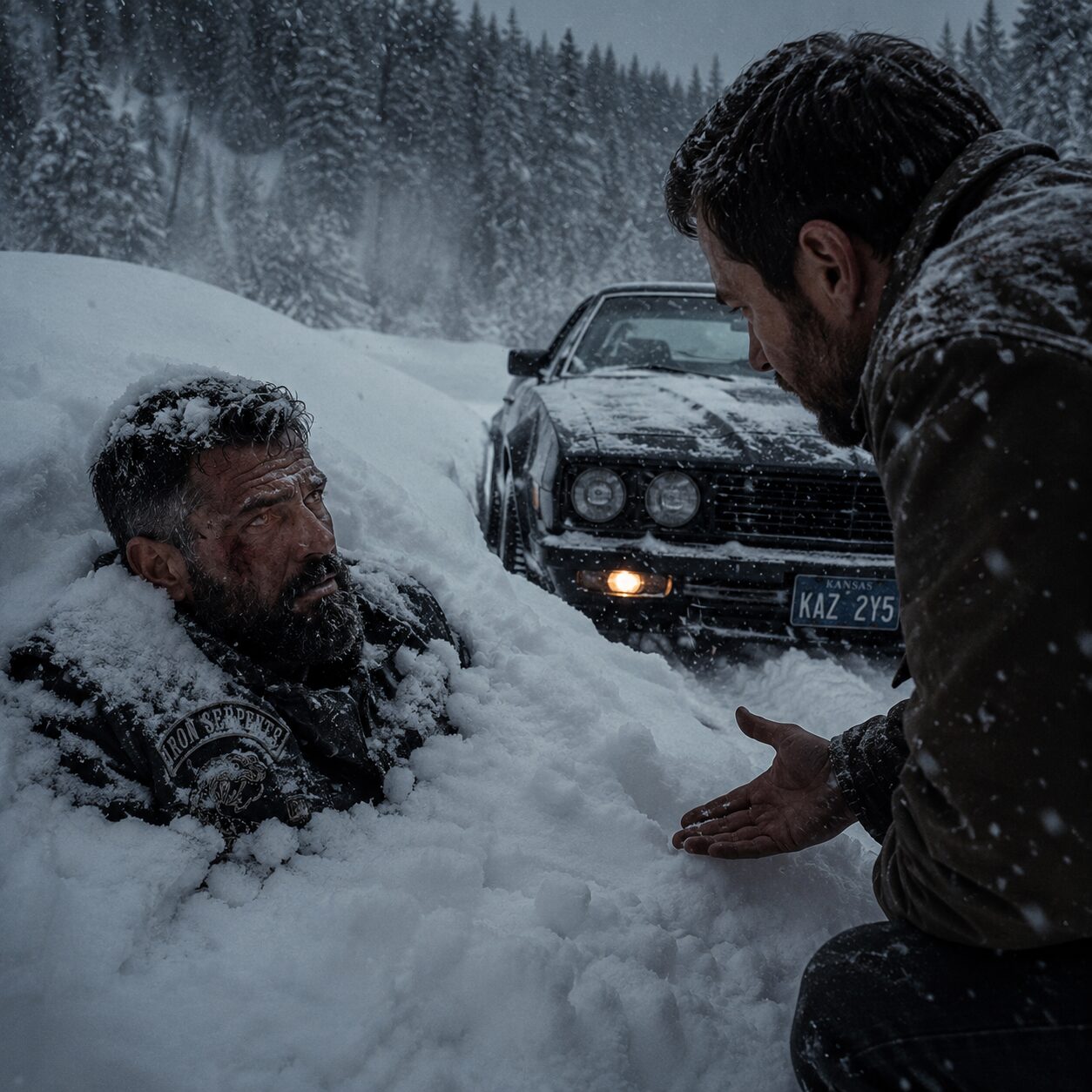
The blizzard hit like it had a personal grudge against me.
I was driving up the old mountain pass in my beat-up SUV, wipers fighting a losing battle against the snow. My name is Sarah Kline, thirty years old, and I was heading to my grandmother’s abandoned cabin for three days of silence. After twelve-hour shifts at the county hospital and a messy breakup, I needed the kind of quiet that only deep snow and no cell signal can give you.
The radio had warned of a sudden storm, but nothing prepared me for how fast the world turned white. Visibility dropped to twenty feet. The road disappeared. I was gripping the wheel so hard my knuckles ached when I saw it.
A flash of chrome.
At first I thought it was a guardrail or a sign. Then the shape resolved through the swirling snow — the handlebar of a motorcycle, half-buried, and beside it, a black boot sticking out of a drift like a dark flag.
I slammed on the brakes. The SUV fishtailed but stopped. For three full seconds I sat there, heart hammering, telling myself to keep driving. People die in these mountains every winter. I was a nurse, not a search-and-rescue team.
But that boot…
I grabbed my emergency kit, the heavy winter coat from the back seat, and the folding shovel I kept for exactly this kind of stupidity. The wind tried to rip the door off when I opened it. Snow stung my face like needles.
I fought my way to the shape in the drift.
It was a man.
He was buried up to his chest in snow, leather vest over a thick jacket, beard crusted with ice. His eyes were closed. Blood had frozen on his temple where he must have hit something when he went down. The motorcycle lay on its side a few feet away, already becoming part of the landscape.
“Hey!” I shouted over the wind. “Can you hear me?”
Nothing.
I dropped to my knees and started digging with the shovel, then with my hands when the snow packed too hard. My gloves were soaked in seconds. My fingers went numb. I kept talking to him the whole time — stupid things, anything to keep myself from panicking.
“Don’t you die on me, you stubborn bastard. I didn’t come all the way up here to find a corpse.”
It took twenty minutes. Twenty minutes of pure hell. By the time I had his upper body clear, my arms were shaking and I was breathing like I’d run a marathon. He was big — six-two at least, solid muscle under the leather. Getting him to the SUV was the hardest thing I’ve ever done. I half-dragged, half-carried him, slipping the whole way. I had to use the winch on the front of the SUV and a tow strap to get him up onto the passenger seat.
He was breathing. Barely. Hypothermic, probably concussed, maybe worse. I cranked the heat to full blast and pointed every vent at him. Then I did the only thing I could think of — I drove toward the cabin. There was no way back down the pass now. The road was gone.
The cabin was only another mile. By the time I reached it, the man was mumbling. One word, over and over.
“Liam…”
I got him inside, stripped off the wet leather and layers with clinical efficiency, and wrapped him in every blanket I could find. I built a fire in the old stone fireplace and dragged the mattress from the bedroom in front of it. Then I did the only thing that actually works for severe hypothermia — I got under the blankets with him, skin to skin, sharing body heat.
He was ice cold. I held him while the storm screamed outside and prayed I wasn’t too late.
He woke sometime after midnight.
I felt the change in his breathing first. Then his body tensed. One big hand came up and grabbed my wrist before I could move.
“Who the hell are you?” His voice was gravel and pain.
“Sarah. I found you in the snow. You’re safe.”
He stared at me with eyes the color of storm clouds. There was a hardness there, but also something broken. He let go of my wrist slowly.
“Ghost,” he said after a long moment. “People call me Ghost.”
Over the next two days the storm trapped us completely. The power went out. We lived by firelight and the emergency lanterns I’d brought. I treated his injuries as best I could — a nasty gash on his head, bruised ribs, a sprained ankle that was already swelling. He was tough. Too tough. The kind of tough that comes from a life where showing weakness gets you killed.
On the second night, when the fever hit and the painkillers I’d given him loosened his tongue, the story came out in pieces.
He had been in an outlaw motorcycle club called the Black Ravens for twelve years. Not the worst of them, he said, but bad enough. He ran guns, broke bones when ordered, lived by the code. Then he met a woman named Elena. She got pregnant. Ghost tried to leave the life. The club didn’t let people walk away clean.
They killed Elena when their daughter was four years old. A drive-by meant for Ghost that hit her car instead. After that, he took his daughter Liam — short for something, he never said what — and disappeared. Changed names. Tried to be a father instead of a criminal.
For five years he managed it. Worked construction. Went to parent-teacher conferences. Taught his daughter how to ride a bicycle. Then the Ravens found him again.
They didn’t want him back. They wanted revenge for the years he’d been gone and the things he knew. One of their prospects — a kid hopped up on meth and orders — ran Ghost’s daughter off the road on her way home from school. Liam was nine. She was in a medically induced coma at a small hospital on the other side of the mountain pass. The doctors said she might not make it through the week.
Ghost had been riding his old bike — the same one I’d found half-buried — because it was the fastest way through the back roads when the storm hit. He was trying to reach the hospital before the pass closed completely. He took a curve too fast in whiteout conditions, went over the embankment, and the snow did the rest.
“I was almost there,” he whispered, staring into the fire. His voice cracked for the first time. “I was twenty minutes away. I could see the lights of the hospital through the trees. Then the world just… went white.”
He had been trying to get to his daughter to say goodbye. Or to be there when she woke up. He didn’t know which it would be. He just knew he couldn’t let her die alone the way her mother had.
That was the reason that broke my heart.
Not the crash. Not the club. Not even the violence.
It was the image of this huge, scarred man — this outlaw who had done terrible things and tried to outrun them — fighting a blizzard on a motorcycle because he refused to let his little girl leave this world without her father holding her hand.
I cried that night. Quietly, so he wouldn’t hear. But he did.
He reached over and took my hand in his rough one.
“You didn’t have to stop,” he said. “Most people wouldn’t have.”
“I’m a nurse,” I answered. “Stopping is what we do.”
On the third day the storm finally broke.
We heard them before we saw them — the low growl of snowmobiles cutting through the trees. Three of them. Ghost went still the second he heard the engines. He looked at me with something close to panic.
“They found me.”
He tried to stand. His ankle gave out immediately. I pushed him back down.
“You can barely walk. You’re not fighting anyone.”
“They’ll kill you too if they think you helped me.”
I didn’t have time to argue. I helped him to the back bedroom, gave him the pistol he’d had in his vest (I’d found it while undressing him), and told him to stay quiet. Then I did the only thing I could think of — I made it look like I was alone.
When they kicked in the door, I was standing in front of the fire with a cast-iron skillet in my hands like some kind of ridiculous pioneer woman.
Three men in snow gear and Ravens patches. The one in front had cold eyes and a scar across his cheek.
“We’re looking for a man,” he said. “Big guy. Beard. Goes by Ghost.”
I kept my voice steady. “Haven’t seen anyone. Storm’s been bad. You should get back before it hits again.”
He smiled like he didn’t believe me. They started searching the cabin.
I don’t know what gave Ghost away — maybe a floorboard creaked or the fever made him groan. The lead man turned toward the bedroom door.
That’s when Ghost came out.
He was pale, swaying, but he had the pistol in one hand and murder in his eyes. He didn’t waste time talking. He shot the first man in the leg before anyone could react. The cabin exploded into chaos.
I grabbed the skillet and swung it at the second man’s head as he lunged for Ghost. It connected with a sickening crunch. Ghost tackled the third one into the wall. They fought like animals — fists, knees, elbows. Blood on the snow that had blown inside. I grabbed the fallen man’s radio and screamed into it, calling for help, praying someone was monitoring the emergency channel.
It ended fast and ugly.
Ghost was still standing when it was over, barely. Two of them were down. The third had fled on a snowmobile. Ghost looked at me, blood running down his face from a reopened cut.
“You shouldn’t have done that,” he said.
“Neither should you,” I answered.
We didn’t have long. The third man would bring more. Ghost was too weak to run, and I wasn’t leaving him. We barricaded the door, built the fire back up, and waited.
That night, while we waited for whatever came next, he told me the rest.
His real name was Nathaniel Crowe. He had been trying to get clean for Liam’s sake. The club had used his daughter to punish him for leaving. And the worst part — the part that broke what was left of my heart — was that Liam had asked for him on the phone two days before the accident. She had said, “Daddy, when are you coming home?” And Ghost had promised he would be there soon.
He never made it.
At dawn, help arrived — not the Ravens, but state troopers and a search-and-rescue team I had managed to reach on the radio. The third man had been caught trying to escape down the mountain. Ghost was arrested on old warrants, but the evidence he’d been carrying — photos, recordings, names — was enough to bring down half the Black Ravens leadership. They had been running a trafficking operation Ghost had refused to touch. That refusal was why they came after his family.
Before they took him away on a stretcher, Ghost looked at me one last time.
“Tell Liam…” His voice failed. He tried again. “Tell her I tried.”
I visited him in the hospital two weeks later. Liam had pulled through. She was going to make it. Ghost was going to prison for a few years on the old charges, but the new evidence had earned him some consideration. Protective custody. A chance at a reduced sentence.
I sat by his bed and held his hand.
“You kept your promise,” I told him. “You got to her.”
He closed his eyes. A single tear slipped down his face and disappeared into his beard.
“I was buried in that snow for hours,” he said quietly. “I thought that was it. Then I heard your voice. You dragged me out of the ground like I still mattered.”
“You do matter,” I said.
He opened his eyes and looked at me — really looked.
“When I get out,” he said, “if you’re still around… I’d like to buy you a coffee that doesn’t taste like hospital shit.”
I smiled through the tears I was trying not to show.
“I’ll be around.”
The snow melted eventually. Spring came. Ghost went to trial, took a deal, and started serving his time. I visited when I could. Liam came with me sometimes once she was strong enough. She was a tough little girl with her father’s eyes.
One day, years from now, when Ghost walks out of those gates, I’ll be there. And maybe, just maybe, the man who was once buried in snow will finally get to live the life he fought so hard to protect.
But that day in the cabin, when the storm was still screaming and the men with guns were still out there, I learned something I’ll never forget.
Some people don’t get buried by snow.
They get buried by the weight of the love they carry and the mistakes they’re trying to outrun.
And sometimes, the only thing that saves them is a stranger willing to dig.