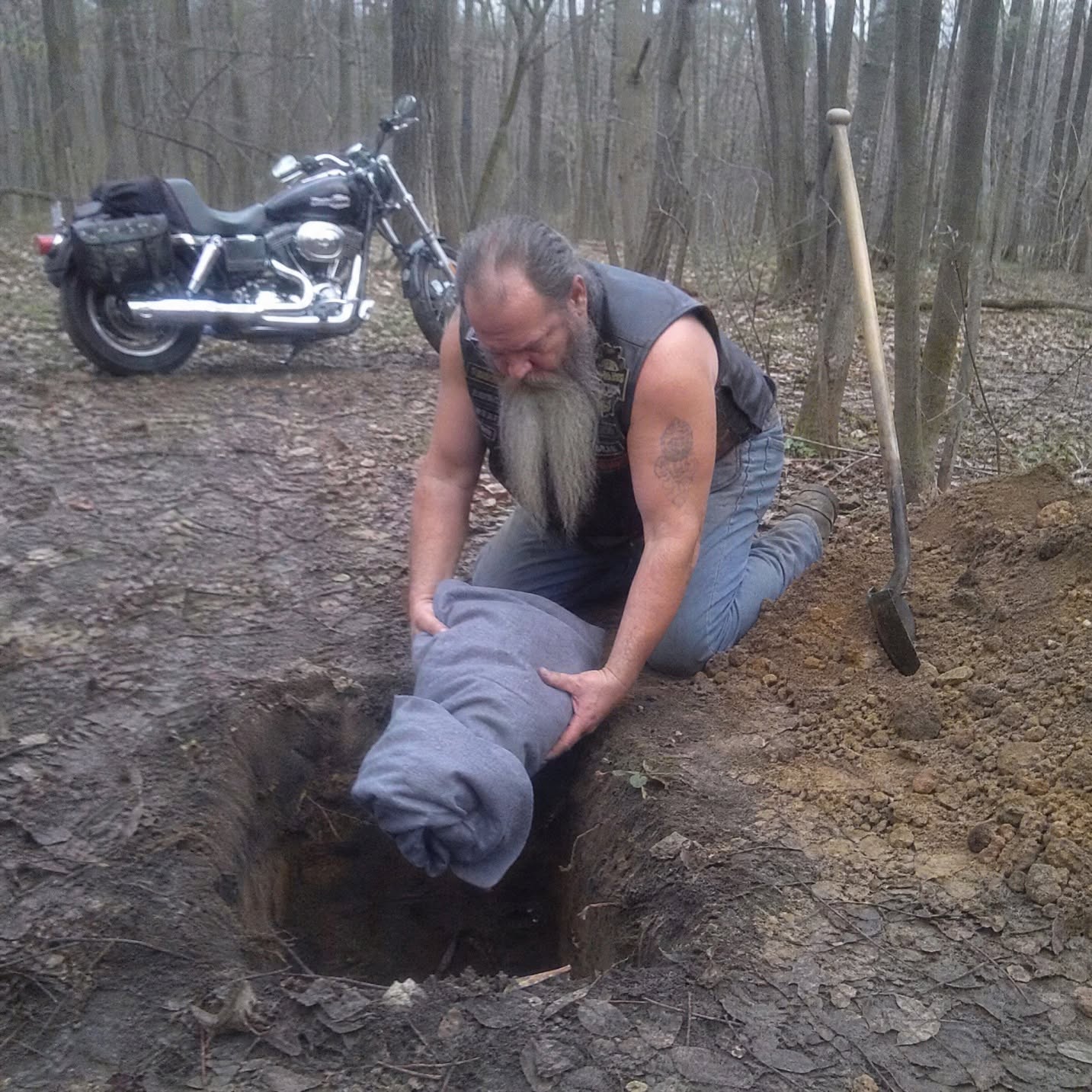
The first gray thread of dawn had just begun stitching itself across the ridgeline when the Harley’s low thunder rolled up the gravel road that dead-ends at my property line. I was already awake—had been for an hour—standing at the kitchen window with a cooling cup of coffee and the old Zeiss binoculars I keep on the sill “for birds.” Truth was, after the string of rural burglaries the county scanner had been crackling about all winter, those binoculars spent more time on the tree line than on chickadees.
The rider killed the engine. In the sudden silence I could hear the tick of cooling metal. He was big—six-four easy, maybe two-fifty, with a chest like a whiskey barrel and a beard the color of old steel wool that reached the middle of his leather vest. Patches I couldn’t read from this distance rode the leather like faded battle flags. He swung off the bike the way a man does when the machine is the only thing that’s never left him. From the left saddlebag he drew a bundle wrapped in a faded quilt. From the right he pulled a long-handled shovel.
The bundle was the size of a child.
My mouth went dry. I set the coffee down so hard it sloshed over the rim.
He walked straight into the pines behind my cabin without looking back. Twenty minutes later the rhythmic chunk of a shovel biting frozen earth drifted up to the house on the still air. No birds sang yet. Even the wind seemed to be holding its breath.
I dialed 911 with hands that didn’t feel like my own.
“911, what’s your emergency?”
“There’s a man on my land,” I said, voice low like the walls might hear me. “He rode in on a Harley at first light. Carried something wrapped in a blanket—looked like a body. Now he’s digging. I’m at 147 Old Mill Road, end of the county road. Send somebody. Fast.”
The dispatcher asked if the man was armed. I said I didn’t know. She told me to stay inside and lock the doors. I said I would.
Then I did the second stupid thing that morning.
I took the .30-06 down from the rack above the fireplace, fed three rounds into the magazine, and chambered one. Safety on. Jacket on. Boots on. The woods were mine. I wasn’t going to sit in my kitchen like some old man waiting for the world to decide what it wanted to do to him.
The ground was hard with frost. Every step crackled like a gunshot. I stayed off the main trail, using the old deer path that skirts the stone wall my grandfather built in 1947. The digging sound grew louder. I could hear the man breathing now—harsh, wet drags of air, like he was fighting something inside his own chest. Once I thought I heard him speak, low and rough, but the words were lost in the pines.
I came up behind a thick hemlock twenty yards from the clearing he’d chosen. He had the hole already past his knees, square and straight-sided the way a man digs when he’s done it before. The bundle lay on a patch of moss beside the pile of dark earth. He drove the shovel in again, twisted, lifted. The muscles in his forearms corded under the ink that covered them. When he paused to wipe sweat from his eyes with a red bandana, I saw the tears.
They cut clean tracks down a face that looked like it had never learned how to cry in front of another human being.
He must have heard the twig I snapped. His head came up fast. One big hand dropped toward his hip—toward the place a man keeps a pistol—and I stepped out from behind the tree with the rifle low but ready, finger alongside the trigger guard.
We stared at each other across twenty feet of cold air.
“Please,” he said. His voice cracked like old leather. “Just give me ten more minutes with her.”
The word hit me sideways. *Her.*
I didn’t lower the rifle. “I called the sheriff. They’re coming. Whatever this is, you need to tell me right now.”
He didn’t move. Just looked down into the hole like it was the only honest thing left in the world. His shoulders started to shake—great, silent heaves that made the leather vest creak.
“Her name was Daisy,” he said finally.
I waited.
He bent, took one corner of the quilt between two scarred fingers, and folded it back.
Brown and white fur. A graying muzzle. A worn leather collar with a tag that caught the first thin sunlight. The dog’s eyes were closed like she was only sleeping. One ear still flopped the way ears do on dogs that have spent their lives riding in the wind.
The air left my lungs in a long, shaking rush. The rifle barrel dipped until the stock rested against my thigh.
“She was sixteen,” he said, and the words came out like they’d been waiting behind his teeth for years. “I got her when she was six weeks old. The same month my wife walked out. Same month the house and the savings and every friend I thought I had picked sides and left with her. I was forty-one years old and starting over with a motorcycle and a job sweeping floors at a machine shop. Then this little brown-and-white pup climbed into my boot while I was looking at her littermates and went to sleep like she’d already decided the rest of my life belonged to her.”
He wiped his face with the back of his wrist. The knuckles were split and scarred. A thin gold ring, worn nearly smooth, caught the light.
“I named her Daisy because my ex hated the name for the daughter we never had. Figured it was the one thing I could still choose.” He tried to smile. It didn’t take. “She rode on the back of that bike in a rig I built—harness, little goggles, the works. People laughed. Big ugly bastard with a dog in pink goggles. I didn’t care. She was the only thing that never once asked me to be smaller than I am.”
While we waited for the sirens I learned the rest in pieces, the way a man tells a story when he’s afraid the telling will finish him.
How she slept at the foot of his bed every night for sixteen years. How, when the shop laid him off in ’09, she was the reason he got up at all—because she still needed to be walked and fed and talked to. How, the night his mother died, Daisy climbed onto his chest in the dark and stayed there until the sun came up. How, three years ago when the heart stents went in and he spent four nights in the hospital, the neighbor watching her couldn’t keep her home; she sat at the emergency room doors until the nurses started bringing her water bowls and letting her sleep on a blanket in the lobby.
“She always knew where I was,” he said. “Even when I didn’t.”
The end had come the way it does with the old ones. Back legs first. Then the long rides she used to love became short walks. Then, last week, she stopped eating. The vet had been kind but clear: anything more would be for the man, not the dog.
So he’d brought her home. Sat on the kitchen floor with her for two straight days, hand on her ribs, telling her every story they’d ever lived together. At 4:17 that morning she took one long breath and let it out and never took another.
“I couldn’t put her in a landfill,” he said, voice breaking for the first time. “She rode every mile with me. I just wanted somewhere quiet. Somewhere birds would still sing. I didn’t know this was anybody’s land. I saw the trees and the clearing and I thought… this is good. She’d like this.”
He looked at me then—really looked—and I saw the man under the leather and the scars and the size of him.
“I was gonna find the owner after. Explain. Offer to pay. I just couldn’t leave her in the truck bed while I knocked on doors like she was a sack of feed. I’m sorry I did it on your ground. That was wrong.”
The sirens came while he was still talking—two county cruisers, lights flashing but no sound, coming up the long drive like they already knew this wasn’t the kind of call that needed noise.
Walt—his name was Walt Ellison—stood up slow and put both hands in the air without being asked. I understood why. A man built like him, with that face and that vest, learns early how to survive the moment blue lights arrive.
Two deputies crossed the field. The younger one had his hand on his holster. The older one—gray at the temples, face like a map that had seen every road—took the lead.
“Sir, keep your hands where I can see them,” the young deputy said.
Walt didn’t move. “Yes, sir. No weapon on me. It’s just me and my dog.”
The older deputy reached the edge of the hole and looked down. I watched his face change the way a man’s face changes when he recognizes something he’s spent months trying not to remember. He looked at the flannel shirt lining the bottom, the chewed tennis ball, the rope toy reduced to threads, the small framed photograph of a much younger Walt with a six-week-old puppy asleep in his lap on the seat of that same Harley.
He took off his hat.
“Put it away, Ruiz,” he said quietly to the younger man. “It’s a dog. Man’s burying his dog.”
Deputy Ruiz lowered his hand, but the tension didn’t leave his shoulders. The older deputy—Delaney, his name tag said—crouched beside the grave the way a man kneels at a church rail. He read the tag on Daisy’s collar. He studied the photograph. When he spoke, his voice was rough.
“How long you have her?”
“Sixteen years,” Walt said.
Delaney nodded like a man adding up his own private ledger. He stood. “I lost my K9 partner eight months ago. Max. German shepherd. Had him since the academy. I did what you’re supposed to do—took him to the vet, let them handle it. My wife still won’t forgive me for not having anywhere to go sit with him. Nowhere that was *his*.” He looked Walt square in the eye. “You did it right. Don’t let anybody tell you different.”
Then he turned to me. “This your land?”
“It is.”
The three of us stood there in the clearing while the sun finally cleared the ridge and the first real birdsong started up in the branches. I thought about my own wife, gone five years now. About the little cedar box on the mantel that holds her wedding ring and the last photo we took together. About how quiet the house had been since. About how, if I died tomorrow, there wouldn’t be anyone left who knew the sound of my voice when I was talking to someone who couldn’t answer back.
I made the decision right there.
“She stays,” I said. “Right where she is. On my land.”
Walt looked at me like I’d spoken in a language he’d forgotten how to hear.
“You sure?” he asked.
“I’m sure.”
Deputy Delaney nodded once, like a man closing a case the right way for the first time in months. Then he and Deputy Ruiz did something I will never forget as long as I live. They got down on their knees in the cold dirt—two armed officers who had rolled up ready for a homicide—and helped a stranger fill a grave with their bare hands because none of us wanted to walk away long enough to fetch a shovel and break whatever thin, holy thing was holding the morning together.
When the hole was full, Delaney pressed the dirt flat with his palms and stayed crouched there a second longer than necessary. I think he was saying goodbye to Max as much as to Daisy. Then he stood, brushed off his knees, and shook Walt’s hand.
“I’m sorry for your loss,” he said, and meant every syllable.
Before he rode out, Walt asked if he could come back sometimes. Just to sit. Just for a few minutes.
I told him the woods were open to him any time he wanted.
He’s been back every Sunday morning since. I hear the Harley long before I see it— that distinctive low rumble that somehow sounds gentler now. He parks in the same spot, walks the same path, carrying a thermos of coffee and sometimes a single flower he’s picked from the side of the road. He sits on the ground beside the little marker he carved himself from a piece of cedar that fell in last winter’s ice storm.
It says:
DAISY
BEST GIRL
BEST MILES
2008 – 2024
Some mornings I take two cups and join him. We don’t talk much. We don’t need to. He tells me a Daisy story now and then—how she once stole an entire cheeseburger off a picnic table in Yellowstone and looked so pleased with herself he couldn’t even be mad. I tell him about the time my wife and I drove Route 66 in a ’67 Chevy with a three-legged mutt named Lucky who thought every cactus was a personal enemy. The birds keep singing overhead, just like he wanted for her.
I called the law on a man because I thought he was burying a body.
What he was burying was sixteen years of the only loyalty that never once asked him to be anything but exactly who he was. The kind that rides in pink goggles through every storm life throws at you and still climbs into your boot on the day you’ve lost everything else and decides, all on her own, that you’re worth staying for.
I almost had that man arrested for loving something that much.
Now there’s a dog resting under the pines on my land, and a marker carved by hand, and a friendship I never went looking for. All because a stranger couldn’t stand the thought of his best girl resting anywhere but somewhere quiet, where the birds still sing.
If you’ve ever loved a dog the way Walt loved Daisy—the kind you’d dig a grave for with your own two hands, the kind that knew where you were even when you didn’t—share this. Walt’s not the only one who knows what she was worth.
And Daisy, if dogs get to read these things wherever they are: good girl. Best miles, sweetheart. Rest easy. The birds are still singing.