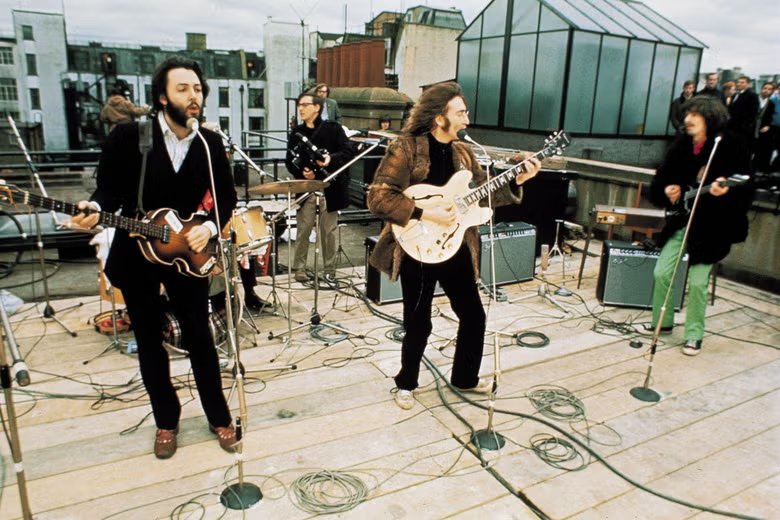
The Beatles’ recording career lasted eight years — from Please Please Me in 1963 to Let It Be in 1970. In those eight years they moved from straightforward rock and roll influenced by Buddy Holly and Chuck Berry to a body of work that encompassed chamber music, psychedelic experimentation, avant-garde tape loops, Indian classical music, music hall pastiche, and the first glimmers of what would become ambient music. The trajectory is so steep that musicologists still study it as one of the most compressed periods of artistic development in the history of popular culture.
What is less discussed is the specific moments within that trajectory where the music they were making outpaced their own understanding of what they had made — where the recording session produced something that none of the four people in the room could fully account for, that required years and sometimes decades to be understood by the broader culture, and that the Beatles themselves heard back in the control room with an uncertainty about what they were listening to that the subsequent history of those recordings has fully resolved.
1. Tomorrow Never Knows (1966)
The final track on Revolver — John Lennon’s vocal run through a rotating Leslie speaker to create the sound he described as the Dalai Lama chanting from a mountaintop, tape loops assembled from household recordings and run simultaneously at different speeds, a drum pattern from Ringo that was unlike anything he had previously recorded. George Martin has said the playback session for Tomorrow Never Knows was the most disorienting experience of his recording career — that he listened to it and understood that music had moved somewhere he had not previously known it could go. Lennon has said he wanted the whole of Revolver to sound like Tomorrow Never Knows. The other Beatles said no. The compromise was everything else on the album, which turned out to be sufficient.
2. A Day in the Life (1967)
The closing track of Sgt. Pepper’s — two unfinished Lennon-McCartney songs joined by an orchestral section that was constructed by instructing forty musicians to begin at their lowest note and arrive at their highest note in twenty-four bars, with no other direction, the results producing a controlled chaos of mounting intensity that ends on a piano chord sustained for almost a minute. McCartney has said the recording of the orchestral section was the moment he understood that the studio was not a place where music was captured but a place where music was invented — that what emerged from those forty musicians following the minimal direction was something that could not have been written or predicted.
3. Strawberry Fields Forever (1967)
Recorded in two different keys and at two different tempos — two complete versions that Lennon liked equally and could not choose between. Martin’s solution was to speed up one version and slow down the other until the keys and tempos matched, a technical solution that had never been attempted and that produced the specific dreamlike quality of the released recording. Lennon has said he did not know, when he heard the combined version for the first time, exactly what had been done to produce it. He knew it was right. The understanding came later.
4. I Am the Walrus (1967)
Written by Lennon as a deliberate act of anti-interpretation — a lyric constructed to resist meaning, to frustrate the critics and academics who had begun analyzing Beatles lyrics with scholarly seriousness, to produce something that sounded profound and was specifically designed to have no stable meaning. The irony is that I Am the Walrus has been analyzed more seriously and more extensively than almost any Beatles lyric — that the attempt to produce meaninglessness produced something that people have been finding meaning in for sixty years. Lennon found this either amusing or irritating depending on the interview.
5. Because (1969)
From Abbey Road — three voices in tight harmony, Lennon’s chord sequence derived from Beethoven’s Moonlight Sonata played backwards, a piece of music so quiet and so strange that it sits in the middle of the album’s final medley like something from a different musical universe. McCartney has said the three-part vocal arrangement was the most technically demanding thing the three of them ever recorded together — that the harmony was so tight and so unusual that achieving it required more takes than almost anything else in the catalog. George Harrison has said the song sounds, on repeated listening, like something the three of them received rather than constructed.
The Beatles broke up before the full significance of what they had made was clear to any of them. Lennon’s assessment of the catalog was characteristically inconsistent — he dismissed much of it in the bitterness of the early 1970s and later revised those dismissals. McCartney has never stopped defending it. Harrison spent the decade after the breakup making work that was partly a demonstration that he had always been capable of more than the band allowed. Ringo has said he simply loved being there.