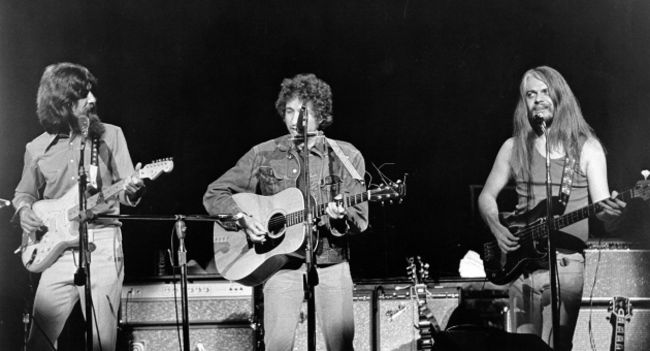
Bob Dylan has spent sixty years in a state of conflict with his audience’s expectations. Not accidentally — not as the byproduct of restlessness or inconsistency. Deliberately. With the specific intention of someone who has decided that the audience’s comfort with a version of him is a problem to be solved rather than a condition to be maintained. He has reinvented himself so many times and with such disregard for the preferences of the people who had come to love the previous version that the reinvention has itself become the defining characteristic. You do not know what you are going to get with Dylan. That is always what you are going to get with Dylan.
The five concerts on this list represent the moments when the distance between what Dylan was doing and what the audience was prepared to receive was greatest. The moments of maximum friction. The moments that produced the strongest negative reactions in real time and the strongest positive reassessments with the passage of time.
1. Newport Folk Festival, 1965. The most famous. The electric set. Three songs with the Paul Butterfield Blues Band in front of an audience that had come for the folk prophet and received instead the harbinger of electric rock. The booing. Pete Seeger reportedly wanting to cut the power cables with an axe. Dylan leaving the stage after three songs. The reassessment has been total — this performance is now understood as the moment rock music became something it had not previously been.
2. Manchester Free Trade Hall, 1966. The acoustic-electric tour of the UK. The audience member who shouted “Judas” — the most famous single word spoken at any concert in history. Dylan’s response: “I don’t believe you. You’re a liar.” And then: “Play it fucking loud” to the band. The performance of “Like a Rolling Stone” that followed is considered by many critics and musicians the greatest live rock performance ever recorded.
3. The Gospel Tours, 1979-1980. Dylan had converted to Christianity. He played exclusively religious material for an audience that had come for the secular canon. People walked out. Reviews were scalding. The material from this period — Slow Train Coming, Saved — is now regarded as among his most musically adventurous and vocally compelling work.
4. The Never Ending Tour, early 1990s. Dylan playing radically rearranged versions of his famous songs — so rearranged that audiences who had come to hear the songs they knew could not recognize them. Complaints were constant. Critics declared him finished. The approach of constant rearrangement is now understood as a refusal to become a museum piece — a determination to keep the songs alive by keeping them in motion.
5. The Masked and Anonymous concert film tour, 2003. A film and concert event that deliberately challenged every expectation of what a Dylan concert or film should be. The critical reception was hostile. The audience was confused. Twenty years later it is studied in film schools as a coherent artistic statement and the concerts associated with it are described by people who attended them as some of the most confrontational and alive Dylan performances of his later career.
Five disasters. Five masterpieces. Twenty years of distance between the verdict and the reassessment.
Dylan does not wait for the reassessment. He is already somewhere else by the time it arrives.
He has always been somewhere else.