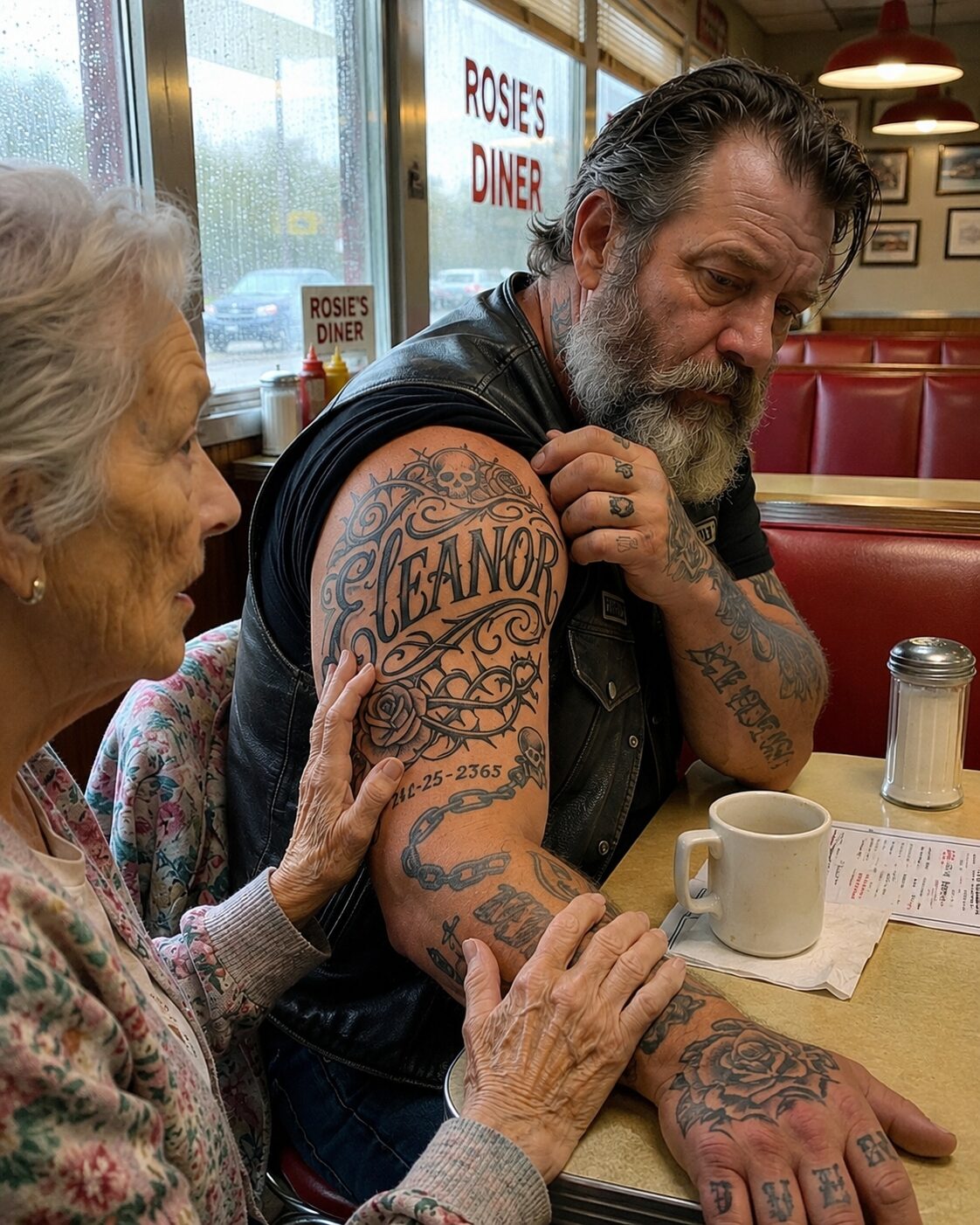
Nobody at Rosie’s Diner ever wanted table seven.
Not because the old woman caused trouble. Eleanor Whitmore was polite, quiet, and always tipped with exact change. The problem was that she stayed too long.
Every morning at 6:15 sharp, she shuffled through the diner doors in the same worn blue coat, carrying a cracked leather purse that looked older than most of the customers. She ordered the cheapest coffee on the menu, asked for one refill, and then sat by the rain-fogged window for hours staring out at the highway.
People noticed.
“She’s here every day.”
“She scares customers away.”
“She buys one coffee and camps all morning.”
But Jake Hollow never complained.
Jake looked like the kind of man people crossed the street to avoid. Huge shoulders. Gray threaded through his beard. Tattoos winding across both arms like scars turned into artwork. Heavy boots. Leather vest. A face that looked carved from old stone.
Yet every morning, without fail, Jake topped off Eleanor’s coffee before she even asked.
And every morning, she thanked him with the same small smile.
One Thursday, rain hammered the diner windows while the breakfast rush filled every booth. A businessman in a tailored gray suit stopped beside Eleanor’s table, irritation written all over his face.
“You almost done here?” he snapped. “Some of us need a place to sit.”
Eleanor immediately reached for her purse. “Oh—I’m sorry. I didn’t realize—”
Before she could stand, a tattooed hand landed flat on the table.
Jake.
“You got an issue?” he asked calmly.
The businessman looked him up and down. “She’s been here three hours.”
Jake shrugged. “And?”
“She’s taking up space.”
Without another word, Jake pulled out the chair across from Eleanor and sat down heavily.
“Looks like the table’s occupied now.”
The diner went silent.
The businessman forced a laugh. “What, are you threatening me?”
Jake lifted his coffee cup slowly, never taking his eyes off him.
“No.”
Then quietly:
“But leaving would still be the smart move.”
The man left muttering under his breath while Rosie watched from behind the counter shaking her head.
“One day,” she warned Jake later, “you’re gonna mouth off to the wrong person.”
Jake smirked faintly. “Hasn’t happened yet.”
Eleanor stared at him over the rim of her cup.
“You didn’t need to do that.”
“Yeah,” Jake answered. “I did.”
Something about the way he said it stayed with her. No pride. No performance. Just certainty.
Over the following weeks, they settled into an odd routine.
Jake brought her pancakes she never ordered.
Eleanor pretended to argue before eating every bite.
He fixed the loose leg on her favorite chair.
She scolded him for climbing on tables without stretching first.
Rosie started calling them “the breakfast pair.”
Little by little, Eleanor learned pieces of Jake’s life.
Mostly the painful parts.
No real family.
Bad foster homes.
Too many fights.
Too many nights sleeping in garages and abandoned cars.
Whenever she asked about his childhood, his expression shut down like a locked door.
One afternoon, after unloading heavy supply boxes, Jake rubbed his left arm with a wince.
“You hurt yourself?” Eleanor asked.
“Old injury.”
“Military?”
Jake gave a dry laugh.
“Nah. Foster care.”
The words hit Eleanor harder than he expected.
She looked down into her coffee cup for a long moment before speaking softly.
“I had a son once.”
Jake leaned back slightly but said nothing.
“They took him when he was little,” she continued. “I got sick. Couldn’t pay rent. Social workers promised it was temporary.”
Her voice trembled.
“A year later they told me he died in a fire at the home they placed him in.”
Jake froze.
Outside, rain rolled slowly down the diner windows.
“Sometimes,” he said quietly, “systems lose kids. Easier to say they died than admit nobody kept track.”
Eleanor looked up sharply.
Jake stood to grab another pot of coffee from the shelf above the counter. As he reached upward, the sleeve of his shirt pulled back enough to expose the inside of his forearm.
Eleanor stopped breathing.
Tattooed there in dark elegant script was one word.
ELEANOR.
Her coffee cup rattled against the saucer.
“Jake…” she whispered.
He turned.
“Why is my name on your arm?”
Jake immediately yanked the sleeve down, but the damage was done. His face lost all color.
“It doesn’t mean anything,” he muttered.
“It means something.”
He stared at the floor.
“When I turned eighteen,” he finally said, “I got my mother’s name tattooed on me. Only thing I had left of her.”
Eleanor’s eyes filled instantly.
“What was your name before Jake?”
Silence.
Then barely audible:
“Leo.”
The spoon slipped from Eleanor’s hand and clattered onto the table.
“Leo…” she repeated like it hurt to say it.
Jake looked up sharply.
Nobody had called him that in over thirty years.
Not since the night police lights flashed through a cheap Nashville motel room while his mother held him against her chest and promised she’d come back for him.
“I never gave you away,” Eleanor sobbed suddenly. “I searched for you for thirty years.”
Jake staggered backward like he’d been punched.
“They told me my mother didn’t want me.”
“They lied.”
“They said you disappeared.”
“I wrote letters every birthday.” Tears streamed down her face. “I bought Christmas presents for a dead boy because I refused to believe them.”
The entire diner had gone still.
Rosie stood frozen behind the register with tears running down her cheeks.
Jake stared at Eleanor as though the world around him no longer existed.
Then slowly, almost fearfully, he stepped closer.
“You’re Eleanor Whitmore?”
“Yes.”
She reached up with trembling hands and touched the scar near his ear—the tiny crescent-shaped mark he’d been born with.
“My baby boy,” she whispered.
Jake broke.
Not the tough biker everyone feared.
Not the giant covered in tattoos.
Just a lost little boy who had spent his entire life believing nobody came looking for him.
He collapsed into her arms beside table seven, shoulders shaking violently as decades of anger poured out of him.
“I thought I was alone,” he choked out.
Eleanor held him tightly despite his massive frame.
“Never,” she whispered into his hair. “Not one day.”
Rosie quietly flipped the diner sign from OPEN to CLOSED.
Customers left without complaining.
Nobody wanted to interrupt what was happening inside.
For hours, Eleanor and Jake sat together talking about the years they lost.
She showed him worn photographs she kept hidden in her purse.
He showed her every tattoo and the story behind each scar.
But the only tattoo Eleanor cared about was the one with her name.
Before sunset, Jake smiled for the first time anyone in the diner could remember.
“I’m getting another tattoo,” he told her.
“Oh yeah?” Eleanor asked softly.
Jake took her wrinkled hand carefully in his rough scarred one.
“Today’s date.”
“Why?”
He looked at her with wet eyes and a crooked smile.
“Because today’s the day I stopped being forgotten.”
That evening, the old woman who used to sit alone at table seven didn’t leave Rosie’s Diner by herself.
She walked out leaning on her son’s arm while rain clouds broke over Nashville and sunlight spilled across the parking lot.
And for the first time in thirty years, table seven stayed empty.
Because the person Eleanor had been waiting for had finally come home.