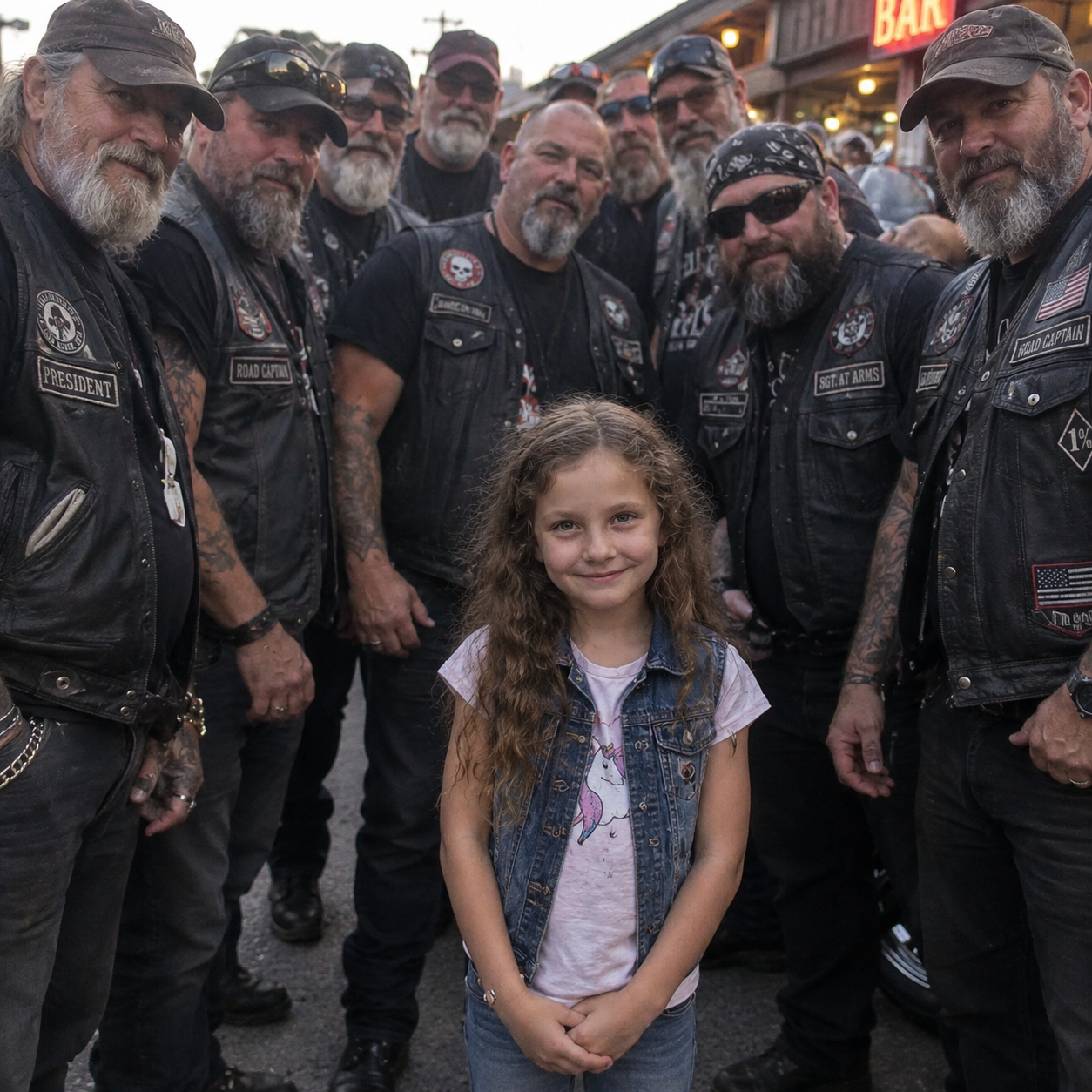
The first thing I noticed was that Lily wasn’t crying.
She was standing in the middle of our clubhouse, barefoot on a floor stained by years of spilled beer and motor oil, holding a stuffed rabbit by one ear. Rain dripped from her pink pajamas. Her small shoulders shook, but she made no sound. She looked at thirty men covered in tattoos, leather, and scars, then fixed her eyes on me.
“Please,” she whispered. “He’s gonna kill Mommy this time.”
I’m Bear, president of the Blackridge Riders. I’d spent thirty years riding motorcycles, breaking up fights, and learning how to recognize danger before it arrived. But nothing in those thirty years prepared me for the sight of a seven-year-old girl standing in front of me, begging a room full of bikers to save her mother.
I crouched so we were at eye level.
“Lily, sweetheart, where’s your mom?”
“Home.”
“Is she hurt?”
Lily nodded. Her lower lip trembled.
“He pushed her into the kitchen. Then he got Daddy’s gun.”
The room went silent.
Big Mike set his coffee down so carefully that the cup barely made a sound. Tank, who had served two tours overseas, was already reaching for his phone. Wizard stood beside the clubhouse door, staring at the rain as if he could see through the darkness to the little yellow house one block away.
Nobody asked whether Lily was telling the truth.
We knew her.
We knew the yellow house with the white porch railing. We knew the woman who used to sit on the front steps and wave when we rode past. We knew the little girl who sold lemonade on Saturdays and insisted that every motorcycle needed a name.
We also knew the man who had moved into that house eighteen months earlier.
His name was Darren Cole.
And every time we heard his truck pull into that driveway, the neighborhood seemed to hold its breath.
“Tank,” I said, keeping my voice steady, “call emergency services. Tell them there’s a child reporting a possible shooting and an injured woman. Give them the address and tell them about the gun.”
Tank was already speaking to the dispatcher.
“Wizard, get the front gate open. Mike, bring Lily somewhere warm. Frank, stay with her.”
My vice president, Frank, stepped forward and wrapped his jacket around Lily’s shoulders. She clutched the leather with both hands.
“I’m going to help your mom,” I told her. “But I need you to stay here with Frank until the emergency crews arrive.”
She grabbed my wrist.
“No! You have to come now!”
Her fingernails dug into my skin.
“Please! He said four minutes. He said nobody could get there in four minutes.”
I looked at Tank.
He covered the phone with his hand. “Dispatch has the call. Police and ambulance are being sent. They’re treating it as a potential firearm emergency.”
“How far away?”
“They’re checking units.”
Lily began shaking her head.
“He knows when the police come. He always knows.”
That sentence hit harder than any punch I’d ever taken.
For three years, we had watched this family suffer. We had reported shouting, heard things breaking, and seen Sarah Bennett wearing sunglasses on cloudy days. More than once, she’d stepped onto her porch with a smile so forced it looked painful.
Every time we asked if she was all right, she’d say the same thing.
“I fell.”
We’d called the police. We’d answered questions. We’d watched officers knock on the door and leave again. We’d tried to convince ourselves that someone with the proper training, the proper authority, and the proper resources would eventually make things better.
But Lily was standing in our clubhouse with a bruise on her arm.
And she had run barefoot through a storm because she no longer believed anyone else would listen.
I took my phone from my pocket and called emergency services myself, confirming the address and explaining that the child believed a firearm was involved. I asked for an update and made it clear that the reported danger was immediate.
Then I turned to the men.
“We are not going in there to start a war,” I said. “Nobody touches that gun. Nobody plays hero. We get the responders to the house, keep the road clear, and do whatever they instruct us to do.”
Big Mike nodded once.
The others followed.
We were angry, but anger wasn’t going to save Sarah. A mistake could get Lily’s mother killed, get one of our men shot, or put a frightened child in the middle of a confrontation she would remember for the rest of her life.
We had to be useful, not reckless.
Still, when I looked down at Lily, I understood why the men were struggling to stand still.
She had wrapped both arms around Frank’s waist, but her eyes never left me.
“Bear?”
“I’m here.”
“Can you please bring Mommy back?”
I swallowed.
“I’ll do everything I safely can.”
She looked at the floor.
“That’s what the police said.”
I had no answer for that.
Outside, engines began turning over. Several of our riders prepared to move their motorcycles away from the entrance so emergency vehicles could reach the street without obstruction. Tank remained on the phone, relaying every new detail to the dispatcher.
I stayed beside Lily until she released my wrist.
Then I followed the others outside.
The rain was coming down hard enough to blur the streetlights. Our clubhouse sat at the end of a narrow road lined with old houses and overgrown hedges. A few neighbors had switched on their porch lights, but nobody had stepped outside.
At the corner, I could see the yellow house.
One upstairs window glowed faintly.
The rest of the building was dark.
I wanted to run straight to that door. Every instinct in my body told me to get there as fast as possible, to put myself between Sarah and the man hurting her.
But the dispatcher had warned us that a firearm might be present. Charging into a house without knowing where the weapon was could turn a rescue into another tragedy.
So we stayed back, kept the road open, and waited for the people trained to handle the emergency.
It was the hardest thing I’d done in years.
Then a sound carried across the rain.
A single crash.
Something heavy had fallen inside the house.
Big Mike took a step forward before stopping himself.
A moment later, a woman’s voice screamed.
We couldn’t make out the words.
Then everything went quiet.
I looked at the house and felt my stomach tighten.
“Come on,” I whispered.
Red and blue lights appeared at the far end of the road.
The first patrol car turned onto our street, followed by an ambulance. I approached the responding officers with my hands visible and gave them the information Lily had provided. I pointed out the house and explained that the child had reported an injured mother and a man with a gun.
The officers moved toward the property while the ambulance crew prepared nearby. We were instructed to remain clear of the entrance.
Nobody argued.
For the first time that night, I had something I hadn’t had when Lily came through our door.
Hope.
But it lasted less than a minute.
A uniformed officer returned to speak with us. He had a radio in one hand and a tense expression on his face.
“Is the little girl still at your clubhouse?”
“Yes,” I said. “She’s with our vice president.”
“Keep her there for now. We need to establish what’s happening inside.”
“Is Sarah alive?”
He hesitated.
“We’re working on it.”
That wasn’t an answer.
I looked past him toward the house. One of the officers was speaking into his radio. Another stood near the front entrance, waiting for instructions.
Then the front door opened.
A man appeared on the porch.
Darren Cole.
He wore a gray T-shirt and jeans. His hair was dry, and his expression was almost bored. He lifted his hands slightly as if greeting an unexpected visitor.
“I called you guys,” he said loudly. “My girlfriend fell. She’s been drinking. I don’t know why everyone keeps making a big deal out of everything.”
I felt my hands curl into fists.
He looked toward our group and smiled.
It was the same smile he’d given us the previous summer when we’d asked why Sarah had a swollen eye.
The same smile he’d worn when Lily stopped selling lemonade because she was afraid to sit outside.
The same smile that said he believed he could explain away anything.
One of the officers asked him to step away from the entrance.
Darren obeyed, but his eyes moved toward me.
“You people need to stay out of my family’s business.”
I didn’t answer.
He had a gun in the house. Sarah might be bleeding inside. A seven-year-old girl was sitting in our clubhouse, terrified that she would never see her mother again.
I had nothing to say to him that would help any of them.
The officers continued working. We couldn’t see what was happening beyond the doorway, but we could hear clipped radio messages and the urgent footsteps of the medical crew.
Then two paramedics emerged carrying a stretcher.
Sarah was on it.
Her face was pale. Her dark hair clung to her forehead, and a medical dressing covered part of her head. One paramedic was working beside her while the other monitored her condition.
For a moment, I couldn’t breathe.
Sarah had waved at us hundreds of times. She’d brought Lily to our clubhouse fundraiser once, carrying a plate of homemade cookies because she’d heard we were collecting money for a family whose house had burned down.
She’d smiled at us then.
Now she lay motionless beneath a rain-speckled blanket.
The ambulance doors closed.
As the vehicle pulled away, I heard myself ask the officer the question that had been burning inside me.
“Is she alive?”
“She has a pulse,” he replied. “The medical team is treating her. That’s all I can tell you right now.”
A pulse.
It wasn’t enough to make me feel safe, but it was enough to keep me standing.
I turned toward the clubhouse.
Lily was still waiting.
And someone had to tell her what was happening.
Frank was sitting beside her when I returned. She had a mug of warm water between her hands, but she hadn’t taken a sip. Her stuffed rabbit rested on her knees.
She looked at me the moment I entered.
“Where’s Mommy?”
I sat down across from her.
“The ambulance took her to the hospital. The doctors are going to help her.”
“Is she awake?”
“I don’t know yet, sweetheart.”
Her eyes filled with tears.
“Did he hurt her again?”
I took a breath.
“Yes.”
Lily stared at the mug.
“It’s my fault.”
“No.”
The word came out sharper than I’d intended. She flinched, and I immediately softened my voice.
“Lily, listen to me. Nothing that happened to your mom is your fault. Not one part of it. Do you understand?”
She shook her head.
“Because I told you?”
“No. Because Darren chose to hurt her. That’s his responsibility, not yours.”
She looked down at the bruise on her arm.
“He said Mommy gets hurt because I make him angry.”
I felt something twist inside my chest.
“Adults sometimes tell children terrible things to make them afraid,” I said. “That doesn’t make those things true.”
Lily rubbed her arm with her thumb.
“He said if I ever told anyone, he’d hurt Mommy worse. Then he said he’d send me away, and nobody would know where I was.”
Frank shifted closer to her.
“That’s why you came here?”
She nodded.
“Mommy told me that if I was ever scared, I should find the motorcycle friends. She said you would listen.”
For a few seconds, none of us spoke.
I remembered Sarah saying those words to us years ago. We’d been outside the clubhouse, repairing a broken fence, when Lily wandered over to ask if she could see a motorcycle up close. Sarah had stood behind her, smiling nervously.
“If you ever need help, honey, you can always ask these gentlemen,” she’d told Lily.
At the time, I’d thought it was just a kind thing to say.
I hadn’t understood that Sarah was leaving her daughter a lifeline.
Lily looked up again.
“Did you see the gun?”
“No, sweetheart. The officers are handling that.”
“It’s in the kitchen.”
I leaned forward.
“How do you know?”
“Because he put it on the table. Mommy told him to put it away, but he said she didn’t get to tell him what to do.”
Frank and I exchanged a glance.
“Did you see him hurt your mother?” I asked gently.
Lily’s fingers tightened around the rabbit.
“I was hiding by the stairs. I heard them fighting. Mommy told him to leave the box alone. Then he pushed her, and she fell.”
“What box?”
She hesitated.
“The one Daddy left.”
I waited.
Lily glanced toward the clubhouse doors as if Darren might suddenly walk through them.
“Mommy found it in the attic last week. She told me Daddy had put it away before he died. Darren saw it, and he got really mad.”
“What was inside?”
“I don’t know. Papers. A little black thing. Mommy wouldn’t let me touch it.”
“Did she tell you why Darren wanted it?”
Lily nodded slowly.
“She said it was something he wasn’t supposed to have.”
Before I could ask anything else, Tank entered the room.
“The officers want to speak with Lily when she’s ready,” he said quietly. “A specialist is on the way, too. They said we shouldn’t question her any more than necessary.”
I nodded.
He was right. Lily had already been through more than any child should experience. We needed to let trained professionals handle the investigation and allow her to speak at her own pace.
Frank brought her a blanket and asked whether she’d like to sit in the quiet room upstairs. She agreed, but before he could help her stand, she caught my hand again.
“Bear?”
“I’m here.”
“Can I tell you one thing?”
“Of course.”
She leaned closer and whispered so softly that I almost didn’t hear her.
“Mommy said if anything happened to her, I should tell you about the blue truck.”
My heart stopped.
“What blue truck?”
“The one Daddy was in the night he disappeared.”
I stared at her.
“Lily, I thought your dad died in a car accident.”
She shook her head.
“That’s what Darren says.”
Then she looked toward the window.
“But Mommy says Daddy never made it to the accident.”
I had known Daniel Bennett’s name for years.
Most people in the neighborhood remembered him as a quiet mechanic who worked long hours and spent his weekends fixing broken things for his neighbors. He had helped one of our members repair a motorcycle engine without charging him a cent. He’d built a wooden lemonade stand for Lily and painted it bright yellow because she said yellow was the happiest color.
Four years earlier, we had heard that Daniel had died in a highway accident outside the city.
Sarah had been devastated. She’d stopped coming to neighborhood events and rarely left the house except to take Lily to school or buy groceries.
When Darren moved in, we assumed he was a new partner who had entered their lives during a difficult period.
We had been wrong about a lot of things.
I didn’t know what Lily’s words meant, and I wasn’t going to turn a frightened child’s memories into accusations. But I knew the claim about the blue truck needed to be passed to the investigators.
I called the officer handling the scene and repeated exactly what Lily had said, making it clear that she was a child who had just experienced a traumatic event and that her statement needed to be checked rather than assumed to be fact.
The officer listened carefully.
“Do you know anything about Daniel Bennett’s death?” he asked.
“Only what everyone was told. A highway accident.”
“Was there ever a vehicle recovered?”
“I don’t know.”
He paused.
“We’ll look into it.”
That was all he could promise.
I ended the call and went upstairs. Lily was sitting on the edge of a sofa, wrapped in Frank’s jacket, while one of our older members made her toast. She held the stuffed rabbit against her stomach.
“Bear,” she said when she saw me, “if Daddy isn’t dead, where is he?”
I sat beside her.
“I don’t know, Lily.”
“Do you think he’s coming home?”
I wished I could give her an answer that would make the world feel safe again.
Instead, I told her the truth.
“I think the police need to find out what happened to your dad. And right now, the most important thing is helping your mom get better and making sure you’re safe.”
She stared at the floor for a long time.
Then she asked a question I still remember word for word.
“If Mommy gets better, will she stop being scared?”
I looked at this little girl who had spent years learning how to recognize the sound of an angry man’s footsteps.
“I hope so,” I said. “And we’ll help make sure she has people around her who can help.”
It wasn’t a promise that everything would be easy. It was a promise that she wouldn’t have to face the next part alone.
For the first time that night, Lily took a bite of toast.
At 2:17 a.m., the hospital called.
Sarah was alive.
She had suffered a serious head injury and significant blood loss, but the doctors had stabilized her. She was being monitored closely, and they needed time to determine the full extent of her injuries.
I thanked the nurse and told Frank.
He closed his eyes for a moment.
“Thank God.”
Lily was asleep in the quiet room, curled beneath two blankets with her rabbit tucked under her chin. I watched her for a moment, thinking about how she’d walked barefoot through the rain to find us.
She had trusted thirty bikers more than the adults who had repeatedly told her that everything was under control.
That fact shamed me.
Not because we had failed to care, but because caring from a distance had never been enough.
We had seen the bruises. We’d heard the screams. We’d called for help and assumed that making the call meant we’d done our part.
Now I understood how easily people could confuse reporting danger with resolving it.
Sometimes help arrived and left before the danger was gone. Sometimes frightened people denied what was happening because the consequences of telling the truth seemed worse than the pain of staying silent. Sometimes children learned to protect the very adults who frightened them because they had nowhere else to go.
And sometimes, a seven-year-old had to run through a storm to make the world listen.
At 2:40 a.m., the investigating officer returned to the clubhouse.
He asked to speak with me privately.
“Darren Cole is in custody,” he said. “Officers recovered a firearm from the kitchen. We’re still establishing exactly what happened inside the house.”
“Did he shoot Sarah?”
“We’re not releasing that detail yet. The evidence is being examined.”
I nodded.
Then he took out a small notebook.
“We have another question. Lily mentioned a box in the attic?”
“Yes. She said Sarah found it last week and that Darren wanted it.”
“Do you know where it is?”
“No.”
The officer studied his notes.
“We found signs that the attic had been searched recently. Several storage containers were opened, and some documents were scattered across the floor. We haven’t established whether anything is missing.”
I thought about Lily’s words.
The one Daddy left.
Something he wasn’t supposed to have.
The blue truck.
“Did you find anything about Daniel Bennett?” I asked.
“Not yet. We’re checking the original accident report.”
He closed his notebook.
“If Sarah is able to speak with investigators, we may learn more. For now, please don’t try to investigate this yourselves. If Lily remembers anything else, pass it to us and let the child specialists handle the interview.”
“You have my word.”
He looked at me for a moment.
“I know your group has called about that house before.”
“We have.”
“I’ve seen the previous reports.”
“Then you know we weren’t imagining it.”
He didn’t defend the earlier responses.
“We need to establish what happened and why those calls didn’t lead to a safer outcome. I can’t answer that tonight.”
It wasn’t enough, but it was honest.
After he left, I sat alone in the clubhouse office and stared at the rain streaking the window.
I kept thinking about the blue truck.
And I kept thinking about Sarah’s face on the stretcher.
By morning, Lily had been taken to the hospital with a trusted advocate and a child-protection specialist. We made sure she had dry clothes, a small bag with her belongings, and her stuffed rabbit.
Frank went with her.
I stayed behind to speak with our members and ensure that no one tried to confront Darren or contact him through friends. We had no interest in creating a second emergency or interfering with the investigation.
The clubhouse was quiet now. Empty coffee cups sat on the tables. Wet boot prints marked the floor. Someone had left Lily’s little mug beside the sink.
I picked it up and washed it.
Then my phone rang.
It was Frank.
“Sarah is awake,” he said.
I stood so quickly that my chair rolled backward.
“She’s talking?”
“Not much. The doctors are limiting visitors, but she asked about Lily. They told her Lily was safe.”
I leaned against the desk.
“What did she say?”
Frank’s voice softened.
“She cried. Then she asked whether the box had been found.”
I closed my eyes.
“Did the police tell her they were looking for it?”
“Yes. An investigator is going to speak with her when the doctors say she’s ready.”
I looked through the office window toward the empty street.
“Frank, I think this goes back further than Darren.”
“I think so, too.”
“Keep Lily safe. Don’t push her for answers.”
“I won’t.”
He hesitated.
“Bear?”
“Yeah?”
“Sarah asked for you.”
I didn’t leave immediately. I called the hospital, confirmed that a brief visit would be appropriate, and followed the staff’s instructions. When I arrived, a nurse escorted me to Sarah’s room.
She looked smaller than I remembered.
Her face was bruised, and a bandage covered her hairline. A monitor beeped beside the bed. She had an IV in her arm, and her eyes looked exhausted.
But she was awake.
When she saw me, she tried to sit up.
“Don’t,” I said gently. “You’ve been through enough.”
She reached for my hand.
“Lily?”
“She’s safe. She’s with Frank and the people helping her. She knows her mother is alive.”
Tears slid down Sarah’s cheeks.
“I told her to run.”
“You did the right thing.”
She shook her head.
“I should have left months ago.”
I pulled a chair beside the bed.
“Sarah, you don’t have to explain everything to me. The investigators will ask questions when you’re ready. Right now, you need to recover.”
But she held my hand tighter.
“You don’t understand. Darren wasn’t supposed to find the box.”
“What was in it?”
She stared at the ceiling.
“Proof.”
“Proof of what?”
She closed her eyes. When she opened them again, the fear in them was worse than anything I’d seen on the night Lily arrived.
“Daniel didn’t die in that accident.”
I said nothing.
Sarah swallowed painfully.
“Four years ago, Daniel found out that someone had been using his repair shop to move stolen vehicle parts. At first, he thought it was a supplier. Then he found paperwork that showed the business was being used to hide money and move cars that had been reported stolen.”
“Who was involved?”
“I don’t know everyone. Daniel was trying to find out. He kept copies of invoices, vehicle identification numbers, and messages. He told me he’d take everything to the police once he understood how far it went.”
She began breathing faster.
“Then one night, he came home and said someone had followed him. He was frightened, but he wouldn’t tell me everything. He put the documents in a metal box and hid it in the attic.”
“What happened the night he disappeared?”
Sarah looked toward the door.
“Daniel told me he was going to meet someone who could help him. He said he’d be back before midnight. He never came home.”
“And the accident?”
“Three days later, a man came to my house and told me Daniel had died in a crash. He showed me a newspaper clipping and said the authorities had identified him.”
“Did you see the body?”
Sarah shook her head.
“No. They said the damage was too severe. I was grieving, and I had Lily to take care of. Everyone kept telling me to accept it.”
She looked at me.
“But something didn’t feel right. Daniel had promised to call me when he arrived at the meeting. I never received that call. His phone disappeared, too. When I asked questions, the man who brought the news told me I needed to stop digging.”
“Who was he?”
“Darren.”
I felt the air leave my lungs.
Sarah continued, her voice barely audible.
“He wasn’t living with me then. He came to the house pretending to be someone who had known Daniel through work. He said he wanted to help me settle Daniel’s affairs. He knew details about the accident before anyone had told me. I thought he was trying to be kind.”
“And later he moved in?”
“He kept coming back. He offered to fix things around the house. He helped with bills. He knew I was alone and frightened. Slowly, he became part of our lives.”
She looked down at her hands.
“By the time I realized how much he knew, I was already afraid of him.”
“Why didn’t you tell someone?”
“I tried. Once, I went to the police and said I thought Daniel’s death might not have been an accident. I didn’t have proof, and I was terrified Darren would find out. I told them I was afraid of him, too.”
She took a shaky breath.
“I don’t know what happened to that report. Nothing changed. Darren found out I’d asked questions, and he told me that if I ever tried again, Lily would be the one who paid.”
I felt anger rise inside me, but I kept my voice calm.
“You’re not alone anymore.”
Sarah’s eyes filled again.
“Last week, Lily and I were cleaning the attic. She found Daniel’s old toolbox. The metal box was behind it, hidden under insulation. I thought it had been lost years ago.”
“What did you find?”
“Documents. Photographs. A small storage drive. And a letter Daniel wrote to me.”
She swallowed.
“I didn’t open everything. I was afraid of what I’d find. But one page had a name on it. Darren’s name. He wasn’t just connected to the people Daniel was investigating. He was listed as someone who had arranged the transfer of several vehicles.”
I sat very still.
“Did Darren see the documents?”
“He came home while I was looking through them. I hid the box, but he knew I’d found something. After that, he searched the house every day. Last night, he demanded I tell him where the box was.”
Sarah’s fingers trembled around mine.
“I told him I’d given it to someone. I thought if he believed the evidence was already out of his reach, he’d leave us alone. Instead, he got the gun.”
She turned her face away.
“I thought he was going to kill me.”
I waited until she was ready to look at me again.
“The police know about the box now. They’re looking for it. You don’t have to solve this yourself.”
Sarah nodded, but I could see she wasn’t finished.
“There was one more thing in the letter.”
“What?”
She looked straight into my eyes.
“Daniel wrote that if anything happened to him, I should find a man named Marcus Vale. He said Marcus had been helping him, and that he knew where Daniel was supposed to go that night.”
“Do you know Marcus?”
“No. I’ve never met him. But the letter had an address.”
“Where?”
She gave me the name of a small repair garage on the outskirts of town.
I wrote it down and called the investigator assigned to her case. I passed along the information without making any attempt to visit the location myself.
When I finished, Sarah was staring at the ceiling again.
“Bear?”
“I’m listening.”
“If Daniel is alive, why hasn’t he come home?”
I didn’t have an answer.
But as I sat beside her hospital bed, I began to understand the real shape of the nightmare.
Darren might have been terrorizing Sarah for eighteen months, but the fear had started long before he moved into her house. It had begun with a disappearance, a story about an accident, and a box of evidence someone had desperately wanted to keep hidden.
And now the little girl who had run to our clubhouse had brought that buried secret into the open.
The following afternoon, the investigator called me.
His name was Detective Harris. He had been assigned to review the assault and the older questions surrounding Daniel’s disappearance.
“I want to make one thing clear,” he said. “We’re not treating Sarah’s account as proof that Daniel is alive. We’re checking the evidence. The old accident report has inconsistencies, and we’re reviewing them.”
“What kind of inconsistencies?”
“The vehicle listed in the report was recovered, but some identification details don’t match the information Daniel’s family provided. We need to verify the original records.”
“Could the wrong person have been identified?”
“It’s possible. We don’t know yet.”
I asked about the box.
“Officers recovered a metal container from the attic. It’s being processed. Some documents appear to relate to vehicle transfers, but we haven’t confirmed what they establish. The storage device will need to be examined by specialists.”
“And Marcus Vale?”
“We found a business registration connected to that name. Investigators are trying to locate him.”
I thanked him and ended the call.
For the first time, the pieces seemed to be moving somewhere. Not quickly enough to satisfy me, but carefully enough that the truth might finally survive scrutiny.
That evening, I visited the hospital again. Sarah was resting, and Lily sat in a chair beside her bed, drawing a picture with a box of crayons someone had brought her.
The drawing showed a yellow house, a woman holding a little girl’s hand, and a row of motorcycles outside.
I stopped beside her.
“That’s quite a picture.”
She nodded seriously.
“That’s our house when Mommy gets better.”
“And who are all the motorcycles?”
“You.”
She pointed to the biggest one.
“That’s you, Bear.”
I smiled faintly.
“Do I look that tall?”
“You’re taller in real life.”
For the first time since she had arrived at the clubhouse, I heard a small laugh escape her.
Then she looked down at the paper.
“Can Daddy be in the picture, too?”
“Of course.”
She drew a man beside the house.
“Mommy says he liked fixing things. Maybe when he comes home, he can fix my lemonade stand. One of the legs is broken.”
I felt my throat tighten.
“That’s a good idea.”
She put the crayon down.
“Do you think he will come home?”
I didn’t want to give her false hope. I also didn’t want to crush the possibility that had kept her going through the night.
“I think the investigators are trying to find out what happened to him,” I said. “When we know more, we’ll make sure someone explains it to you.”
She accepted that answer, though I could tell it wasn’t the one she wanted.
Sarah watched us from the bed.
When Lily turned back to her drawing, Sarah whispered, “She used to ask about him every day.”
“I can imagine.”
“I kept telling her that her father loved her. I told her he would have wanted her to be brave.”
She wiped her cheek.
“I didn’t realize how much she was carrying until last night.”
I looked at the little girl drawing motorcycles beside a yellow house.
“She’s brave,” I said. “But she shouldn’t have had to be brave like that.”
Sarah nodded.
“No child should.”
Three days passed before the investigators found Marcus Vale.
He was living in a neighboring district and working under his own name at a small vehicle repair business. When officers contacted him, he initially refused to discuss Daniel Bennett. After learning that investigators were reviewing the old accident report, he agreed to meet with them and provide a statement.
I heard about it from Detective Harris.
“Marcus says Daniel contacted him the night he disappeared,” the detective told me. “He claims they were supposed to meet at a garage, but Daniel never arrived.”
“Did he say why?”
“He says Daniel had found evidence of a stolen-vehicle operation and believed someone inside the network had discovered what he was doing.”
“Does he know Darren?”
“According to Marcus, yes. He says Darren worked with one of the people who arranged vehicle transfers. We’re checking that against records.”
The detective paused.
“There’s something else. Marcus says Daniel told him he had a backup copy of the documents hidden somewhere separate from the metal box.”
“Where?”
“He didn’t know. Daniel never told him.”
I looked out the clubhouse window.
The metal box might explain why Darren had terrorized Sarah. But if Daniel had made a second copy, the evidence could be more complete than anyone realized.
I asked whether there had been any confirmed sighting of Daniel after the night he disappeared.
“Not yet,” Harris said. “We’re examining a few leads, but I don’t want to give you details that could interfere with the investigation.”
I understood.
For years, people had treated rumors as facts. I wasn’t going to make the same mistake.
When I told Sarah about Marcus, she began to cry again.
“Someone else remembers him,” she whispered.
“Yes.”
“Then maybe I’m not crazy.”
“No, Sarah. You weren’t crazy for asking questions.”
She closed her eyes.
“I spent four years wondering whether I had imagined the things Daniel told me. Darren kept saying I was confused, that grief had made me paranoid. After a while, I started doubting my own memories.”
I sat beside her.
“That’s what fear can do. It can make a person question what they know.”
She looked at me.
“What if Daniel really is dead?”
“Then we’ll have to face that truth when the evidence tells us. But you won’t have to face it alone.”
She held my hand for a long time.
That was the first time I understood that saving Sarah wasn’t going to be as simple as getting her out of a dangerous house. She would need time, medical care, legal protection, and people who believed she deserved a life without threats.
Lily would need those things, too.
The immediate danger had passed, but the work of helping them recover was only beginning.
On the sixth day, Detective Harris called again.
The metal box had contained more than papers.
The storage drive held photographs, scanned invoices, and messages that appeared to connect several people to a stolen-vehicle network. Some documents referenced Darren, but investigators were still verifying the material and determining which records could be used as evidence.
More importantly, the original accident report had a serious problem.
The vehicle associated with Daniel’s reported death had been identified through partial records, but the chain of identification was incomplete. A witness statement described a person leaving the scene before emergency crews arrived. The witness had never been interviewed again after the initial report.
The detective was careful with his wording.
“We’re reopening the disappearance investigation. That doesn’t mean Daniel is alive. It means we can no longer rely on the original report without checking the gaps.”
I asked about the blue truck.
“The registration number Lily described is incomplete, but it gives us a lead. We’re checking historical records and looking for vehicles linked to Darren’s associates.”
When I told the other riders, nobody celebrated.
We had learned to be careful with hope.
Instead, we helped in ways that would make a difference. One member arranged temporary repairs at Sarah’s house after investigators finished processing the scene. Another organized meals for the hospital and the relatives who were supporting Lily. Several riders offered to contribute to a fund for Sarah’s medical expenses, but we made sure she could decide whether to accept it.
Nobody wanted to turn their suffering into a story about us.
Lily had already had too many adults make decisions around her without giving her a choice.
When she came to the clubhouse for a short visit with her advocate, we had set aside the quiet room and placed her drawing on a shelf. She stood in front of it for a long time.
“Did you keep it?” she asked.
“Of course,” I said.
She smiled.
Then she asked whether she could see the motorcycles.
We took her outside under supervision, away from the road. Big Mike showed her how to recognize the different shapes of the handlebars and explained why riders wore protective gear. Wizard let her sit on his stationary bike while holding it steady.
For twenty minutes, she was simply a little girl looking at motorcycles.
No one mentioned Darren. No one asked about the gun. No one asked her to repeat what she had seen.
When it was time to leave, Lily walked beside Frank toward the car waiting to take her back to the hospital.
She turned around.
“Bear?”
“Yeah, sweetheart?”
“Thank you for listening.”
I crouched in front of her.
“You never have to thank someone for listening when you’re scared.”
She thought about that.
Then she gave me a small nod and climbed into the car.
I watched it pull away.
Behind me, thirty bikers stood quietly in the parking lot.
We had spent years believing toughness meant being unafraid. That night, a barefoot child had taught us something different.
Sometimes courage meant asking for help.
Sometimes it meant believing a frightened person when their story was difficult to hear.
And sometimes it meant staying calm enough to let the right people do their jobs.
The breakthrough came eleven days after Lily walked into our clubhouse.
Detective Harris called just after lunch.
“We’ve located a witness who says he saw Daniel Bennett several weeks after the reported accident.”
I stood up from my desk.
“Are you certain it was him?”
“No. The witness identified him from a photograph, but we’re verifying the details. He says the man was using a different name and working temporarily at a vehicle repair yard outside the city.”
“Why didn’t he come forward before?”
“He says he didn’t know Daniel had been reported dead. He only recently saw a local notice asking for information.”
I sat down slowly.
“What’s next?”
“We’re checking the location and comparing records. If we find someone matching Daniel’s description, we’ll need to confirm his identity and establish why he disappeared.”
I thanked him and called Frank.
For the next several hours, we waited without pretending we knew what the outcome would be.
Late that afternoon, Harris called again.
Investigators had located a man whose fingerprints and personal records were consistent with Daniel Bennett. He had been living under a different name and had not contacted his family since his disappearance.
The detective wouldn’t tell me more over the phone, but he confirmed that Daniel was alive.
I closed my eyes.
Four years.
Four years of Sarah being told her husband was dead. Four years of Lily growing up without a father. Four years of questions, fear, and silence.
And now a man who had supposedly vanished forever was alive.
I didn’t call Sarah immediately. I asked the detective whether she was ready to hear the news and whether a professional should be present. He agreed that the information needed to be delivered carefully, given her medical condition and the uncertainty surrounding Daniel’s reasons for disappearing.
That evening, I sat beside Sarah’s hospital bed with a social worker nearby.
“There’s an update from the investigators,” I said.
She looked at me, her hands tightening around the blanket.
“About Daniel?”
I nodded.
“They found him. He’s alive.”
For several seconds, she didn’t move.
Then her mouth opened, but no words came out.
The social worker pulled her chair closer. Sarah covered her face with both hands and began to sob. Not the quiet crying I’d seen before, but the kind that came from holding a fear inside for so long that the body no longer knew what to do when it finally loosened.
“Alive?” she whispered.
“Yes.”
“Are you sure?”
“The investigators have confirmed his identity. They’ll explain the details when they’re ready, but he is alive.”
Sarah pressed her hands to her chest.
“I knew it. I knew something was wrong.”
She cried until she was exhausted.
When she finally looked up, her face was wet.
“Does Lily know?”
“Not yet. We wanted to talk to you first and make sure the news was shared carefully.”
Sarah nodded.
“She needs to know. But I want someone with her when they tell her.”
“We’ll make sure of that.”
She looked out the window.
“Why didn’t he come home?”
It was the question I had been waiting for, and the one I still couldn’t answer.
The detective later explained that Daniel had been frightened after discovering the stolen-vehicle operation. According to the preliminary account, someone had warned him that his family would be targeted if he cooperated with authorities. He had left to protect himself and hoped to find a way to expose the operation without bringing danger to Sarah and Lily.
But he had made a terrible decision.
He had disappeared without ensuring that his family knew where he was or how to get help. He had believed silence would keep them safe. Instead, it had left them alone with unanswered questions and allowed others to control the story of his death.
Investigators were still examining the details, including what Daniel had known, whom he had contacted, and why he had continued living under another name.
His decision might have begun in fear, but it had consequences that could not be erased.
Sarah had suffered.
Lily had grown up believing her father was gone.
And neither of them could get those years back.
The day Lily learned her father was alive, she was sitting at a small table in the hospital family room, coloring a picture of a yellow house.
Frank was beside her. Sarah’s social worker had arranged for the news to be shared in a quiet place, with time for questions and no pressure to react a certain way.
I stood near the doorway while the social worker spoke.
“Lily, the investigators have found out something important about your dad.”
Lily stopped coloring.
“Is he dead?”
“No, sweetheart. Your dad is alive.”
The crayon slipped from Lily’s hand.
She stared at the social worker, waiting for the rest of the sentence.
Then she looked at Frank.
“Alive like really alive?”
Frank nodded, his eyes already shining.
“Yes, kiddo. He’s alive.”
Lily stood up so quickly that her chair scraped the floor.
“Where is he? Can I see him? Is he coming home?”
The social worker explained that the investigators were arranging the next steps and that Lily would not be expected to meet him until she was ready. There were important questions to answer, and everyone needed to make sure the meeting was safe and supported.
Lily listened without speaking.
Then her face crumpled.
“I thought he forgot me.”
Frank knelt beside her.
“I know.”
“Did he forget my birthday?”
Nobody answered immediately.
Lily began to cry.
“He missed my birthday when I turned five. And six. And seven. I thought maybe he didn’t love me anymore.”
Frank wrapped his arms around her when she reached for him.
I turned away for a moment, unable to watch.
We had hoped the news would bring relief. Instead, it opened another wound. Lily was happy her father was alive, but she was also a little girl who had spent years waiting for someone who never came.
Her feelings didn’t cancel each other out.
She could love him and be angry with him. She could want to see him and still be afraid of what his return might mean. She could feel relieved and heartbroken at the same time.
The social worker gave her space to cry and reassured her that none of this had been her fault.
After a while, Lily wiped her face with her sleeve.
“Can I ask him something?”
“Of course,” the social worker said.
“When I see him, can I ask why he didn’t come back?”
“Yes. You can ask him that.”
Lily picked up her crayon again.
She drew a small man beside the yellow house.
Then she drew a line between him and the little girl.
It was the first time she had put her father in the picture without asking whether he was dead.
Daniel agreed to speak with investigators and meet Sarah and Lily under professional supervision.
The meeting was arranged only after Sarah’s doctors and the family-support team agreed that she was well enough. Nobody wanted to rush the process or treat a reunion as if it could erase four years of pain.
I was not present when Daniel first saw his daughter.
Frank later told me what happened.
Lily entered the room holding her stuffed rabbit. Daniel stood beside a chair, looking older than the man in the photographs. His hair had gone gray at the temples, and his hands shook when he saw her.
“Lily,” he whispered.
She stopped several feet away.
For a moment, neither of them moved.
Then she asked the question that had been waiting inside her for four years.
“Why didn’t you come home?”
Daniel’s face crumpled.
He knelt, but he didn’t reach for her.
“I was scared,” he said. “I thought staying away would keep you safe. I thought I could fix everything before I came back.”
Lily stared at him.
“But Mommy was scared, too.”
Daniel began to cry.
“I know.”
“And Darren hurt her.”
“I know, sweetheart.”
“You weren’t there.”
The words were quiet, but they landed heavily.
Daniel bowed his head.
“No. I wasn’t there. And I’m sorry.”
Lily looked at him for a long time.
Then she took one small step forward.
“Did you forget my birthday?”
Daniel shook his head.
“Never. I remembered every one.”
“Then why didn’t you send a card?”
He couldn’t answer immediately.
Finally, he said, “I should have found a way to let you know I loved you. I should have found a safer way to get help. I made choices that hurt you, even though I thought I was protecting you. I’m sorry.”
Lily looked down at her rabbit.
She didn’t run into his arms.
She didn’t tell him everything was forgiven.
Instead, she walked to the chair beside him and sat down.
“Can you tell me about my birthday when I was five?”
Daniel wiped his face.
“Yes,” he said. “If you want me to.”
“I want you to tell me everything you remember.”
So he did.
He told her about the yellow cake she’d wanted, the candles that had melted before everyone finished singing, and the little wooden bicycle he’d planned to build for her. He answered her questions as honestly as he could, without pretending that his absence had been harmless.
Lily listened.
Sometimes she smiled.
Sometimes she looked away.
And when the meeting ended, she allowed him to hold her hand.
It wasn’t a magical ending. It was a beginning, fragile and uncertain, built from truths that should have been spoken years earlier.
The investigation into Darren and the stolen-vehicle operation continued for months.
The documents from the metal box were examined alongside financial records, vehicle registrations, messages, and witness statements. Investigators worked to establish which people had participated in the operation and what Darren had known about Daniel’s discovery.
The assault on Sarah was handled separately from the wider investigation. The firearm was secured, evidence was collected from the house, and Sarah received support to help her understand her legal options and protect herself and Lily.
We didn’t get every answer immediately.
Some records were incomplete. Some people refused to cooperate. Some of the details Daniel remembered needed to be checked against independent evidence.
But the story was no longer buried in a box in an attic.
And Sarah was no longer being forced to carry it alone.
When she was discharged from the hospital, she didn’t return to the yellow house. A support service helped her arrange a safe place to stay while the legal process continued. She had medical appointments, counseling, and practical problems to solve. There were nights when she couldn’t sleep and days when ordinary sounds made her tense.
Lily had her own difficult moments. She sometimes woke from nightmares and asked whether Darren could find them. She worried about her mother’s injuries and struggled to understand why her father had been gone for so long.
Nobody told her to stop being afraid.
Instead, the people helping the family gave her simple, consistent answers. They explained who would be caring for her, where she would sleep, and whom she could contact if she felt unsafe. They let her ask the same questions more than once.
Our club helped where Sarah wanted us to. We repaired the lemonade stand, arranged transportation for appointments, and collected money for immediate expenses. We didn’t post photographs of Lily or turn her experience into a public spectacle.
She had already lost enough control over her own life.
A few weeks later, Sarah asked if she could visit the clubhouse with Lily.
When they arrived, the rain had stopped, and the afternoon sun fell across the parking lot. Lily was wearing clean sneakers and a yellow sweater. Her stuffed rabbit was tucked beneath one arm.
She walked straight toward me.
“Bear, look!”
She held up a small piece of paper.
It was a drawing of a yellow house. Beside it stood a woman, a little girl, and a man. In front of the house, she had drawn thirty tiny motorcycles.
At the bottom, she’d written three words with help from an adult.
“People who listened.”
I stared at the drawing for a long time.
“That’s beautiful, Lily.”
She smiled.
“Mommy says we’re going to have a new house someday. One where nobody shouts.”
Sarah stood behind her, one hand resting gently on her daughter’s shoulder. She still looked tired, and she still had a long road ahead of her, but there was something different in her face.
She wasn’t smiling because someone might be watching.
She was smiling because she wanted to.
Daniel was not living with them. Rebuilding their relationship would take time, and Sarah was making decisions about her future at her own pace. Lily would continue seeing him with support while everyone worked out what a healthy relationship could look like.
That was the part I was proudest of.
Nobody was telling Sarah what she had to forgive. Nobody was telling Lily how she had to feel. Nobody was pretending that finding Daniel alive had made the past disappear.
They were finally being given room to choose what came next.
Before leaving, Lily stopped beside my motorcycle.
“Bear?”
“Yeah?”
“Do you remember what I said when I came here?”
I nodded.
“You said your mom needed help.”
She shook her head.
“No. I said I was scared.”
I crouched beside her.
“You did.”
She looked at the clubhouse doors.
“And you listened.”
I couldn’t find the right words.
So I simply nodded.
She hugged me around the neck, then hurried back to her mother.
I watched them walk toward the car, Sarah holding Lily’s hand while the little girl talked excitedly about the lemonade stand she wanted to rebuild.
For the first time in a long time, their future seemed to belong to them.
People sometimes ask why a little girl would run to a biker clubhouse instead of going straight to the police.
The answer isn’t that bikers are better than police. It isn’t that the law doesn’t matter, or that frightened people should take dangerous situations into their own hands.
The answer is that Lily knew us.
She knew the sound of our motorcycles. She knew we waved when she stood beside her lemonade stand. She remembered that her mother had told her she could ask us for help if she was ever scared.
When the worst night of her life arrived, she ran toward the people she believed would listen.
And when she reached us, our job wasn’t to prove how tough we were.
It was to believe her, call for emergency help, keep her safe, and avoid turning an already dangerous situation into something worse.
We couldn’t undo the years of fear. We couldn’t promise Sarah would recover without scars, or that Lily would stop having nightmares, or that Daniel’s return would repair everything his disappearance had broken.
But we could refuse to look away.
That was what Lily had needed from us all along.
Not thirty men willing to start a fight.
Thirty men willing to take a frightened child seriously.
I still remember the rain dripping from her pink pajamas. I remember the stuffed rabbit hanging from her hand and the way she looked at every face in that room, searching for just one person who would believe her.
And I remember the words she whispered when I knelt in front of her.
“Please don’t let him take Mommy away.”
She was seven years old.
She shouldn’t have known what it meant to fear losing her mother. She shouldn’t have had to learn how to recognize danger from the sound of a man’s footsteps. She shouldn’t have believed that the only way to save her family was to run barefoot through the rain.
But she did.
And she found a room full of men who finally understood that being strong wasn’t about how loudly you could roar or how many people stepped aside when you entered a room.
Sometimes strength meant making a phone call.
Sometimes it meant staying calm while someone else did the dangerous work.
Sometimes it meant sitting beside a child while she cried and telling her, again and again, that none of it was her fault.
Months later, Lily’s lemonade stand stood outside a new home with a small garden and a white fence. The paint was still a little uneven, and one of the legs leaned to the left, but she didn’t care. Every Saturday, she put a handwritten sign on the table and set out paper cups.
The first time we rode past, she jumped up and waved.
“Hi, motorcycle friends!”
This time, her mother was sitting on the porch beside her, laughing at something Lily had said.
I slowed my bike and raised a hand.
Behind me, the other riders did the same.
Lily’s smile was bright enough to see from the road.
For a moment, I thought about the night she came to us. I thought about how close we’d come to losing Sarah, how much we’d still never know about the years Daniel had been gone, and how long it would take for this family to feel truly safe.
Then Lily held up a cup of lemonade.
“It’s free for you,” she shouted. “Because you helped my mommy!”
I parked the motorcycle and walked over to the table.
“No, sweetheart,” I told her, placing a few dollars beside the cups. “You worked hard making this.”
She looked at the money, then at me.
“Are you coming next Saturday?”
I smiled.
“If you want us here.”
She nodded seriously.
“I do.”
And that was the promise we kept.
Not because we were heroes. Not because leather vests made us fearless. And not because we could fix every terrible thing that happened in the world.
We came back because a little girl had trusted us with the most important thing in her life.
Her mother.
And the night Lily arrived at our clubhouse, barefoot and desperate, she taught thirty hardened bikers something we should have understood long before then.
When someone is frightened enough to ask for help, the first thing they need isn’t a lecture about who should have helped them sooner.
They need someone to listen.
And then they need someone to act.