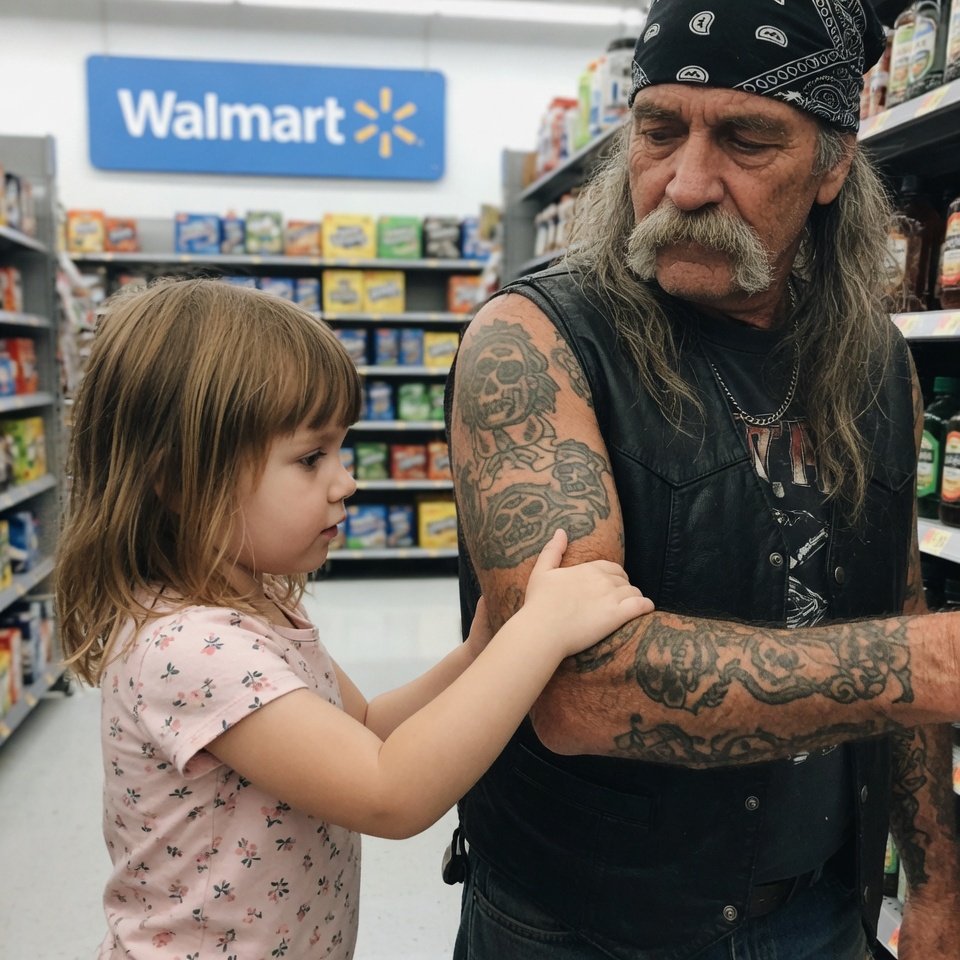
**The Little Girl Who Grabbed My Tattooed Arm**
I was sixty-three years old, every inch of me a walking roadmap of hard miles. Vietnam still lived in my bones on rainy nights. The club had buried too many brothers on blacktop. My knuckles carried forty years of scars from bar fights I didn’t start but always finished. I rode alone now. My old lady was gone ten years. My daughter Amanda lived three states away with her own kids. Most days I kept to myself, spoke little, and let the world assume the worst when they saw the leather, the ink, and the size of me.
That Tuesday I was at Walmart because the fridge was empty and my bones ached. Nothing special. Just an old man buying milk and cereal like everybody else. I was in the cereal aisle, trying to decide between the kind with too much sugar and the kind that tasted like cardboard, when I felt it.
A small, trembling hand latched onto my left forearm like it was the last solid thing on earth.
I looked down.
She couldn’t have been more than six. Tangled brown hair, eyes the size of dinner plates, and bruises—fresh, finger-shaped bruises—circling both her skinny arms. She pressed herself against my leg so hard I could feel her heart hammering through my jeans.
“Please, mister,” she whispered, voice cracking. “Please pretend you’re my daddy. Please don’t let him take me.”
Before I could answer, she kept going, words tumbling out in a terrified rush.
“Daddy’s trying to kill Mommy. She’s on the kitchen floor and there’s blood everywhere. He said if I told anyone he’d make me go to sleep forever too. Please, mister. Please.”
My blood turned to ice water.
I scanned the aisle without moving my head much. Old habits from the jungle and the road. Two women at the end comparing granola bars. A stock boy restocking Fruit Loops. And then I saw him.
Thirty-something. Red-faced, sweating through a cheap polo shirt. Eyes darting like a cornered animal. He moved with that particular kind of frantic purpose that sets every nerve in a man like me on fire. Predator mode. He hadn’t spotted us yet, but he was coming fast.
“Addison!” he barked, voice echoing off the shelves. “Addison Marie, get over here right now!”
The little girl—Addison—started shaking so violently I thought she might collapse. Her fingers dug into my vest like claws.
“That’s my daddy,” she whispered against my thigh. “But he’s not acting like my daddy anymore.”
I put my hand on top of her head, gentle as I could manage with hands that had broken bones. “You stay right here, sweetheart. Right behind my leg. You don’t move unless I tell you.”
The man spotted us.
His eyes locked on Addison first, then climbed up to me. I saw the calculation happen in real time. Six-foot-three, two-hundred-fifty pounds, leather vest with Vietnam patches and a skull that had seen too much, scars on my knuckles that told their own stories. He sized me up the way a coyote sizes up a bear.
I stood up slow. Let him see all of it. Let him see the way I positioned myself between him and the child like it was the most natural thing in the world.
“Addison, sweetie, come here,” the man called. His voice tried for calm and missed by a mile. “We need to go home and check on Mommy. She’s waiting for us.”
Addison made a sound I never want to hear again—a tiny, broken whimper that came from somewhere deeper than six years old should reach.
I kept my voice low, steady, the same tone I used when I talked brothers down off ledges. “She’s okay right where she is. Seems to me maybe we oughta call somebody to check on Mommy instead.”
The fake calm evaporated. His face twisted. “That’s my daughter. Give her to me right now or I’m calling the police.”
“Good,” I said. “Excellent idea. Let’s call them together. Right now.”
I pulled my phone out slow, deliberate. The man’s eyes flicked to it, then back to Addison, then to the growing number of shoppers who had stopped to stare. A woman near the end of the aisle had her phone up, recording. Good. Let there be a record.
“Addison, I’m going to count to three—” the man started, stepping forward.
I took one step toward him. Just one. It was enough.
“You’re not counting to anything,” I said quietly. “You’re going to stand right there while I call 911. And if you take one more step toward this little girl, you and I are going to have a very old-fashioned conversation about what happens to men who hurt children.”
He hesitated. I could see the rage and the fear fighting behind his eyes. He was used to people backing down. He wasn’t used to a wall of leather and scar tissue that didn’t flinch.
Other shoppers were forming a loose semicircle now. An older man in a John Deere cap had moved closer, phone in hand. A young mother pulled her own kids behind a cart. The tension was thick enough to choke on.
The man’s hand twitched toward his pocket. I tensed, every old instinct screaming. But he didn’t pull anything. Not yet.
“Addison, I’m warning you—” he tried again.
I cut him off. “You’re not warning anybody. You’re going to turn around and walk toward the front doors nice and slow while I call the police. Because if you don’t, I promise you this: the last thing you’ll see before the lights go out is my face.”
He broke.
He spun and sprinted toward the exit, knocking over a display of cereal boxes. A store employee shouted and started after him, but I called out, “Let him go! Call 911! Tell them there’s a domestic violence situation with a child at—” I looked down. “Sweetie, what’s your address?”
“1247 Maple Street,” she recited through tears, voice small but clear. “The yellow house with the broken fence on the corner.”
I knelt so we were eye level. “Police are coming, baby girl. They’re going to check on your mommy right now. You did good. You were so brave.”
“But what if he comes back?” Her eyes were huge, swimming.
I wiped a tear from her cheek with a thumb that looked ridiculous next to her tiny face. “Then he goes through me first. And I don’t break easy.”
I stayed right there in the cereal aisle with her while chaos erupted around us. Sirens in the distance. Radios crackling. Shoppers whispering. I kept one hand on her shoulder and the other on my phone, giving the 911 operator every detail I had.
A female officer arrived first, calm and professional. She took one look at Addison’s bruises and my protective stance and her expression hardened. More units poured in. They split up—two officers stayed with us while others headed to the address.
Addison wouldn’t let go of my vest. When they tried to separate us for statements, she screamed. I ended up sitting on the floor with her in my lap while I gave my statement over her head. She told them everything in a small, shaking voice—the yelling about money, the frying pan, the sickening sound of her mother hitting the floor, her father’s threat to “make her go to sleep forever too” if she told.
The radio on the officer’s shoulder crackled to life.
“Unit 47, we’re at 1247 Maple. Female victim, unresponsive, severe head trauma. Paramedics en route. Possible homicide attempt.”
Addison went rigid in my arms. “Mommy?”
The officer looked at me. I looked at her. We both knew what that silence meant.
“Is she alive?” the officer asked into the radio.
Static. Then: “Barely. They’re working on her now. It’s bad.”
Addison started to cry in earnest—huge, silent sobs that shook her whole body. I held her tighter. “She’s alive, baby girl. Doctors are helping her right now. You hear me? She’s fighting.”
They caught Craig Bennett twenty-three minutes later.
He was heading north on Highway 9 in his beat-up Honda, probably planning to disappear with his daughter and start over somewhere nobody would look. A state trooper spotted the BOLO and the plates I’d memorized when he ran. Bennett tried to run again. The trooper boxed him in with two other units. He was in cuffs before he could even reach for the door handle.
At the station they processed him while I sat with Addison in a quiet interview room. My daughter Amanda arrived forty minutes later, still in her nurse scrubs, eyes wide when she saw the tiny girl glued to my side.
“Dad,” she said softly, “what did you get yourself into this time?”
I looked down at Addison, who was now half-asleep against my chest, exhausted from terror. “Something right, I think.”
Child Protective Services showed up. A tired-looking woman with a clipboard tried to take Addison. The little girl lost it. Screamed like someone was ripping her soul out. “No! I want to stay with Mr. Bear! Please don’t let them take me!”
It took two hours, three phone calls to a judge, and my daughter threatening to call every lawyer she knew. They granted me emergency temporary custody. Paperwork signed under fluorescent lights while Addison clung to my hand like it was the only thing keeping her from drowning.
We went to the hospital that night.
Sarah Bennett was in the ICU, head wrapped, tubes everywhere, machines beeping in that terrifying hospital rhythm. She was barely conscious when they let us in for two minutes. Her eyes found me, then her daughter. Tears leaked down her face.
“Thank you,” she whispered, voice barely there. “For my baby.”
“Your daughter saved herself,” I told her. “She ran to the right person. I just happened to be wearing the right vest.”
The next six weeks were the hardest and the best of my life.
Addison had nightmares every single night. She’d wake up screaming “Daddy’s coming!” and I’d be there before the second scream finished, sitting on the edge of the bed in my old flannel pajama pants, letting her crawl into my lap while I rocked her like I used to rock Amanda.
I read her stories every evening—old biker tales cleaned up for little ears, or silly ones about talking motorcycles. She started calling me “Mr. Bear” because, she said, I looked scary on the outside but was “squishy on the inside like a teddy bear.” She drew pictures of me with a big heart on my chest and her father with X’s for eyes.
My MC brothers came by in ones and twos. Big, bearded men who normally looked like they ate nails for breakfast. They brought stuffed animals and coloring books and sat on my living room floor letting a six-year-old paint their fingernails. One of them—Big Mike, who did time back in the day—turned out to have a law degree he never talked about. He helped with every piece of paperwork like it was the most important case of his life.
There were scares.
One night a car drove past the house slow, headlights off. I sat on the porch with my old .45 until three in the morning, just in case. Turned out to be kids looking for a place to park. But I didn’t sleep for two days after.
Another time Addison saw a man in the grocery store who looked like her father from behind. She froze, then bolted straight into my legs so hard she nearly knocked us both over. I carried her out of there while she hyperventilated. We sat in the truck for twenty minutes until she could breathe again.
The trial was its own special kind of hell.
Craig Bennett pleaded not guilty at first, forcing Sarah to testify while she was still in a wheelchair. He tried to paint me as some dangerous biker who’d kidnapped his child. His lawyer asked me on the stand if I’d threatened his client. I looked him dead in the eye and said, “Sir, I told him if he took one more step toward that little girl I would end the conversation. I meant it then. I mean it now.”
The jury was out for less than four hours.
Guilty on attempted murder, child endangerment, kidnapping, and assault. Twenty-five years. He’ll be almost sixty when he walks out. Addison will be a grown woman with a life that doesn’t include him.
Sarah made it. Two weeks in a coma, fractured skull, brain bleed, months of rehab. She walked with a limp now and sometimes forgot words, but she was alive. She got her daughter back after those six weeks. I drove them both home the day the judge signed the papers. Addison cried the whole way, but she knew she’d see me every week. We made a deal.
And we kept it.
Seven years later, Addison is thirteen. She’s tall for her age, smart as a whip, and has her mother’s eyes and her own quiet strength. She still calls me Grandpa Bear. She and Sarah come over once a month for dinner. Sometimes she brings friends and I grill burgers while they sit on the porch and I tell them carefully edited stories about the road. She tells me about school, about the self-defense class she talked her mom into letting her take, about how she wants to be a police officer or maybe a social worker so she can help kids like the scared little girl she used to be.
Last month Sarah remarried.
His name is David. High school teacher. Gentle voice, kind eyes, the kind of man who opens doors and remembers birthdays. He treats Addison like she’s made of something precious. When they got engaged, Addison called me herself.
“Grandpa Bear,” she said, voice older now but still carrying that same serious tone, “will you walk me down the aisle? Mom said it’s okay if you want to.”
I stood in my kitchen holding the phone, staring at nothing, trying to remember how to speak around the lump in my throat.
“I’d be honored, sweetheart.”
The day of the wedding I rented a suit that felt like wearing someone else’s skin. My daughter Amanda helped me tie the tie. My MC brothers showed up in clean jeans and button-downs, looking uncomfortable but proud. Big Mike cried before the ceremony even started.
I walked Addison down that aisle in a little church with sunlight coming through stained glass. She wore a simple white dress and flowers in her hair. Her hand was steady in the crook of my arm. Halfway down she looked up at me and whispered, just like she had in that cereal aisle seven years earlier.
“Thank you for being my hero. Thank you for not being scared away.”
I had to stop for a second. Clear my throat. Blink hard.
“Sweetheart,” I told her, voice rough, “I was terrified that day. Still am, some nights. But being scared and doing it anyway? That’s what courage is. You taught me that when you were six years old.”
She squeezed my arm. We kept walking.
At the reception she made me dance one slow song with her. I stepped on her toes twice. She laughed like it was the funniest thing in the world.
Later, when the sun was going down and the string lights came on, I sat at a table with my daughter and watched Addison spin with her new stepfather. Sarah came over, still walking carefully, and sat beside me.
“You gave me my life back,” she said quietly. “Both of us.”
I shook my head. “Your daughter gave herself a chance. I just happened to be the scary-looking bastard in the right place at the right time.”
Sarah smiled. “You know what she told me last week? She said the safest place in the whole world is standing behind your leg.”
I didn’t have words for that. Still don’t.
People still cross the street when they see me coming. They clutch their purses. They assume the worst because of the ink and the leather and the size of me. And maybe they’re not entirely wrong. I am dangerous—to the Craig Bennetts of the world. To anyone who puts their hands on a child or a woman who can’t fight back. To cowards who think size and rage give them the right to destroy lives.
But to a thirteen-year-old girl who still sometimes has nightmares, I’m just Grandpa Bear. The man who reads her stories and shows up to every school event and keeps an old stuffed bear she gave me on my nightstand.
That day in the cereal aisle, when a six-year-old with bruises and terror in her eyes grabbed my tattooed arm and whispered those words, something shifted in the universe. Or maybe it just reminded me what I was still here for.
I was exactly where I needed to be.
And somewhere out there is a thirteen-year-old girl who knows—deep in her bones—that sometimes the scariest-looking person in the room is the one you run to when the monsters are real.
That’s all that matters.
That’s everything.