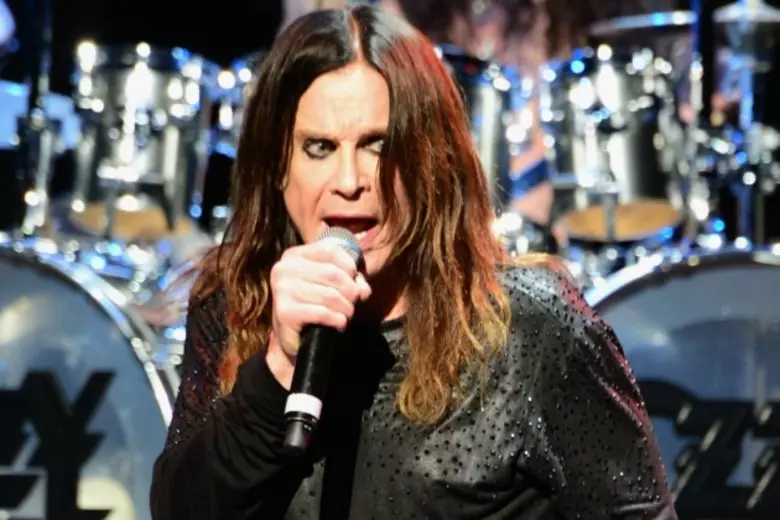
When Ozzy Osbourne was fired from Black Sabbath in 1979 — a dismissal driven primarily by his escalating substance abuse and the band’s exhaustion with managing it — he was, by his own account, finished. Not metaphorically. He has described the months following his firing as among the darkest of his life, a period of genuine belief that his career in music was permanently over, that Black Sabbath had been the only vehicle capable of using whatever talent he possessed, and that life beyond the band held nothing comparable.
His then-girlfriend and future wife Sharon Arden — later Sharon Osbourne — refused to accept this assessment and began assembling musicians for a solo project, holding auditions in Los Angeles for a guitarist who could anchor whatever Osbourne’s post-Sabbath career was going to become. The guitarist who walked into that audition was Randy Rhoads, a classically trained 22-year-old from Burbank who had been teaching guitar lessons and playing in a band called Quiet Riot, largely unknown outside Southern California’s local rock scene.
Osbourne has described the audition with a specificity that has not diminished across forty years of retelling. Rhoads warmed up before the formal audition began — not performing, simply tuning and stretching his fingers across the neck in patterns Osbourne did not yet understand as exercises. Osbourne has said he assumed, watching this warm-up, that he was witnessing the actual audition — that what Rhoads was doing casually, almost absentmindedly, already exceeded what he expected from a serious candidate. When Rhoads stopped and asked if he was ready to begin, Osbourne reportedly said something to the effect that he had already heard enough.
What Rhoads brought that distinguished him from Tony Iommi — whose dark, heavy, blues-rooted riffing had defined the sound Osbourne had built his entire identity around for a decade — was a fusion of classical composition and neoclassical metal technique that did not yet have a widespread vocabulary in 1979. Rhoads had studied classical guitar seriously, understood music theory with an academic rigor uncommon in hard rock guitarists of the period, and brought a melodic and harmonic sophistication to heavy metal that expanded what the genre could sound like.
Blizzard of Ozz (1980) and Diary of a Madman (1981) — the two albums Rhoads recorded with Osbourne before his death — relaunched Osbourne’s career so completely that the commercial failure he had feared never materialized. Crazy Train, Mr. Crowley, Flying High Again — songs built on Rhoads’s guitar work that demonstrated a different relationship between heaviness and melody than Sabbath had explored.
Rhoads died on March 19, 1982, in a small plane crash during a tour stop in Florida — a reckless, unauthorized joyride taken by the tour bus driver that killed Rhoads, a hairdresser traveling with the tour, and the pilot. Osbourne has said he never fully recovered from the loss, that Rhoads represented a creative partnership of a quality he never found again in quite the same way, and that the brief two years they worked together produced some of the most significant music of his career. He was 25 years old.