I spent twenty-six years as a law enforcement officer in a county that had, during most of those years, a significant and complicated relationship with the Copper Saints Motorcycle Club. I made a lot of arrests in those twenty-six years. I made one arrest that I think about more than most.
His name was Eddie Castain. He was twenty-nine when I arrested him, which would have made him approximately fifty now, which is roughly how old the man who showed up at the hospital looked when I walked into the waiting room and stopped dead and had the specific experience of time folding back on itself.
Let me tell you about the arrest first.
It was late March, many years ago. I was thirty-four, a detective at that point, and we’d been building a case against the Copper Saints for what we believed was a fencing operation running stolen automotive parts through a legitimate repair shop connected to the club. The operation was real — we had documentation, we had witnesses — but it was also more complicated than the initial brief suggested, in ways I partly understood at the time and more fully understood later.
Eddie Castain was the legitimate owner of record for the repair shop. He was also, my report stated, the operational manager of the fencing side. He was convicted on two counts, served sixteen months, was released.
What I understood later, through channels that are their own story: Eddie had bought the repair shop from a man with Copper Saints connections as a genuine business investment, had known the fencing operation was running through it, and had made the decision — complicated, neither wholly coerced nor wholly chosen — to allow it to continue under pressure from people significantly more senior in the club hierarchy. His knowledge and participation were real. His culpability was complicated by a context I’d been given an incomplete version of.
I’ve thought about this case many times over my career. Policing is full of cases where the version of events that produces a conviction is real and also simplified, where the person in the dock is guilty of something and also subject to forces the legal process doesn’t have good tools for capturing. I sleep fine at night, mostly. But I think about Eddie Castain. I thought about him for twenty years.
My daughter Claire is twenty-eight. She works in the city and she’s careful and smart and has, as her mother says, good instincts about most things. On the night in question — a Thursday in November, two years ago — her good instincts came up against something bigger than instincts handle.
She was driving home from a friend’s. A man in another vehicle forced her off the road on an elevated highway interchange — not an accident, she was certain, deliberate — and her car hit the barrier and she was hurt, not critically, but significantly: broken arm, concussion, laceration on her forehead that bled dramatically. She was disoriented. The other driver did not stop.
What happened next, I know from Claire’s account and from subsequent conversations: a motorcyclist who had been several vehicles behind her had seen the incident and pulled over immediately. He called 911 before he even reached her car. He stayed with her, kept her calm, kept her awake because he’d assessed the concussion and knew keeping her alert was important — where had he learned that? I asked her. She said he’d been matter-of-fact about it, said you need to stay awake, look at me, tell me your name. He’d held her hand while they waited for the ambulance. He had not asked her anything about herself except her name and whether there was someone he should call, and when she gave him my number — she called me dad even though we’d been calling each other by first names for years, which wrecked me when I heard it — he called me immediately and told me what had happened and where she was.
Then he waited until the ambulance arrived, gave a statement to the first responding officer, and was about to leave.
Claire asked his name.
He said: Eddie.
She didn’t know. Why would she? She was three years old when I made that arrest.
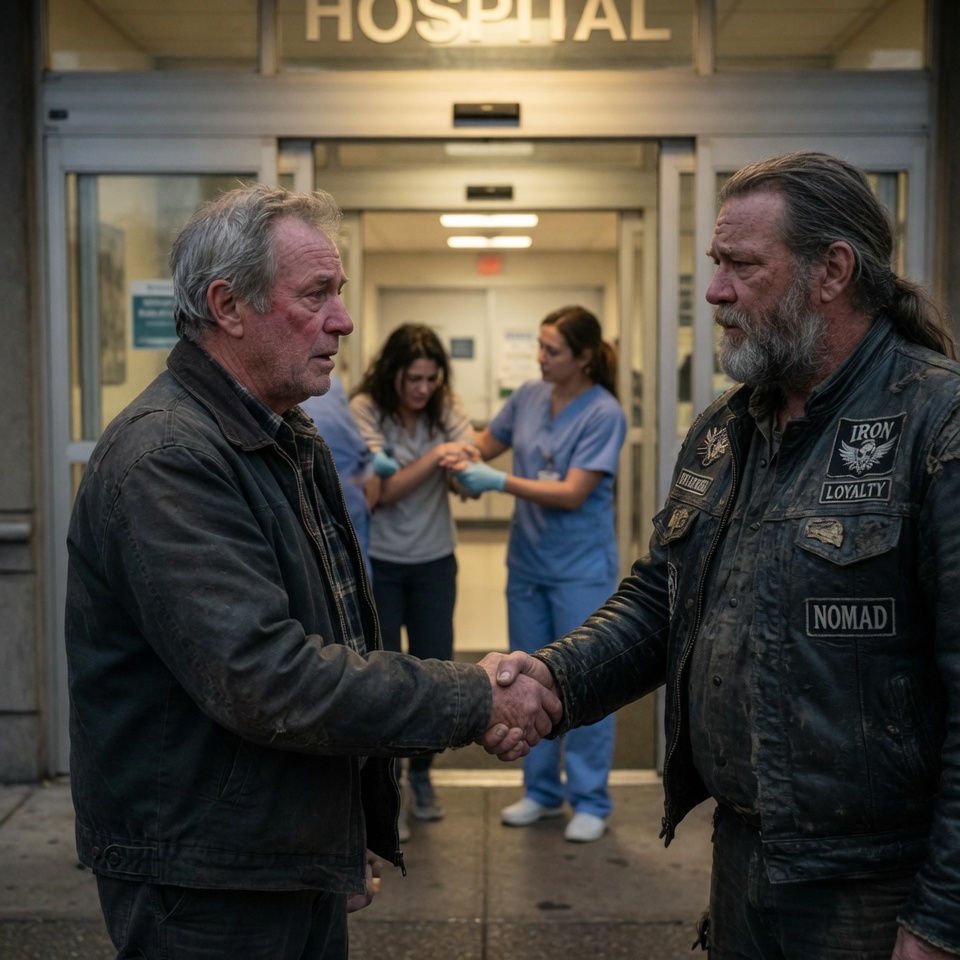
I knew who Eddie Castain was the moment she described him to me in the hospital. I walked into the waiting room with my wife and I looked at the man sitting in the corner chair — older, heavier, the beard gone white at the edges, but with the same direct eyes I remembered from across an interrogation table twenty years ago — and he looked at me and there was a specific quality to the moment, the kind of quality that you feel in your sternum before you feel it anywhere else.
We looked at each other for a moment.
“Detective Calloway,” he said. Not hostile. Not even particularly surprised.
“Just Pete,” I said. “I’ve been retired for four years.”
He nodded.
I sat down next to him. We were the only people in that section of the waiting room. My wife had gone in to see Claire.
“How is she?” he asked.
“Concussion, broken arm, facial laceration,” I said. “She’ll be okay.”
He let out a breath. “Good. She was sharp — stayed alert, answered questions. That matters with a head injury.”
I looked at him.
“You know about head injuries,” I said.
“I had a nephew,” he said. “He wasn’t as lucky. I learned what to do.”
We sat in the particular silence of people who have a twenty-year history that is entirely incomplete, that is real and complicated and neither concluded nor resolvable, who are sitting together in a hospital at eleven PM because one of them did something genuinely good for the other’s family.
I said, because it was the only place to start: “I’ve thought about your case.”
He was quiet for a moment. “I figured you might.”
“I wasn’t given a complete picture of the situation,” I said. “I think you know that.”
“I know that,” he said. He wasn’t gracious about it and he wasn’t bitter. He said it with the neutrality of someone who processed something a long time ago. “You did your job with what you had.”
“Sixteen months,” I said.
“Sixteen months,” he confirmed.
Another silence.
“Thank you,” I said. “For Claire.”
He looked at his hands. “She reminded me of someone,” he said. “A lot of people’s daughters out there. You want them to be okay.” He glanced at me. “That’s it. That’s the whole thing.”
I’ve talked about this with my wife. With my therapist, who is a practical woman who has heard many complicated things from me over four years of retirement and who responded to this one with the observation that life rarely offers the opportunity for direct accounting and that when it does, the accounting is rarely as clean as we’d like but that unclear is different from meaningless and that it might be worth sitting with what happened rather than trying to resolve it into a verdict.
She’s right. I’m trying.
I know Eddie Castain is still a Copper Saints member. I know the club has, over the years since my arrest, had further encounters with law enforcement, some of which I’m aware of from colleagues who remained on the job. The ledger, if you’re keeping one, does not balance to a simple conclusion.
But I know that a man I put in prison for sixteen months pulled my daughter’s hand and told her to look at him and stay awake and then called me before the ambulance arrived and waited until he knew she was safe and did not ask for anything and did not tell me his name, and I had to find it out from her.
That’s also real. Both things are real at the same time.
I called him, a week after the hospital. I got his number through Claire — she’d saved it. He picked up on the third ring.
I said: “I just wanted to call and say it again, when it wasn’t the middle of the night in a hospital.”
He was quiet for a moment. Then he said: “How’s she doing?”
“Good,” I said. “She’s good.”
“Good,” he said.
We spoke for about four minutes. Nothing revelatory. Nothing that resolved anything. But four minutes of two men talking to each other like people rather than like positions, which felt, given the twenty years before it, like something.
I don’t know if I’ll call again. I don’t know if that matters. Some things don’t need to continue. Some things are complete in their single occurrence, like a note that rings and fades and doesn’t need another note to have meant something.
I think that might be enough.
You did the right thing in the academic course if was not there she might not make it be safe out there come back you a preacher down you do do the right down prayers 🙏 my Godbless you on your journey 🙏 ❤️ 💖 love the story