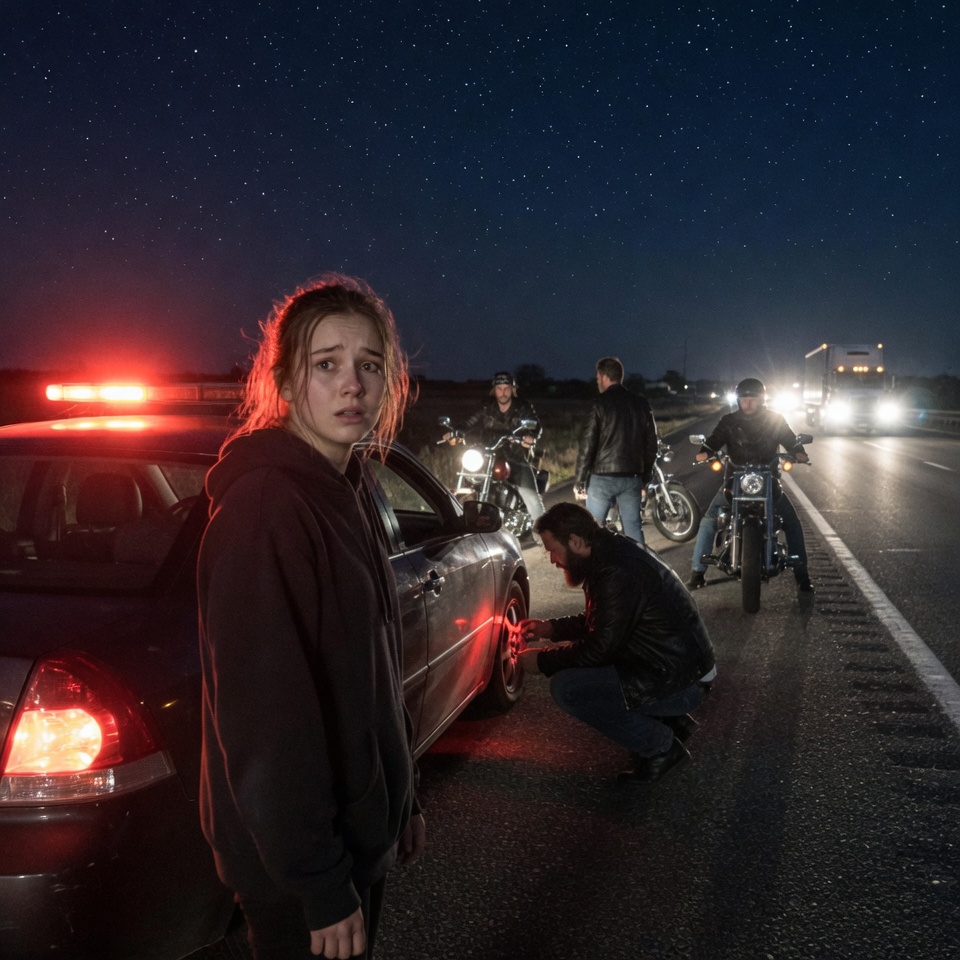
I was seventeen years old and I had been driving for exactly eleven months when my front left tire blew out on Highway 12 at nine-thirty on a Friday night.
The blow-out was so sudden and violent that I screamed before I’d processed what was happening — one second the car was moving normally and the next there was a sound like a gunshot from somewhere beneath me and the wheel jerked hard and I wrestled it to the right shoulder by pure reflex and adrenaline.
I sat there for a moment with my hands still clenched on the wheel, shaking in the specific way that happens after the body has flooded itself with chemicals in response to a situation that turned out not to be fatal.
Then I got out and looked at the tire, which was completely destroyed. Not flat — destroyed, the rubber peeled and hanging off the rim.
And then I remembered, in a sequence that I can still recall with perfect clarity, the following things: I did not have a spare tire because I had used the spare six weeks earlier on a different flat and had not replaced it because seventeen-year-old me had the long-term planning instincts of a golden retriever.
My phone was at eighteen percent battery. I was on a stretch of Highway 12 between two towns, in a section with no cell towers I could identify, at nine-thirty at night.
My parents were at a fundraiser dinner in the city, fifty miles away, at which point I remembered with crystalline clarity every single piece of advice my father had given me about roadside emergencies that I had listened to with the polite surface attention that means you are not actually listening.
I called my mom. Straight to voicemail — she often turned her phone on silent for events. I called my dad. Same. I called my friend Jess, who didn’t have a car. I called my friend Marcus, who had a car but who was forty minutes away and whose driving at night I did not trust with my life.
I was standing on the shoulder running through options when I heard the motorcycles.
I need to be honest about what I felt when I heard them and then when I saw them: I was scared. I am not proud of this in retrospect, but I am committed to accuracy, and the accuracy is that four large motorcycles pulling up behind your car on a dark highway at nine-thirty when you are seventeen and alone and already frightened does not immediately register as rescue. It registers as the next problem.
They slowed down well before they reached me. I noticed this. They stopped at a distance and one of them, the rider of the lead bike, got off and walked toward me in a way that I can only describe as deliberately non-aggressive — hands visible, unhurried, stopping about eight feet from me. He was maybe fifty, built like a construction worker, with a beard going gray and a vest covered in patches. He looked at my car, then at me.
“You all right?” he asked.
“I had a blowout,” I said. My voice was steadier than I felt.
“I can see that. Are you hurt?”
“No.”
He nodded slowly. He turned halfway back to the others and held up one hand — some kind of signal — and then turned back to me. “You got someone coming?”
“I’m trying to reach my parents,” I said. “They’re not answering.”
“You got a spare?”
I told him the spare situation. He made no expression that could be interpreted as judgment. He crouched down by the destroyed tire and looked at it. “Yeah, that’s done,” he said, mildly. “You got a wheel lock key? For the lug nuts?”
He knew what a wheel lock key was. He was already planning.
His name was Dennis. The other three were Ray, who was the youngest and who handled most of the physical work; a large man they called Boon who barely spoke but who took up a position at the back of my car facing oncoming traffic in a way that I understood gradually was intentional, was protective, was putting his body between the road and me; and a woman named Sherry, which surprised me, because I had not expected a woman, who turned out to be practical and competent and who came and stood with me while the others worked and talked to me in the easy, specific way of someone whose entire purpose is to make another person feel less frightened.
They did not have a matching spare tire. But Dennis made a call — on a phone that was, I noticed, significantly nicer than his general aesthetic would have suggested — and twenty minutes later a truck arrived from a town twelve miles back. The truck belonged to a man who ran a garage who was also, I understood without needing it explained, a member of whatever club these people were part of. He had two used tires in the truck bed that were within range of my rim size and he charged me, when I asked anxiously about cost, forty dollars, which was his cost for the tire and nothing for the service.
While Ray and the garage man put the tire on, Dennis sat on the hood of my car — with a naturalness that suggested he’d done this many times in many situations — and we talked. He asked where I was going, where I was coming from. He told me I should always carry a can of tire sealant as a stopgap measure, which I now do, always, without exception. He told me about his daughter, who was twenty now and in college, and how his heart had been in his throat every day she’d driven alone for the first year. He said it not as a way of talking about himself but as a way of saying I understand being the person sitting here.
Sherry, at some point, produced a bag of chips from her saddlebag and offered it to me. I don’t know why that specific detail makes me emotional when I recall it, but it does. There’s something about a bag of chips offered on a dark highway — the ordinariness of it, the normalcy of the gesture — that was more reassuring than anything else that happened.
My mother called back when the tire was three-quarters on. I told her what had happened, that I was fine, that there were people helping me. She asked to speak to one of them, which I found slightly mortifying but which Dennis accepted without comment, taking my phone and introducing himself and giving her the highway mile marker and telling her I’d be on the road in ten minutes. He handed the phone back.
“She sounds like she’s going to have words with you about emergency preparedness,” he said, not unkindly.
She did, at length, when I got home. But that was later.
I got home safely. I called my mother when I got in the driveway as promised. I sat in the parked car for a few minutes before going in because I needed to process the gap between the thing I had feared and the thing that had happened.
The thing I had feared was four dangerous strangers on a dark road.
The thing that had happened was Dennis and Ray and Boon and Sherry, who had given up an hour of their Friday night to make sure a scared kid got home, who had put their body between traffic and me, who had made calls and called in favors and charged me forty dollars for a tire they could have charged me four times that for, and who had ridden alongside me for the next eight miles to the exit where I turned off, just to make sure the tire held, and then peeled away without drama, without ceremony, with just a brief flash of lights that I understood to be goodbye.
I am thirty-one now. I have told this story many times. The part I emphasize changes depending on who I’m telling it to, what I need them to understand. Sometimes I emphasize the practicality — always carry tire sealant, always have a charged phone, always have your parents’ friends’ numbers and not just their cells. Sometimes I emphasize the fear I felt and the gap between that and the reality.
Mostly I tell it like this: there was a dark road and four strangers and I was scared and they were kind, and the fear and the kindness existed simultaneously, and the kindness turned out to be what mattered.
I think about Boon standing at the back of my car, facing the oncoming traffic. Not talking, not comforting, not making gestures. Just standing there. Putting himself between the road and me. He didn’t say one word to me the whole time.
He didn’t need to. The standing was the whole sentence.