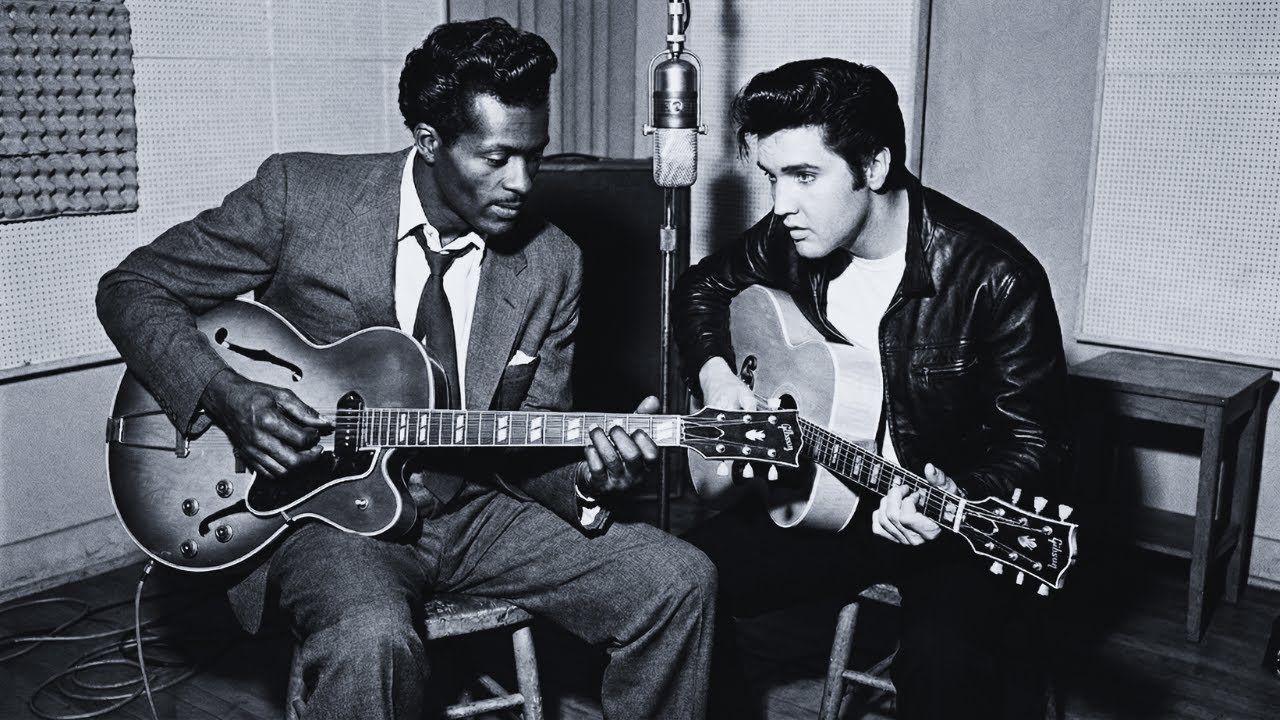
The relationship between Chuck Berry and Elvis Presley is one of the most complicated and least examined in the history of rock and roll. On the surface it looks simple: two foundational figures of the same musical revolution, operating in adjacent territory, sharing sources — the blues, the rhythm and blues tradition, the specific American musical inheritance that both of them had absorbed and transformed in their different ways. They were contemporaries. They were aware of each other. They were, in the understanding of the music industry that surrounded them, competitors for the same audience.
What the surface conceals is more interesting. Chuck Berry was Black. Elvis Presley was white. And in the America of the mid-1950s, this distinction was not incidental to anything — it was structural, it was legal in certain states, it was embedded in the economic arrangements of the music industry in ways that meant two men making music from the same source received very different treatment from the same system.
Berry has spoken about this throughout his life with varying degrees of candor at different times — sometimes with bitterness that he acknowledged directly, sometimes with the philosophical distance of someone who has had decades to arrive at a perspective that is more complex than simple resentment. He understood what had happened. He understood that the machinery of American popular culture in the 1950s was structured to make a white performer’s version of Black musical innovation more commercially accessible than the original. He lived inside that understanding for his entire career.
Elvis Presley also understood it. This is the part that gets left out of the easier versions of the story. Presley was not naive about the racial dynamics of his own success — he could not have been, given the specifics of his origins in Tupelo, Mississippi, given his musical education in the Black churches and rhythm and blues radio of the Deep South, given the specific way his career had been built on a foundation that others had laid. He carried this knowledge. People who knew him have said that he carried it as a specific weight — an awareness of debt that he could not repay in the currency that would have been most meaningful, which was the currency of credit and recognition and commercial opportunity.
He spoke about Berry in terms that went beyond professional admiration into something more personal. He called him foundational. He called him the real thing. He said these things in the controlled environments of interviews where the political dimension of the statement could be received without challenging too many of the structures it was indicting.
The letter Berry wrote arrived — by the accounts of people who were in Presley’s circle during the period it was received — sometime in the mid-1970s. A private communication, handwritten, sent through channels that ensured it reached Elvis directly rather than through the management apparatus that controlled most of his communications.
What the letter contained is known only to the very small number of people who were present when it was found after Elvis’s death in August 1977. They have described it without quoting it — with the discretion of people who understand that some communications retain their private character even after the deaths of both parties. What they have said consistently is that it was not a business letter. Not a professional courtesy. That it was personal in the specific way of someone saying something they had thought for years and were choosing, finally, to say.
It was found under his pillow. Not in a drawer, not in a file, not in the managed archive of a famous man’s possessions. Under his pillow. The place where people keep the things they want closest to them in the hours of vulnerability and unconsciousness. The place where things that are privately most important live.
Elvis Presley had been sleeping with Chuck Berry’s letter for an unknown amount of time. Had chosen to keep it in the most intimate available location. Had not shown it to anyone, not mentioned it, not made it part of any narrative about his relationship with the musician whose work was foundational to his own.
He kept it private. He kept it close.
The debt he felt — the specific, complicated debt of one man to another across the racial landscape of twentieth-century America — found its expression in that. In a letter kept under a pillow. In a private acknowledgment that the public version of the story had never fully contained.
Some recognitions arrive too late and travel too short a distance. This one at least arrived. It at least traveled as far as the space between a man and his sleep.