There are conversations that change the direction of a life. Not because they contain revelations exactly — not because something entirely new arrives — but because they confirm something a person has been half-believing in private and was not yet sure they had permission to fully commit to. Someone you respect looks at you and reflects back something true and the thing you were approaching carefully you suddenly approach without hesitation.
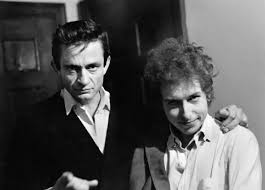
Johnny Cash and Bob Dylan met properly in 1964. They had been aware of each other for years — had been watching each other from their respective positions in the American music landscape with the specific alertness of two people who recognize something in the other’s work that most people around them don’t fully see. Cash was the Man in Black, the voice from the American underside, the man who sang about prisoners and outcasts and the specific dignity of people the mainstream preferred to forget. Dylan was twenty-three years old and already rewriting the possibilities of what a song could say and do and be.
They should have had nothing in common. The distance between country music and the folk revival — between Nashville and the Greenwich Village coffee houses — was enormous in 1964, both culturally and commercially. People operated in one world or the other. Crossing between them was unusual and not always welcome.
Cash crossed. He had heard Dylan’s first album and written him a letter — an actual physical letter, sent through Dylan’s label — that said, in effect: I hear what you are doing and I want you to know that someone in Nashville hears it too. Dylan was startled and moved. He kept the letter.
When they finally sat together in person, the conversation that emerged was reportedly about authenticity. About the specific problem of performing truth in a commercial context without having the truth corrupted by the performance. About how you stay honest when the music industry is structured to reward a particular kind of dishonesty. About how you keep the rawness in the work when everyone around you is trying to smooth it into something more acceptable.
Cash had been fighting this battle for years. He knew what happened when you let the machinery win — he had lived through his own period of commercial compromise and the toll it took on the work and on himself. He had things to tell Dylan about that. Specific, practical, hard-won things.
Dylan had things to tell Cash in return — about the folk tradition, about the political possibilities of music, about the ways that a song could be simultaneously personal and universal in ways that the Nashville industry had largely abandoned.
They talked for three hours. Nobody recorded it. There are no transcripts.
What there is, instead, is the music each of them made in the period immediately following. Cash’s recordings became rawer, more defiant, more willing to inhabit discomfort without apology. Dylan’s began incorporating country textures and a directness that his earlier work — more self-consciously literary — had sometimes avoided.
Two careers. One conversation. No record of what was said. Only the music that came after, pointing back at that room like an arrow toward something invisible but real.