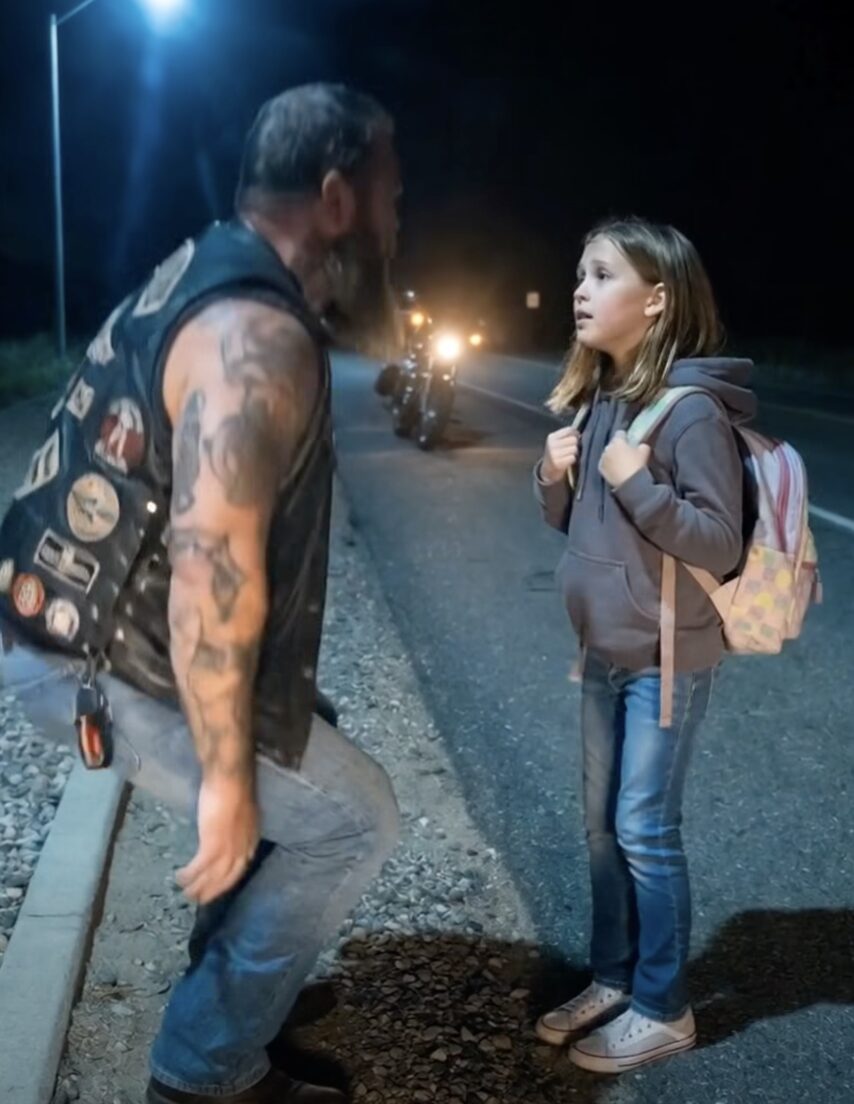
It was 11:07 p.m. on a cold October night when thirteen-year-old Tessa Galloway stepped out the bedroom window of her parents’ single-wide trailer on County Road 318.
She had been hiding under her bed for two hours while the screaming in the kitchen grew louder, sharper, until something heavy shattered and her mother’s scream split the air like a siren. That was the moment Tessa’s bare feet hit the cold linoleum, then the dew-soaked grass of the front yard, then the gravel of the driveway. She turned right onto the narrow shoulder of Highway 49 and started walking north, pink mouse pajamas clinging to her skin, heart hammering so hard she could feel it in her teeth.
She didn’t know where she was going. Only that the distant glow of a gas station sign, two miles up the road, looked like the only light left in the world. She told me later she had already decided she was never going back.
Headlights whipped past her every thirty seconds, each one blasting wind across her body and making the yellow line on the asphalt flicker like a warning. Tires hissed on the blacktop. One truck came so close the side mirror brushed the sleeve of her pajamas. She kept walking, arms wrapped around herself, bare feet stinging on the gravel.
Then she heard it.
A low, guttural rumble growing behind her, deep and steady, like something alive moving through the dark. A single headlight swept over her, bright enough to cast her shadow long and trembling on the shoulder ahead. The motorcycle passed without slowing. Taillight shrinking. Red eye winking out.
Tessa felt something inside her cave in. She stopped, shoulders slumping, the cold suddenly sinking all the way into her bones.
But the brake light flared.
The engine throttled down to a low idle. The bike eased onto the shoulder a hundred yards ahead and stopped. For a moment nothing moved except the hazard lights blinking orange against the pines.
Then the rider killed the engine.
He didn’t chase her. He didn’t walk back. He simply swung a leg over, sat down on the gravel shoulder with his back turned to her, and stayed there.
Twenty minutes.
Tessa told me she counted every one of them.
She stood frozen, watching the broad silhouette of the man in the leather vest, his tattooed arms resting on his knees, the faint glow of his phone screen the only light near him. Cars kept whipping past, each one rocking her on her heels. The night pressed in—crickets, distant train horns, the occasional whoosh of wind through the pines. Every few seconds she expected him to stand up, to turn around, to come after her. He never did.
He just sat there, back to her, patient as stone.
She took one step. Then another. Gravel bit into her feet, but she kept moving, drawn by the only person on that highway who wasn’t rushing past her like she didn’t exist.
When she was twenty feet away, the man spoke without turning around. His voice was low, rough, calm in a way that cut straight through the dark.
“Hey, kid. Name’s Briar. I’m not gonna hurt you. I’m not even gonna look at you until you tell me it’s okay. You good?”
Tessa stopped. She was shivering so hard her teeth clicked.
“I’m… tired,” she whispered.
Those two words landed between them like a confession.
Briar stayed exactly where he was, back still turned, but she saw his shoulders drop, like the weight of what she’d just said had hit him harder than any punch he’d ever taken. He was a big man—six-two, two-forty, salt-and-pepper beard, sleeves of ink disappearing under the leather. The kind of man most thirteen-year-olds would cross the street to avoid. Yet something in the way he refused to face her made her take the last ten steps.
She stopped beside him.
Briar still didn’t turn. He kept his eyes on the dark trees across the highway.
“Can I stand up now?” he asked quietly. “I’d like to help you get warm, but only if you say yes.”
She nodded.
He rose slowly, turned, and knelt so he was eye-level with her. His face was shadowed, but she saw the lines around his eyes, the way they softened when he looked at her.
“You’re freezing,” he said. “I’ve got a jacket on the bike. Can I get it for you?”
Another nod.
He walked to the Harley, pulled the heavy leather jacket off the seat, and held it open like a blanket. Tessa stepped into it. The sleeves swallowed her hands. The hem brushed the backs of her knees. It smelled like motor oil and cedar and something safe she couldn’t name. The moment the warmth settled over her shoulders, her legs gave out.
Briar caught her before she hit the gravel. One arm under her knees, one behind her back, he lifted her as carefully as if she were made of glass. She wrapped her arms around his neck and buried her face against the worn leather over his chest. Her whole body went limp.
He sat back down on the shoulder, right there in the gravel, holding her against him while cars still whipped past. With the hand that wasn’t cradling her, he pulled out his phone and dialed 911. The call was recorded. I’ve heard it.
His voice never wavered. He gave the dispatcher—Loretta—his exact location, described the thirteen-year-old girl in pink mouse pajamas, barefoot, no visible injuries but very cold. He told her Tessa was “pretty checked out” and that he wasn’t going to push her to talk. For four minutes and seventeen seconds he stayed on the line, answering every question while he rocked her gently, whispering once, “Here you go, kid. Jacket’s yours now,” as he tucked it tighter around her.
When the cruiser’s headlights finally swept around the curve, Deputy Dontrelle Marston found Briar exactly where he’d been sitting—back straight, arms full of a sleeping girl, leather jacket wrapped around her like armor.
Dontrelle later told me: “I’ve responded to a lot of calls with kids. Never seen a man hold one like that. Like she was the only thing in the world that mattered.”
The rest of the story unfolded the way stories like this sometimes do when someone refuses to look away.
The jacket stayed with Tessa through the hospital, through the child advocacy interviews, through two foster placements, and finally into the home of Marlowe Beasley, the retired librarian who became her forever mom. Tessa wore it like a second skin for the first year. Then on bad days. Then on good days when she needed courage. At fourteen she still keeps it folded on the chair in her bedroom.
She told me, voice steady as a heartbeat, that she joined the police youth academy because of that night. “He didn’t chase me. He didn’t scare me. He just sat down in the dark and waited until I was ready. I want to be the person who does that for somebody else.”
Eight years after that October night, Briar Coleridge still rides the same Harley. He still has the small cursive tattoo on the inside of his right wrist that reads EMMA—the name of the five-year-old sister he couldn’t save from a neighbor’s pool in 1981. He told me he believes Emma gave him the eyes to see a scared kid on the side of a highway when everyone else would have kept riding.
He keeps a sticky note on his workbench that reads, in his careful handwriting: Tessa. 2032.
Because when she graduates from the Mississippi Law Enforcement Officers’ Training Academy at twenty-one, Briar will be there. He promised.
He’ll bring the bike.
And Tessa says she’ll be wearing the jacket.
The one that kept her warm on the coldest night of her life.
The one a stranger on a motorcycle gave her when he chose to sit down instead of chase her.
The one that proved, on a dark stretch of Highway 49 at 11 p.m., that sometimes the most powerful thing a man can do is simply wait.
Beautiful. Bless you Briar and love and respect too who would this. Not enough of you in this world
Jeg har børnebørn og hvis de en dag ikke længere kunne regne med deres forældre vil jeg håbe de render ind i en som dig Brian ❤️