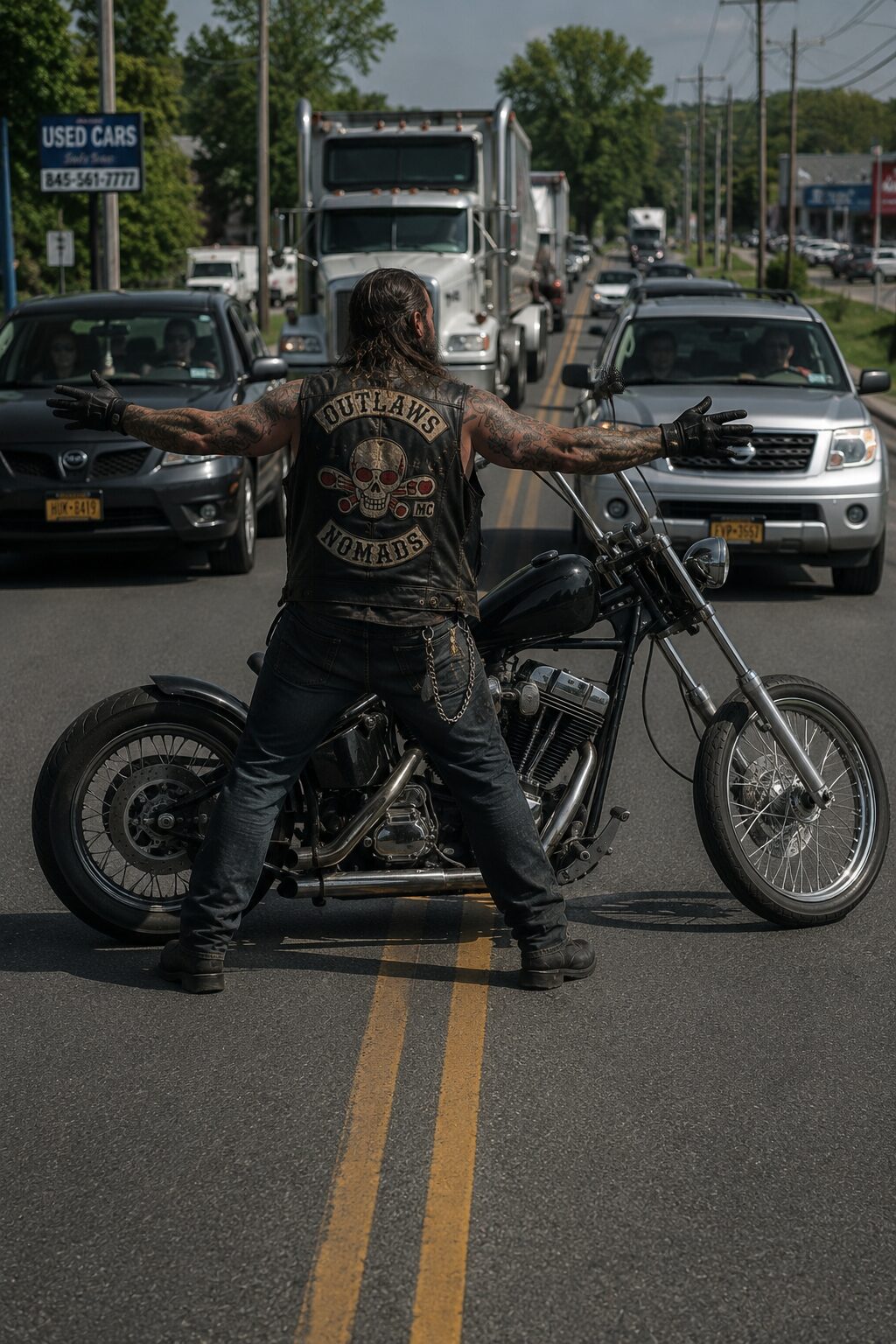
It was a quiet Thursday evening in mid-October, the kind where the grocery store’s fluorescent glare still clung to your eyes long after you’d loaded the bags into the trunk and pointed the car toward home. I was on the usual route—a two-lane county road that wound through a sleepy residential neighborhood just outside of town, where the houses sat back from the pavement behind neat lawns and the streetlights flickered on one by one as dusk settled in.
Traffic was light, the kind of predictable flow that lets your mind wander to dinner plans and tomorrow’s to-do list. The sun had already slipped behind the rooftops, stretching long shadows across parked cars and empty sidewalks, and everything felt ordinary, almost peaceful, right up until it wasn’t.
Brake lights flared ahead in a sudden red chain, rippling backward faster than I expected. I pressed my own pedal a little harder than necessary, coming to a stop behind a silver sedan. At first I figured it was nothing serious—maybe a dog in the road, or someone making a wide turn into a driveway. These things clear up in thirty seconds if you’re patient.
But the line didn’t move. Horns started almost immediately, short impatient blips at first, then longer, angrier blasts that overlapped into a messy chorus of frustration.
I leaned forward, squinting past the cars ahead, and that’s when I saw him.
He stood dead center in the middle of the road, planted between the two lanes like a man who had every right to be there. Tall, broad-shouldered, wearing a faded black leather vest over a dark gray shirt, tattoos snaking down both forearms and disappearing under the sleeves. His motorcycle was parked at an angle just behind him, half on the shoulder, half in the lane, as if he’d stopped it mid-motion and simply stepped off.
He wasn’t waving anyone through. He wasn’t holding a sign or wearing a reflective vest. He was just… standing there, feet planted wide, shoulders squared to the oncoming line of cars, eyes fixed straight ahead like he was waiting for something none of us could see.
The horns grew louder, more insistent. Someone three cars up leaned out their window and shouted, “Get the hell out of the road, man!” Another driver behind me laid on the horn in a long, continuous blast that made my teeth ache. A woman in an SUV a few vehicles ahead actually opened her door and stepped halfway out, gesturing wildly. “Are you serious right now? Move!”
The biker didn’t flinch. Didn’t turn his head. Didn’t raise a hand in apology or defiance. He simply stood there, solid as the asphalt beneath him, like the noise and the anger were weather he had decided not to acknowledge.
I felt my fingers tighten around the steering wheel. A low unease settled in my chest—not fear exactly, but the kind of instinctive wariness you get when something familiar suddenly feels wrong. People don’t just stand in the middle of a road at dusk unless they’re drunk, crazy, or looking for trouble. And this guy didn’t look drunk or crazy. He looked… deliberate.
I glanced in the rearview mirror, checking how far back the traffic had stacked up. Headlights stretched into the distance, a neat line of red and white. Everything looked normal until my eyes caught the car at the very back of the visible queue.
It wasn’t stopped like the rest of us.
It was drifting—slow at first, then more noticeably off-center, weaving slightly between the lanes as if the driver were fighting the wheel and losing. I adjusted the mirror, leaning back a fraction, trying to convince myself I was imagining it.
The biker still hadn’t moved. But I saw his shoulders tighten, just a little, the way someone does when they already know what’s coming.
The horns were frantic now, tipping from irritation into something sharper, uglier. Then I heard it—the distinct sound of tires losing their grip, a high-pitched squeal mixed with the stuttering growl of an engine that no longer answered the brakes. The car behind us lurched forward unevenly, front end dipping hard, as if the pedal had gone straight to the floor and stayed there.
A woman somewhere in the line screamed.
People started scrambling out of their vehicles—some backing away, some frozen halfway out their doors, unsure whether to run or stay put. My own heart slammed against my ribs as the realization hit: there was nowhere for any of us to go. The cars were packed too tightly, the road too narrow, the shoulders too soft. If that out-of-control vehicle plowed into the back of the line, it would turn the whole row into an accordion of metal and glass.
The biker moved then.
Not in panic. Not dramatically. He took one measured step sideways, widening his stance, then another, placing himself directly in the narrowing gap between the stopped traffic and the oncoming runaway car. He lifted one arm, palm out—not waving anyone forward, but holding the line like a human barricade. His other hand stayed low at his side, steady.
The car accelerated instead of slowing, tires howling, front bumper dipping violently. I could see the driver inside now, wide-eyed and frantic, both feet apparently useless against the failing brakes.
For one impossible second everything hung suspended—the horns, the shouts, my own held breath.
Then the impact came.
The runaway car slammed into the rear of the biker’s parked motorcycle instead of the line of stopped vehicles. Metal screamed. Sparks sprayed across the pavement as the bike was shoved sideways, twisting and sliding with a grinding roar. The car itself veered hard, jumped the curb, and spun partially before slamming to a stop against a low retaining wall.
The noise cut off abruptly, replaced by a chaotic rush of doors opening, people shouting, feet pounding asphalt. I shoved my own door open and stepped out on legs that felt loose, moving toward the scene before I’d even decided to.
The biker was already up.
He rose from the pavement with the same calm control he’d shown standing in the road, brushing grit from his vest as if the fall had been nothing more than a minor inconvenience. His motorcycle lay on its side a few yards away, front wheel bent at a sick angle, but he didn’t even glance at it. He was already walking toward the crashed car, purposeful and unhurried.
The crowd converged, voices overlapping in a stunned babble. “Call 911!” someone yelled—this time not in anger, but in raw urgency. The driver sat behind the wheel, dazed, chest heaving, one foot still jammed awkwardly on the dead brake pedal.
The biker reached the driver’s door first. He pulled it open with a quick, practiced motion and crouched beside the man.
“Stay with me,” he said, voice low and steady, cutting through the chaos like an anchor. “Breathe. You’re okay. Just stay right here with me.”
It was the first time any of us had heard him speak, and the sound of it shifted the entire moment. Not aggressive. Not defensive. Just calm, grounded, the kind of voice you instinctively trust in an emergency.
I edged closer, close enough to see the driver’s pale face and the way the biker gently moved the man’s foot off the pedal, checking for obvious injuries without causing more harm. Sirens were already wailing in the distance, growing louder by the second.
The crowd had gone quiet now, the earlier rage replaced by something heavier—a collective understanding settling over us like the cooling night air. I looked back down the road, picturing what would have happened if the biker hadn’t been there: the tight spacing, the lack of escape room, the way one failing car could have turned all of us into a pile-up none of us would have walked away from.
A patrol car arrived first, lights flashing. The officer stepped out, scanned the scene, and walked straight to the biker instead of the wrecked vehicle.
“You stopped the whole line,” the officer said—not a question, but a quiet acknowledgment. There was respect in his tone now, the kind that comes when someone sees the full picture after assuming the worst.
The biker gave a single, small nod. His eyes swept the row of cars once, making sure everyone was still safe, then he turned back toward his damaged motorcycle. No one tried to stop him. No one shouted. A few people watched him with new eyes—expressions softer, almost ashamed, as if they were rewriting the story they’d told themselves only minutes earlier.
He righted the bike with a steady heave, checked it briefly, and swung a leg over. The engine caught on the first try, a low, steady rumble that somehow sounded different now.
I took an involuntary step forward, mouth opening, wanting to say something—thank you, or sorry, or anything that might bridge the gap between what we’d assumed and what he’d actually done. But the words stuck.
He looked at me for the briefest moment, just long enough for our eyes to meet. His face was unreadable, but not cold. Just tired in a way that suggested this wasn’t the first time the world had misread him.
Then he gave one short nod—not a goodbye, not a demand for gratitude. Just acknowledgment.
He twisted the throttle and rode off into the growing dark, the sound of his engine fading around the bend until the night swallowed it completely.
I stood there a long time after the ambulances and tow trucks arrived, long after the crowd thinned and the road reopened. The groceries in my trunk were probably warm by now, but I couldn’t bring myself to leave. I kept replaying the moment: the horns, the anger, the way we had all decided what kind of man he was before we’d seen what he was actually doing.
Sometimes the person standing in your way isn’t the obstacle.
Sometimes he’s the only thing keeping the rest of the world from crashing into you.
It’ really a shame but this is typical how the Citizens, what I refer too, As The Brainwashed Masses, react to a, Long Haired, Usually Bearded, Usually Tatooed,
Deeply Suntaned, Man or The Same Description minus the Beard for The Biker Woman, when given similar circumstances.
A ” Biker ” Is almost always Stereotyped as a ScumBag, having no morals that Rapes, Robs and Pillages for having nothing better to do.
Or there abouts.
Sorry to say, but farthest from the truth.
I consider myself a Scooter Tramp A.K.A. Biker and I, , nor anyone I know fit the description of Biker that Citizens have in thier minds eye.
We are nothing but fun loving, down to earth, believe in the man upstairs, Don’t Fuck with Children, Woman, Animals or Other Peoples Shit, and usually we’ll get along, kind of people.
If you only took the time to meet us you would probably come away from that meeting with a new friend, for life.
Try it sometime!!!!!