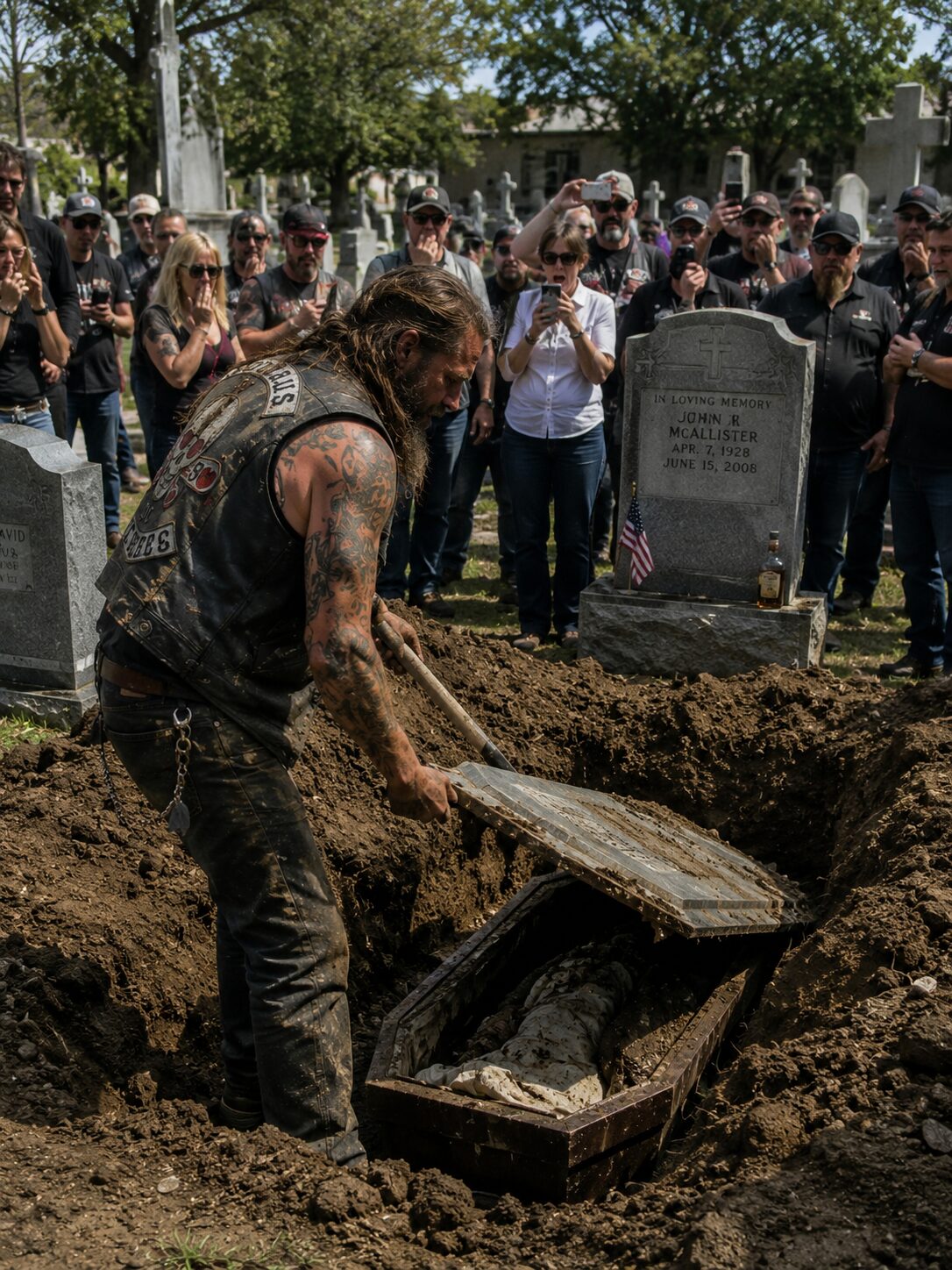
It was an overcast Tuesday in mid-March. The sky hung low and gray over Maple Grove Memorial Park like a sheet of damp slate, the kind of Oregon afternoon where the air tasted of rain that hadn’t quite decided to fall yet. I was edging the grass along Section C when I spotted the motorcycle parked sideways at the main gate, half-blocking the entrance like the rider couldn’t be bothered with rules or parking lines.
It was a black Harley Softail, older but immaculate—chrome gleaming despite the clouds, a single brown leather saddlebag strapped to the left side, bulging so tightly the buckle looked ready to snap.
I didn’t think much of it at first. People ride bikes to cemeteries. Grief doesn’t care what you look like when you show up.
Then I saw him.
He was already standing over a fresh grave in Section E—the newer plots where the earth still looked unsettled and raw. A big man, easily six-two, two-twenty, dressed in black jeans, black boots, and a worn leather vest with nothing underneath. Tattoos covered every visible inch of skin: skulls grinning across both cheeks, a spiderweb crawling up the side of his neck, letters across his forehead I couldn’t make out from a distance. His arms were sleeved solid from wrist to shoulder.
He stood perfectly still, eyes locked on the headstone.
I almost turned away. People stare at graves. That’s the whole point of a place like this.
But then he dropped to his knees, unzipped the saddlebag, and pulled out a folding military-style shovel.
And he started digging.
My stomach knotted hard. I keyed my radio with a thumb that suddenly felt clumsy. “Claire, we’ve got a situation in Section E. Someone’s… I think someone’s digging up a grave.”
Static. Then Claire’s voice from the office, flat with disbelief: “Run that by me again?”
I didn’t answer right away. Because the man had already cleared nearly a foot of soil, and he wasn’t slowing down. Each thrust of the shovel was clean, measured, almost respectful—like he’d done this in his head a thousand times and knew exactly how deep he needed to go.
I walked closer. Forty feet. Close enough to hear the wet bite of metal into clay, close enough to see sweat tracing lines through the dirt already streaking his neck.
That’s when I read the headstone.
“Sophia Grace Harlan. 1990–2024. Beloved daughter. Finally at peace.”
Sophia Harlan. I remembered that service. Three days earlier. Small gathering, maybe twenty people total. A thirty-four-year-old woman gone after what the obituary had called “a long illness”—the kind of phrase that usually means the fight was brutal and private. No bikers in attendance. I would have noticed.
Yet here one was, tearing into her grave like a man retrieving something the earth had stolen.
A couple visiting a nearby plot had frozen mid-step. The woman pressed a hand to her mouth. The man already had his phone up, recording.
I radioed again. “Claire. Police. Now.”
She didn’t argue this time.
I took another few steps. The biker paused, wiped his forehead with the back of his wrist, and for the first time looked up.
Our eyes locked.
I braced for rage, for madness, for the kind of wildness that would explain a man desecrating a fresh grave in broad daylight.
Instead his eyes were bloodshot and wet. Not crazy. Not furious.
Just shattered.
He held my gaze for three long seconds, then went back to digging without a word.
That was the moment I should have understood. But I didn’t. Not yet. Because what kind of man digs up his wife’s grave seventy-two hours after her funeral with tears cutting through the dirt on his face and a child’s small gray stuffed rabbit poking out of his saddlebag?
I hadn’t noticed the rabbit before. Worn, one ear missing, wedged between the shovel sleeve and the bag’s lining like it had been packed with deliberate care.
I stared at it.
He kept digging.
In the distance, sirens began to rise.
Two patrol cars rolled up within minutes. Officers Torres and Brennan—both familiar faces from smaller disturbances over the years. A rowdy visitor, a vandalism incident, the usual.
This was not usual.
Torres approached first, hand resting on his holster but not drawn. “Sir. Drop the shovel and step away from the grave.”
The biker didn’t stop.
“Sir. I won’t ask twice.”
One more deliberate scoop of earth. Then, slowly and without defiance, he laid the shovel on the grass and stood. Hands out to his sides, palms open. Not fighting. Just finished with what he’d come to do.
“On the ground,” Brennan said from behind him.
He dropped. Face to the dirt right beside the hole he’d made. Torres cuffed him while Brennan called for backup that probably wasn’t needed but felt necessary given the man’s size and the skulls staring up from his cheeks.
By now a small crowd had gathered: the couple with the phone, an older woman who’d been placing flowers two sections over, a jogger who’d been using the cemetery path, and Claire from the office, cardigan clutched tight around her like the chill had nothing to do with the weather.
“What’s wrong with him?” the older woman whispered. “Why would anyone do that?”
No one had an answer.
Torres walked the biker toward the cruiser. As they passed me—close enough I could smell the damp earth and sweat on him—the man stopped dead. Planted his boots. Looked me square in the eye with that wrecked gaze.
“The rabbit,” he said, voice like gravel dragged over rust. “Don’t let them take the rabbit.”
Torres pulled him forward. He went.
I walked to the Harley. The saddlebag hung open. The small gray rabbit sat there, impossibly fragile against all that black leather. I picked it up before I could talk myself out of it.
It was lighter than it looked. Soft in places, stiff in others where something—tears, I guessed—had dried into the fabric long ago. I turned it over.
On the bottom of the left foot, in faded black marker, a child’s careful printing read two words:
“For Mommy.”
The police held him for four hours. I know because I asked. A groundskeeper has no business checking on a suspect’s status, but I couldn’t shake that rabbit or those two words written in a little girl’s hand.
For Mommy.
Sophia Grace Harlan. Thirty-four. Beloved daughter. Finally at peace.
No mention of children on the headstone. No mention of a husband. No toys left at the service. No small voices in the front row. I always notice the kids. They’re the ones who stay with you—the way they clutch someone’s hand and stare at a box they don’t fully understand.
But there were no kids at Sophia Harlan’s funeral.
So whose child had written on that rabbit?
I went home that night and couldn’t sleep. I kept seeing his face—the skulls, the tears, the quiet desperation when he said “don’t let them take the rabbit” like nothing else in the world mattered. Not his freedom. Not his dignity face-down in the dirt. Just the rabbit.
The next morning I was back at the cemetery before sunrise. The grave was cordoned off with yellow police tape. The hole was maybe two and a half feet deep—not all the way to the casket, but deep enough that it had never been casual. He’d been digging toward something specific.
I was still staring at the turned soil when a silver Toyota Camry pulled into the lot. Older model, dent in the rear fender. A woman stepped out. Sixtyish. Small frame. Gray hair pulled back severely. She wore an oversized coat and carried a manila envelope against her chest like a shield.
She walked straight to Section E, straight to the taped-off grave.
“You work here?” she asked without looking at me.
“Yes, ma’am.”
“Did you see what happened yesterday?”
“I did.”
She nodded, eyes on the disturbed earth, on the headstone, on the quiet ruin of what should have stayed buried. Then she said something that made the world tilt under my boots.
“He was trying to keep his promise.”
She opened the envelope and handed me a photograph without another word.
It showed a little girl—maybe four or five—sitting on a man’s lap at a kitchen table. The man was younger then, leaner, fewer tattoos, but the jawline and cheekbones were unmistakable.
It was him. The biker.
The girl held a small gray stuffed rabbit with one ear.
“That’s my daughter Sophia,” the woman said, voice steady but thin. “And that’s the man who loved her more than breathing. Her husband. His name is Knox.”
She swallowed.
“And that,” she added, the first crack showing, “is their daughter, Ellie.”
Her name was Vivian Harlan. Sophia’s mother. Standing beside her daughter’s roped-off grave, she told me the story no one at the funeral had been willing to share.
Knox and Sophia met at nineteen. He was already riding, already inked, already the kind of man mothers warned their daughters about. Sophia was studying to be a nurse. Quiet. Kind. The last person anyone expected to fall for a man who looked like trouble on two wheels.
But she did. Completely.
They married at twenty-two. Ellie arrived at twenty-four. For a short, bright season they were a family in a small apartment in Springfield—pancakes on Sunday mornings, the gray rabbit that Ellie carried everywhere, and a life that made sense only to them.
Then Sophia got sick.
The kind of sick that hides for years, mimics other things, sends you home from the doctor with pamphlets and hope until one day it doesn’t. Ovarian cancer. Advanced by the time it was caught.
Sophia’s family blamed Knox. Not for the illness, but for the life she’d chosen. For the tattoos their granddaughter saw every day. For the motorcycle parked outside a home they believed she deserved better than. They had never accepted him. When Sophia fell ill, they saw their chance to reclaim what they thought was theirs.
They went for custody of Ellie. And they won.
Not because Knox was unfit. Court papers showed a man with no record, steady work, a clean home. But in a small-town family courtroom, appearances win. A man with skulls on his face and a Harley in the driveway never stood a chance against Sophia’s parents in suits and pearls.
He lost Ellie eighteen months before Sophia died.
“He came to the hospital every single day,” Vivian told me, crying openly now. “Even after my husband got the restraining order. Even after the police warned him. He’d park across the street on that motorcycle and wait for someone—anyone—to bring Ellie to the window so he could see her face.”
I felt my chest tighten with the kind of ache that has nothing to do with weather.
“Ellie gave Sophia that rabbit the last time she saw her,” Vivian continued. “Put it right in her mother’s hands in the hospital bed and said, ‘Keep it so you won’t be lonely, Mommy.’ Sophia died holding it.”
I closed my eyes.
“We buried her with it,” Vivian said. “My husband insisted. Said it belonged with Sophia. But it wasn’t Sophia’s. It was Ellie’s. And Knox knew that one day Ellie would ask about the rabbit she gave her mom, and someone would have to tell her it was six feet under because an old man’s pride put it there.”
Vivian looked at me then.
“He wasn’t desecrating her grave. He was keeping the only promise he had left. That rabbit is the last piece of her mother Ellie has in this world, and no court order, no dirt, no amount of time was going to stop him from getting it back for her.”
I reached into my jacket pocket.
Pulled out the rabbit I’d carried since yesterday—taken from the saddlebag on instinct, brought home, stared at all night, carried back without knowing why.
Now I knew.
Vivian looked at it. Her hand rose, trembling, and she touched the missing ear, the faded marker on the foot, the places where a little girl’s tears had dried years ago and never been washed out.
“For Mommy,” she read aloud.
Then she pressed it to her chest and made a sound I will never forget—not a sob, but something deeper. The sound of a woman realizing the man she had helped break had been a better father than she had ever let him be.
Knox was released two days later. No charges. The district attorney reviewed the facts and decided that while digging at a grave was technically a misdemeanor, the circumstances didn’t warrant prosecution. I heard later that Vivian herself called the DA’s office and asked them to drop it.
I don’t know what that phone call cost her. I imagine it cost her everything.
I was at the park the morning Knox returned. He didn’t ride the Harley this time. He came in an old Chevy pickup with a car seat buckled in the back. Parked like any other visitor. Walked through the gate with his hands in his pockets and his head down.
He stood at Sophia’s grave a long time. The hole had been refilled. Fresh sod laid. You couldn’t tell anymore.
I watched from a distance, leaning on my rake, pretending to work.
Then the silver Camry pulled in.
Vivian got out, walked around to the back door, and opened it. A little girl climbed down—five years old, dark hair, Sophia’s eyes in a face that hadn’t yet learned how permanent some losses could be.
Ellie.
She wore yellow rain boots with daisies and a jacket zipped to her chin. Vivian took her hand and they walked toward Section E together.
Knox saw them coming. He didn’t move. Didn’t speak. Just stood there—a man built of ink and silence and years of waiting—watching his daughter walk toward him for the first time in over a year.
Ellie stopped about ten feet away. She looked at him the way kids do when they recognize something they can’t quite name.
Vivian reached into her coat and pulled out the rabbit.
She handed it to Ellie.
The girl took it. Touched the missing ear. Turned it over until she found the writing on the foot. Her small face changed—the kind of change that only happens when memory clicks back into place.
“Bunny,” she whispered.
She looked up at Knox.
“Daddy?”
Knox dropped to both knees in the wet grass. Arms open, tattooed face streaked with fresh tears, he waited—the same way he had waited across streets, through courtrooms, and outside hospital windows—for his daughter to come to him on her own terms.
She did.
She crossed those ten feet like they were ten miles, rabbit clutched in one fist, and when she reached him she threw her free arm around his neck and buried her face in his shoulder.
He wrapped her up slowly, carefully, like she was made of something that might break if he held on too tight.
No one in the park made a sound.
Vivian stood a few steps behind them, one hand over her mouth, tears sliding silently down her face. She looked across the grass at me. I looked back. We didn’t nod. We didn’t speak. We just stood there, two people who had witnessed something too big for words.
After a long while Knox stood with Ellie on his hip. The rabbit dangled from her small hand, one-eared and priceless. He carried her to the truck. Vivian followed—not leading, not directing. Just following.
He buckled Ellie in. Closed the door gently. Then he turned to Vivian.
They didn’t hug. They didn’t shake hands. They just looked at each other, and something passed between them—something quieter than forgiveness, heavier than regret. Recognition, maybe. The acknowledgment that love had been there the whole time, buried under the same dirt they had both been too afraid to move.
Knox got in the truck. Started the engine. Pulled away slowly, a man with a car seat, a rearview mirror, and a second chance he’d fought the earth itself to earn.
Vivian watched until the truck disappeared around the bend. Then she walked to Sophia’s grave, knelt, and laid her hand flat on the fresh sod.
She stayed there a long time.
I went back to edging the grass. The sky was still gray. The air still tasted of iron and coming rain. Nothing at Maple Grove had changed.
But I had.
Every day since, when I walk past Section E, I stop at Sophia Harlan’s headstone. I read the words I’ve read a hundred times—“Beloved daughter. Finally at peace”—and I think about the man with skulls on his face who loved her, the little girl in rain boots who remembered a rabbit, and the grandmother who finally opened a door she had kept locked for years.
I think about how easy it is to look at a man and see only the ink.
And how the shovel in his hands was never a weapon.
It was the only key he had left.
I love that story of a men who did not give up he did what he needed ❤️ to do for his little gril he loved ❤️ 💙 ♥️ 💖