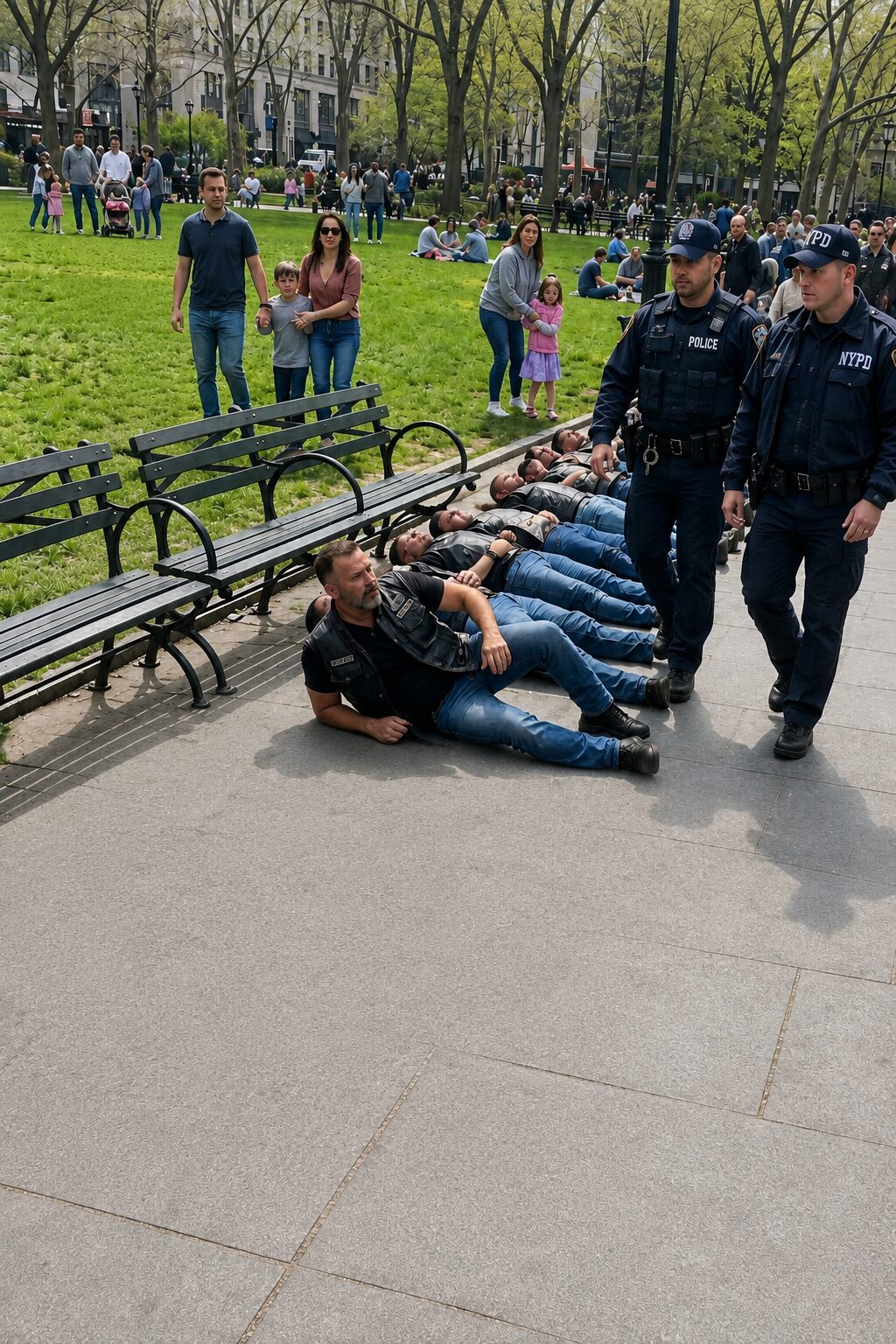
It was a clear Saturday afternoon in late September. Picnic blankets dotted the lawn beneath the maple trees, and a street performer strummed an old acoustic near the fountain. Children darted between the benches, laughing as they played tag. The park hummed with ordinary weekend life.
And then we rolled in.
Engines humming low and even.
Not roaring.
Not intimidating.
But impossible to ignore.
I parked my motorcycle by the east gate, right next to the weathered iron bench shaded by the ancient oak. The same bench that had been my shelter back when I was barely eighteen.
No banners.
No chants.
No speeches.
I removed my helmet, placed it on the grass, and stretched out flat on my back.
Arms straight at my sides.
Eyes fixed on the sky.
One by one, the rest of the crew did the same.
Leather jackets against cool green blades.
Boots still laced tight.
Complete silence.
In seconds, the easy weekend mood fractured into unease.
“What on earth are they doing?” a mother whispered, clutching her toddler.
A father tugged his daughter behind him.
Someone muttered, “Is this some kind of gang thing?”
From across the lawn it must have looked eerie—thirty riders lying motionless in formation, like a silent memorial in the middle of a family park.
Nobody had noticed the boy being escorted away half an hour earlier.
Nobody heard the cops tell him he couldn’t “loiter” on public property.
They only saw us now.
And phones were already lighting up with 911 calls.
The first squad car pulled up at 12:18 p.m.
Lights flashing, siren quiet.
An officer stepped out, hand hovering near his duty belt.
“What’s happening here?” he shouted across the grass.
None of us stirred.
That only ratcheted up the tension.
To the outside world it probably looked like a planned takeover—thirty leather-clad men claiming public ground without a word.
“Sir, you need to get up,” the officer said, walking straight toward me.
I stayed put.
Eyes still tracing the slow drift of clouds through the oak branches—the exact same view I used to lose myself in when this park was the only roof I had.
“Are you protesting something?” he pressed.
I didn’t reply.
Because this wasn’t politics.
This was about a scrawny kid with scuffed sneakers and a backpack that looked almost empty.
I’d spotted him hanging around the park for days.
Sleeping on that same iron bench by the fountain.
Not causing trouble.
Just trying to exist in a space that welcomed everyone—except him.
That morning, two officers had walked him out.
“Loitering,” they’d called it.
“Violation of the no-camping rule.”
He couldn’t have been older than twelve.
The cop moved closer.
“You’re disturbing the peace.”
More patrol cars arrived behind him.
Families were hurriedly folding blankets, snapping coolers shut, pulling kids away.
The park that had been full of music and laughter twenty minutes ago now felt charged with suspicion.
From their viewpoint it was obvious: a coordinated group of bikers refusing to move.
A deliberate occupation.
Something dangerous.
One officer knelt near my shoulder.
“If you don’t stand up, we’re going to have to physically remove you.”
I finally turned my head and met his eyes.
“Why?” I asked softly.
“Because you’re blocking public space.”
Public space.
The phrase landed like a stone.
“So was he,” I said, almost under my breath.
The officer’s brow furrowed. “Who?”
I didn’t explain.
Instead I reached slowly into the inside pocket of my vest.
Every cop in sight tensed.
Hands dropped to holsters.
The crowd murmured louder.
I pulled out my phone.
Typed four words.
“They took the kid.”
Hit send.
I didn’t say to whom.
Didn’t need to.
The air grew tighter, like a guitar string about to break.
Now it wasn’t just weird—it was thirty bikers defying direct orders in broad daylight.
The park suddenly felt a lot smaller.
The officer repeated himself, voice rising.
“Stand up. Right now.”
I remained on the ground.
I knew exactly what would happen next—and it wasn’t more sirens.
His shadow covered my face.
“You’re interfering with lawful use of public property,” he said. “Final warning.”
Behind him, two more cruisers eased in. No lights, just presence.
The families who hadn’t left yet stood at a safe distance, watching.
One voice carried across the lawn: “This is how things turn bad.”
Another answered: “They’re clearly trying to prove a point.”
They weren’t wrong.
We were.
But not the point they imagined.
The officer crouched again. “On three, we assist you up.”
I sat up then—not in defeat, but in perfect timing.
That was when I heard it.
Not sirens.
Not shouts.
Just small footsteps.
A quiet voice from near the fountain.
“Why are they all lying down?”
Every head turned.
And I knew the moment had arrived—the one that would either clarify everything or explode across the evening news.
The boy stood on the path, backpack hanging off one shoulder.
Same worn hoodie.
Same dirt-smudged sneakers.
He had wandered back.
Maybe out of curiosity.
Maybe because he had nowhere else.
The officers went rigid when they saw him.
“Hey,” one called sharply. “You can’t be here.”
The words carried extra weight now.
Because thirty of us were still on the grass.
The image was no longer abstract.
The kid looked over at us. “Are they in trouble?”
I stood up slowly.
Brushed the grass off my vest.
“No,” I said calmly. “We’re just resting.”
A handful of my crew rose with me—smooth, unhurried, no aggression.
The lead officer turned to me. “You’re staging this to create a spectacle.”
“No,” I answered. “You already created one.”
The line landed clean.
The boy shifted his weight, uncomfortable.
“I wasn’t hurting anything,” he mumbled.
I walked over to the iron bench beneath the oak.
The same one I’d called home for six long months.
After my father passed and the house was lost to bills.
No job. No family. Just stubborn pride and a backpack that got lighter every week.
I rested my hand on the backrest.
“You know how long I slept on this bench?” I asked the officer quietly.
He stayed silent.
“Six months.”
The crowd’s murmur shifted.
The story was starting to tilt.
The officer glanced at the boy, then back at me.
“You can’t promote this kind of thing.”
“I’m not promoting anything,” I said. “I’m just remembering.”
My phone vibrated twice in my pocket.
I didn’t check it yet.
The officer signaled his team.
Two more uniforms moved toward the line of riders.
Tension crackled, but my guys stayed disciplined—no sudden moves, no raised voices.
We weren’t here to clash.
We were here to reflect.
My phone buzzed again.
This time I looked.
“Outreach team two minutes out.”
Perfect.
From the west entrance, a white city-services van rolled in quietly.
The side panel carried the community support logo.
Two outreach workers stepped down.
One of them I knew well—Lila. She had helped three of our own years ago earn their high-school diplomas after they left county lockup.
The officers looked thrown off balance.
“This really isn’t necessary,” one muttered.
“Isn’t it?” Lila answered, steady and professional.
She walked straight to the boy and knelt so they were eye level.
She spoke gently—not about rules, but about possibilities.
A warm bed tonight.
A meal.
Real options.
The whole atmosphere in the park changed again.
The families who had stayed to watch were no longer scared.
They were paying attention.
The boy looked from me to Lila.
“You guys gonna get kicked out because of me?” he asked.
“Yeah,” I said with a small smile. “But not because they told us to.”
We hadn’t yelled.
We hadn’t waved signs.
We had simply lain down in the exact spot where he had been told he couldn’t stay.
And the contrast became impossible to miss.
The lead officer let out a long breath.
Not beaten—just rethinking.
“Next time,” he said to me under his breath, “maybe talk to us first.”
“Next time,” I replied, “maybe look twice before moving a kid.”
No anger.
Just honesty.
Lila guided the boy toward the van with a hand lightly on his shoulder.
He paused at the door and glanced back at the bench.
“You really slept there?” he asked me.
I nodded.
“Eventually got out, too.”
A tiny, uncertain smile crossed his face.
Then he climbed inside.
The park seemed to breathe again.
So did I.
Thirty motorcycles waited in their neat rows.
Engines still off.
No one whooped.
No one claimed victory.
Because this had never been about winning.
It had been about being impossible to overlook.
We didn’t roar away like some victory lap.
That would have ruined the point.
We left the way we arrived—steady, deliberate.
One by one my crew picked up their helmets.
A few blades of grass still clung to leather vests.
They brushed them off casually, as if the afternoon had been just another stop on a long ride.
But it hadn’t been nothing.
The officer who had been ready to haul us off now stood near the fountain, watching the outreach van disappear down the street.
He didn’t glare.
He simply gave me a single, slow nod.
The kind of nod that says the picture finally looked different.
Families drifted back onto the grass.
A little girl asked her mom why the “big motorcycle guys” had been sleeping.
This time her mother didn’t hush her.
She just answered softly, “They were trying to show us something.”
That was enough.
I walked back to the iron bench under the oak.
Ran my fingers along the chipped paint.
New initials had been carved since my time, and the city had tried to sand them away again.
Some marks refuse to vanish.
I remembered the chill of the sprinklers at sunrise.
The way the grass went damp and cold around three in the morning.
The way joggers looked straight ahead so they wouldn’t have to see me.
I remembered the heavy cloak of being invisible.
That boy carried the same weight today.
And for a little while, thirty grown men chose to wear it with him.
I wasn’t proud of those six months I spent on that bench.
But I wasn’t ashamed of them anymore either.
Because I understood something the city still struggled to see.
The line between “loitering” and “surviving” is usually just a matter of who’s looking.
One of my crew, Leo, walked up beside me.
“You all right, boss?”
“Yeah.”
“Think it made any difference?”
I watched the van turn the corner and vanish.
“Doesn’t have to solve the whole world,” I said. “Just has to make someone pause.”
He nodded.
That had always been our way.
We don’t escalate.
We interrupt.
When the engines finally turned over, the sound wasn’t loud.
It wasn’t a battle cry.
Just a low, steady rumble rolling across the park.
A reminder.
Not of threat.
Of presence.
As we pulled out, I caught the reflection in my mirror.
The officer had sat down on that same iron bench.
Just sitting.
Staring at the wood and metal like he was seeing it for the first time.
Maybe wondering how it would feel at night.
Maybe not.
Either way, something had shifted.
And that was plenty for one Saturday afternoon.
People will always notice the leather jackets before they notice the stories behind them.
They’ll assume the worst before they ask for the reason.
But if you lie still long enough in plain view, sometimes you force an entire city to look at what it’s been stepping over.
That bench is still there.
The oak still casts its shade at noon.
And if I ever see another kid being moved along like he’s damaging the grass simply by existing—
We’ll lie down again.
Not to fight.
Not to yell.
Just to make sure no one can look away.