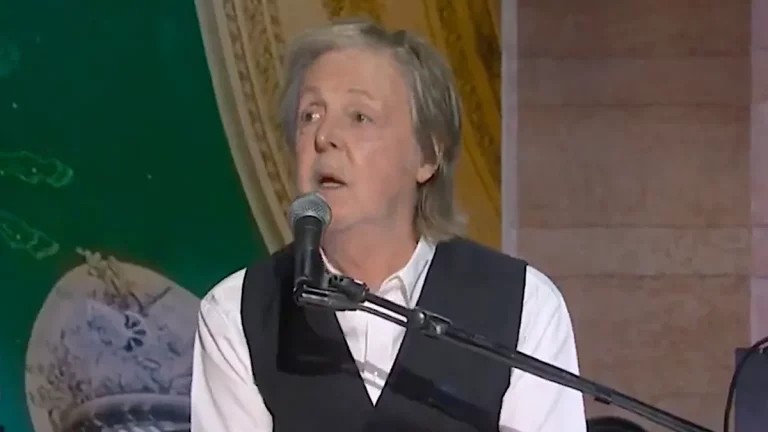
Paul McCartney is not a humble man by nature. That is not a criticism — it would be strange if he were. He co-wrote the most covered song in history (“Yesterday”), produced a body of work across six decades that has almost no parallel in popular music, and has been called a genius so many times and by so many people that it would be reasonable to simply accept it. He has written melodies that appear to arrive fully formed, as though they always existed and he simply had the good fortune to be nearby when they surfaced.
So when Paul McCartney says another musician makes him feel inadequate, you stop. You listen. Because this is not something he says often or lightly.
The musician is Stevie Wonder, and specifically Songs in the Key of Life (1976) — the double album that many music critics consider the greatest album ever made and that McCartney has referenced in interviews across decades with the kind of awe that never seems to diminish.
What makes Wonder’s achievement on that record so overwhelming is its totality. Wonder did not just write the songs. He wrote, arranged, produced, and played virtually every instrument himself. He sang everything. He constructed the entire world of that record from inside his own imagination — and then populated it with music of such harmonic sophistication, emotional range, and technical precision that musicians who have spent their careers studying it are still finding new things to admire.
“Sir Duke” is a joy so concentrated it’s almost physical. “Pastime Paradise” is a philosophical meditation that Coolio sampled for “Gangsta’s Paradise” — which became one of the most successful hip hop tracks ever — and the original is still more powerful than the sample. “As” is one of the great love songs in the American popular canon. “Isn’t She Lovely” was written for his newborn daughter and it sounds exactly like that — radiant with a love that has no ceiling.
McCartney has spoken about listening to Songs in the Key of Life and feeling not inspired, but genuinely daunted. The feeling that someone else was operating in a different category entirely. That is an extraordinary admission from a man who wrote “Eleanor Rigby” at 23 and “Blackbird” at 25.
There is a larger truth here about the Beatles mythology. People speak about Lennon and McCartney as the summit of songwriting — and by most measures, they are among the greatest partnerships in music history. But Wonder’s work in the mid-1970s — Innervisions, Talking Book, Fulfillingness’ First Finale, and the culminating masterpiece of Songs in the Key of Life — represents something that sits in its own category. It is music made by a man who was blind, who played by ear and feel, who translated an inner world of extraordinary richness into sound with a precision that technically sighted, technically trained musicians have never been able to fully replicate.
McCartney’s admission is the most honest thing about his character: that he is capable, despite everything he has achieved, of recognizing the thing he cannot touch.