My name is Marcus Webb.
I am thirty-eight years old. I live in Memphis, Tennessee. I work in automotive repair at a shop on Summer Avenue that is owned by a man named Pete Holloway who knew my situation when he hired me and hired me anyway, which is the kind of thing that sounds small until you understand that most places don’t.
I went to prison at twenty-six years old. I came out at thirty-two.
I am not going to tell you I was innocent, because I was not innocent. I am not going to tell you the sentence was unfair, because the sentence was the sentence and the judge applied the law and I had made choices that put me in front of that judge. I made those choices. They were mine.
What I am going to tell you is what six years looks like from the inside, which is this: it is long in the way that silence is long. It is not dramatic. It is not what the movies make it. It is days that look like the day before and the day before that, and you either build something inside that silence or you don’t, and the building is the only thing you have control over.
I built.
I got my GED in the first year. I got a vocational certification in automotive repair in year three. I read — I had not been a reader before, and I became one in a way that has not left me. I worked on myself in the specific, unglamorous way that is the only way that actually works, which is one day and then the next day and then the next, without a dramatic turning point, without a moment where everything changes, just the slow accumulation of days where you choose differently than you chose before.
I had no family waiting for me. My mother died when I was in year two. She died of a heart attack in February, and I was not there, and I will carry that for the rest of my life in whatever compartment a person keeps the things they cannot change. My father had been gone since I was eight. I had a sister in Atlanta who had cut contact before I went in — understandably, given the circumstances — and had not reestablished it.
I had one person.
His name is Terry Okafor. He was my roommate for the first two years of a community college I attended for one semester before my life took the direction it took. We were not close — we were friendly in the way of people who share a refrigerator and a zip code. He had gone on to get a degree, get a job, build a life. We had stayed in occasional contact in the loose way of people who have a shared history but live different presents.
When I went in, I wrote him a letter. I did not ask him for anything. I just told him what had happened and where I was, because it seemed like the honest thing to do with the one person who might not already know.
He wrote back.
He wrote back every month for six years.
Not long letters. Sometimes just a paragraph. Sometimes a card. But every month, without fail, something came with his handwriting on it. Updates on his life. A joke. A magazine article he thought I’d find interesting. Sometimes just: Still here. How are you holding up?
I don’t know if Terry Okafor understands what those letters were. I hope someday I can explain it adequately, which I don’t think I can. When you have nothing coming in from the outside world except what arrives in an envelope, a monthly letter from a man who owes you nothing is not a small thing. It is the evidence that you still exist in someone’s accounting of the world.
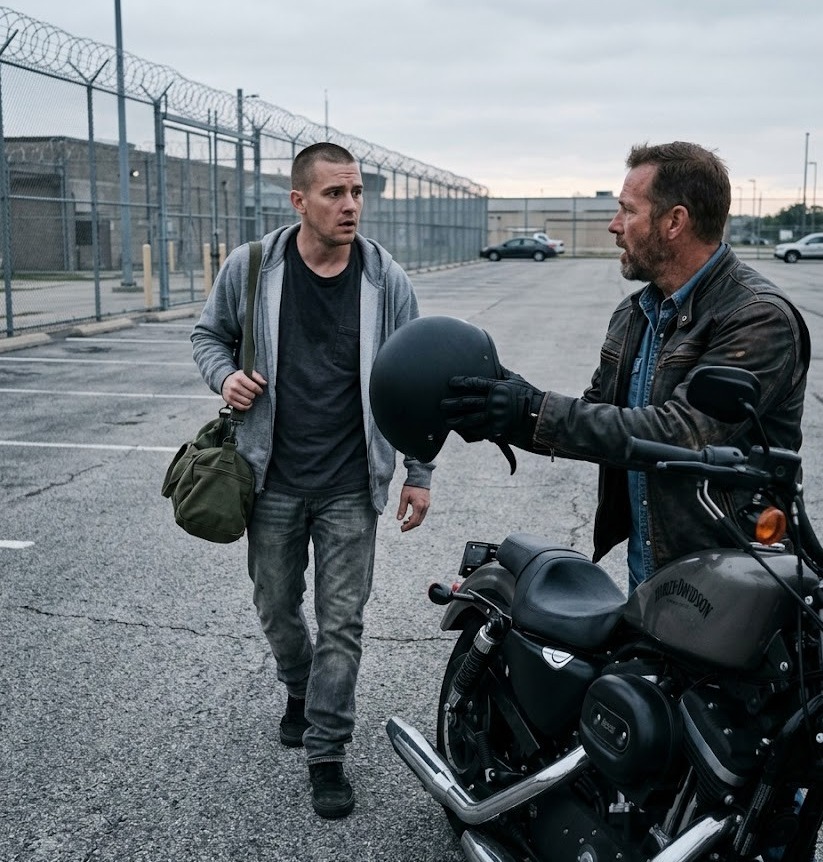
I was released on a Tuesday in September. Six-fifteen in the morning. Standard processing — property returned, paperwork signed, the particular institutional efficiency of a system that is very good at intake and considerably more indifferent to the exit.
They let you out a side door into a parking lot.
I walked out.
It was a cool morning. The sky was the specific color of early September in Tennessee, not quite blue yet, the light still low and pale. I had a bag with the things I had gone in with and a bus voucher for downtown Memphis.
There was one person in the parking lot.
A man sitting on a motorcycle. Parked along the fence, maybe fifty feet from the door. He was maybe fifty, heavyset, wearing a leather vest over a flannel shirt. He was looking at his phone.
When I came out the door, he looked up.
He said, “Marcus Webb?”
I stopped.
I said, “Yeah.”
He got off the bike. He reached into his saddlebag. He held out a helmet.
He said, “Terry sent me. He couldn’t get the time off work. He asked me to come.”
I stood there.
He said, “My name’s Dale. I ride with the Mid-South chapter. Terry and I have ridden together for three years. He called me last week and said his friend was coming home and he didn’t want him taking a bus.” He held the helmet out a little further. “You want a ride?”
I took the helmet.
We rode into Memphis on a Tuesday morning in September. I had been inside for six years. The last time I had been on a motorcycle was before I went in — a friend’s bike, once, for about twenty minutes, nothing significant. I had no particular attachment to motorcycles.
What I had, that morning, was the road.
I had the road coming at me and the city opening up around me and the particular feeling that I don’t have the right word for, of being outside and moving through the outside, of the air being something you are inside rather than something on the other side of a window. I had not felt that for six years and I had forgotten what it was and it came back all at once and I held onto the back of Dale’s vest and I did not say anything because there was nothing to say and because I did not trust my voice.
Dale took me to a diner on Union Avenue. He bought me breakfast. Eggs and toast and coffee and orange juice, and I ate all of it.
He didn’t ask me about what I’d done or what had happened. He asked me what I knew about cars, because Terry had told him about the vocational work. We talked about engines for forty-five minutes over breakfast.
He drove me to the address Terry had arranged — a room in a boarding house on the north side run by a man who worked with a reentry organization. The room was clean. There was a window.
At the curb, before he rode off, Dale stopped.
He said, “Terry’s coming down this weekend. He wants to take you to meet the chapter.” He paused. “No pressure. Just if you want.”
I said, “Why would a chapter want to meet me?”
Dale looked at me.
He said, “Because Terry vouches for you. And because you did six years and you came out the other side building something. That’s not nothing.” He started the bike. “Think about it.”
He rode away.
I stood on the sidewalk on the north side of Memphis on a Tuesday morning in September with a bag and a bus voucher I hadn’t needed and the feeling of the road still in my hands.
I met the chapter that weekend.
I did not join — I want to be honest about the order of things. I was not in a position to join anything for a long time. I needed to find my footing first, and finding my footing took the better part of two years — the job, the room, the slow rebuilding of a life from the materials you have left when you come out of something like that. The chapter was patient with the timeline in a way I had not expected and could not have asked for.
I have been a full member for four years now.
I have been at Pete’s shop for five years. I work on the kind of old Detroit iron that a lot of people have given up on, which suits me. Things that are broken can usually be fixed if you understand how they work and you’re willing to do the patient unglamorous work of doing it right.
That’s what I knew going in.
That’s what six years confirmed.
Terry Okafor was in the parking lot in spirit on a Tuesday in September when Dale said his name before I even knew what was happening. He sent someone because he couldn’t come himself, because that is who Terry is — when he says he’ll be there, he finds a way to be there.
I told Terry, the first time I saw him after I got out, that the monthly letters had kept me building when I would have stopped.
He said, “I just wrote.”
I said, “Terry. That was everything.”
He said, “Then it’s good I didn’t stop.”
It is good.
It is the reason I am here, on this side of the door, on a bike, in a chapter, at a job, in a life I built from the materials I had.
I came out a side door into a parking lot and a man I had never met said my name and handed me a helmet.
That was the first morning.
Every morning since has been built on top of it.