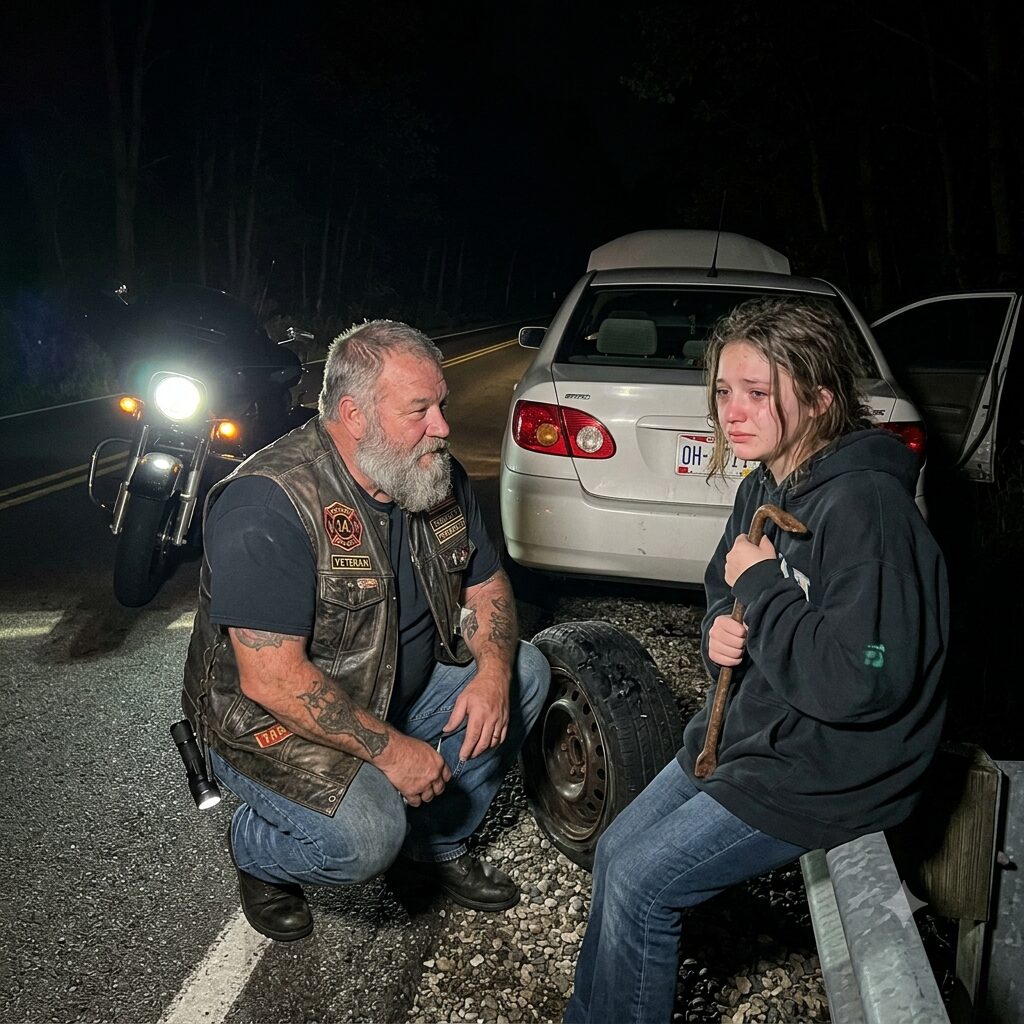
The humid night air on Route 42 usually smells like cut hay and damp asphalt, but that night, it smelled like sulfur and ozone. Heat lightning was fracturing the horizon, lighting up the silhouette of a white sedan stranded on the shoulder like a ghost car. Its hazards were dying, blinking out in long, agonized intervals.
I was sixty miles out from my own bed, my joints aching with the familiar stiffness of a sixty-three-year-old retired firefighter. Thirty-eight years on the trucks teach you to read a scene before your wheels even stop turning. As my headlamp swept across the sedan, I didn’t see a frustrated driver waiting for a tow.
I saw a girl, barely a teenager, dropped to her knees by the rear quarter-panel, clutching a cheap steel tire iron like a shield. She wasn’t looking at the lug nuts. She was staring at the wall of pine trees behind her, her shoulders hitched in violent, silent sobs.
That look. It’s the same look people give you when they’re trapped on a third-floor balcony with the room behind them fully involved. Pure, unadulterated terror.
I dropped my cruiser into second gear, circled back, and parked twenty feet behind her, leaving my high beam cutting through the dark to illuminate the space between us. The moment my boots touched the gravel, she scrambled up, backing against the rusted bumper, raising the iron.
“Don’t come near me!” she screamed, her voice cutting through the crickets. “I have mace! I swear to God I’ll use it!”
I stopped dead. I didn’t drop my hands, but I turned my palms up, flat and open. I was wearing my full club vest—the Firefighters MC rocker, the old Station 14 patch, the faded American flag. To a terrified kid, I probably looked like a nightmare rising out of the highway mist.
“I’m keeping my distance, kiddo,” I said, keeping my voice deep, slow, and level—the exact tone I used to use through smoke to find trapped civilians. “My name’s Rick. I’m a retired fire captain. I’ve got grease in my saddlebags and a jack that actually works. How about we just talk about the tire?”
“I don’t need you! I’m fine! Get out of here!”
She was vibrating with adrenaline, her knuckles white against the iron. But her eyes didn’t stay on me. They darted frantically to the trunk of the sedan, then back to the woods, then to the trunk again.
“Here’s the deal, Madison,” I said, guessing the name wouldn’t matter, but needing her to hear a human voice that wasn’t shouting. “You’re shaking so hard you’re going to drop that steel on your foot. The sidewall on that front tire is entirely shredded—meaning you’ve been running on the rim for ten miles. You’re out of gas or out of luck, and if I leave you here, I’m breaking my own code. So I can either sit on my bike and call the county sheriff to come give us a hand, or you can let me look at the wheel.”
The word sheriff hit her like a physical blow. Her face went translucent under the high beam. “No. No cops. Please. If they track the plates, he’ll know where we are.”
We.
That was the word that changed the temperature of the night.
Before I could ask, the car gave a slight, rhythmic shudder. Not from the wind. From inside the chassis. Then came a sound that made my chest tighten—a wet, muffled cough, followed by a child’s low, rhythmic whimpering coming straight from the trunk.
Madison dropped the tire iron. It hit the asphalt with a dull clink. She buried her face in her dirt-streaked hands and just broke. “Please,” she choked out. “They’re just little. They couldn’t breathe in the cabin if he woke up. I had to put them where they wouldn’t make noise until we hit the state line.”
I didn’t wait for permission. I walked past her, my heavy boots clicking against the road, and popped the manual latch on the trunk lid.
The interior light didn’t work, but my flashlight caught them. Three kids, packed into the small space like cargo, surrounded by a single garbage bag of mismatched clothes. Two boys, maybe eight and six, and a little girl no older than four clutching a cross-eyed stuffed bear. The oldest boy had a yellowing contusion blooming across his jawline; the middle one had three distinct circular scars on his forearm that I recognized instantly from my years responding to domestic calls. Cigarette burns.
“Maddy?” the oldest boy whispered, squinting into the LED glare. “Is it him?”
“No, Tyler,” Madison sobbed, leaning over the trunk lip. “It’s okay. He’s… he’s a fireman.”
I reached in, my large, scarred hands feeling monstrous against their small shoulders, and lifted them out one by one. The four-year-old, Lily, didn’t make a sound. She just locked her arms around my neck like a vice, her small face burying into the rough leather of my vest, smelling of stale smoke and old road dust.
Madison collapsed onto the rear bumper, her strength entirely spent. “Thirteen hours,” she whispered to the gravel. “From northern Ohio. He… he put the barrel of his service piece against my teeth last night because I didn’t wash the grease trap. He told me he’d finish the house this weekend. My mom was in the kitchen. She just turned the radio up.”
She looked up at me, her eyes massive in the darkness. “I have seventy-three dollars and my grandmother’s old address in Memphis. If you call the troopers, they have to notify the legal guardians. They’ll hand us right back to him.”
I looked at the shredded tire, the stolen car, and the four pieces of broken humanity sitting on the shoulder of Route 42. Every protocol I’d followed for thirty years told me to dial the dispatcher.
Instead, I pulled out my phone and hit speed dial for Jake, our club president.
“Rick? You still out on the ridge?” Jake’s voice was thick with sleep.
“I need the van, Jake. And call Marcus and Bill. Tell Marcus to bring his medical kit from the clinic, and tell Bill to leave his badge at home but bring his legal stationary. I’m three miles south of the old Mill Creek exit. Don’t use the sirens.”
“Ten minutes,” Jake said, and the line went dead.
For thirty minutes, we sat on the guardrail. I gave the kids the beef jerky from my saddlebags and let Tyler wear my heavy riding gloves. When the headlights of Jake’s Ford Econoline finally cut through the dark, followed by three other bikes, Madison scrambled back, terrified again. But these weren’t just random riders; these were guys I’d crawled through burning hallways with.
Marcus, a retired flight medic, didn’t say a word. He just knelt in the gravel with a penlight, checking pupils and gently touching the scars on the middle boy’s arm, his jaw tightening into iron. Bill, who spent twenty years in family law after his military discharge, sat with Madison on the bumper, a yellow legal pad on his knee, taking down names, dates, and the specific precinct where the stepfather worked.
“The plate’s already reported stolen out of Akron,” Bill said, walking over to me and Jake. “If we cross state lines with them in the van, technically it’s transport of minors across state lines. If the stepdad has friends in the department up there, he can trigger an Amber Alert by morning.”
“I don’t give a damn about the alert,” I said. “Look at the girl’s neck. Those aren’t old marks.”
Jake looked back at the kids, who were currently wrapped in Marcus’s wool emergency blankets, watching us like we were judges deciding their fate. “We don’t go to a shelter,” Jake said, wiping his beard. “The bureaucracy will hold them in the county system for forty-eight hours before they even look at the paperwork. By then, the Akron warrants will hit the teletype.”
“We take them straight to the grandmother in Memphis,” I said. “We run the back roads through Kentucky. No interstates, no toll booths. Bill, you call the Tennessee Department of Children’s Services from the road using the grandmother’s name. We file the emergency dependency petition in a jurisdiction where the stepdad has no pull.”
It wasn’t a legal plan. It was an tactical extraction.
We left the sedan right there on the shoulder, keys in the ignition, hazards finally dying completely. Madison and the little ones piled into the back of the Econoline with Marcus. I took the lead on my cruiser, my headlamp cutting a path through the humid southern night, while Jake and Bill formed a rear guard with the van between us.
We rode for five hours without a break, watching the mirrors for blue lights that never came. The heat lightning eventually turned into a steady, gray dawn as we crossed into Shelby County, Tennessee.
The grandmother’s house was a small, frame cottage with peeling blue paint and a concrete porch covered in fern pots. When the convoy pulled into the gravel drive, the front door flew open so hard the screen bounced off the siding. A woman in her late sixties, her hair in silver pin-curls, stumbled out into the damp grass.
Madison didn’t wait for the van door to open fully. She tumbled out, her boots catching in the weeds, and hit her grandmother at full speed. The old woman went down on her knees, wrapping her arms around Madison, then around Tyler, Mason, and Lily as they scrambled out behind her.
None of us spoke. We just stood by our hot engines, the exhaust pipes ticking in the morning air, watching a family stitch itself back together in the front yard.
The grandmother looked up at us—seven large, bearded men covered in road grime, leather, and tattoos. She didn’t look scared at all. She stood up, walked over to my bike, and reached up to touch the flag patch on my vest.
“I’ve been praying for a legal miracle for two years,” she whispered, her voice cracking with the gravel of west Tennessee. “I didn’t think the Lord would send them on Harleys.”
“We’re just the transport, ma’am,” Jake said, pulling off his helmet. “Bill here has the paperwork ready for the Memphis family court. They’re safe now.”
We stayed long enough to help move the kids’ single garbage bag into the back bedroom. Before we left, Madison walked out to the porch where I was checking my oil. She looked different in the morning light—smaller, but the frantic, wild look in her eyes had been replaced by a deep, heavy exhaustion.
“You could have just ridden past,” she said, her arms wrapped around herself. “Everyone else did.”
“My headlights were working fine, Madison,” I told her, tightening the oil cap. “I saw what I needed to see.”
She reached out and gave me a quick, awkward hug, her forehead pressing against the cold metal buttons of my vest. “Thank you for stopping, Captain.”
That was three months ago. The legal battle wasn’t clean—the stepdad tried to use his badge to cause trouble—but Bill’s documentation was airtight, and the Tennessee judge granted full permanent custody to the grandmother three weeks ago. The mother never called.
Every now and then, I still take the long way home via Route 42. The shoulder where the white sedan sat is empty now, just overgrown with chicory and wild clover. But every time my headlamp hits that spot in the dark, I don’t see the broken car anymore. I see four kids who made it out of the fire because someone bothered to look at the side of the road.