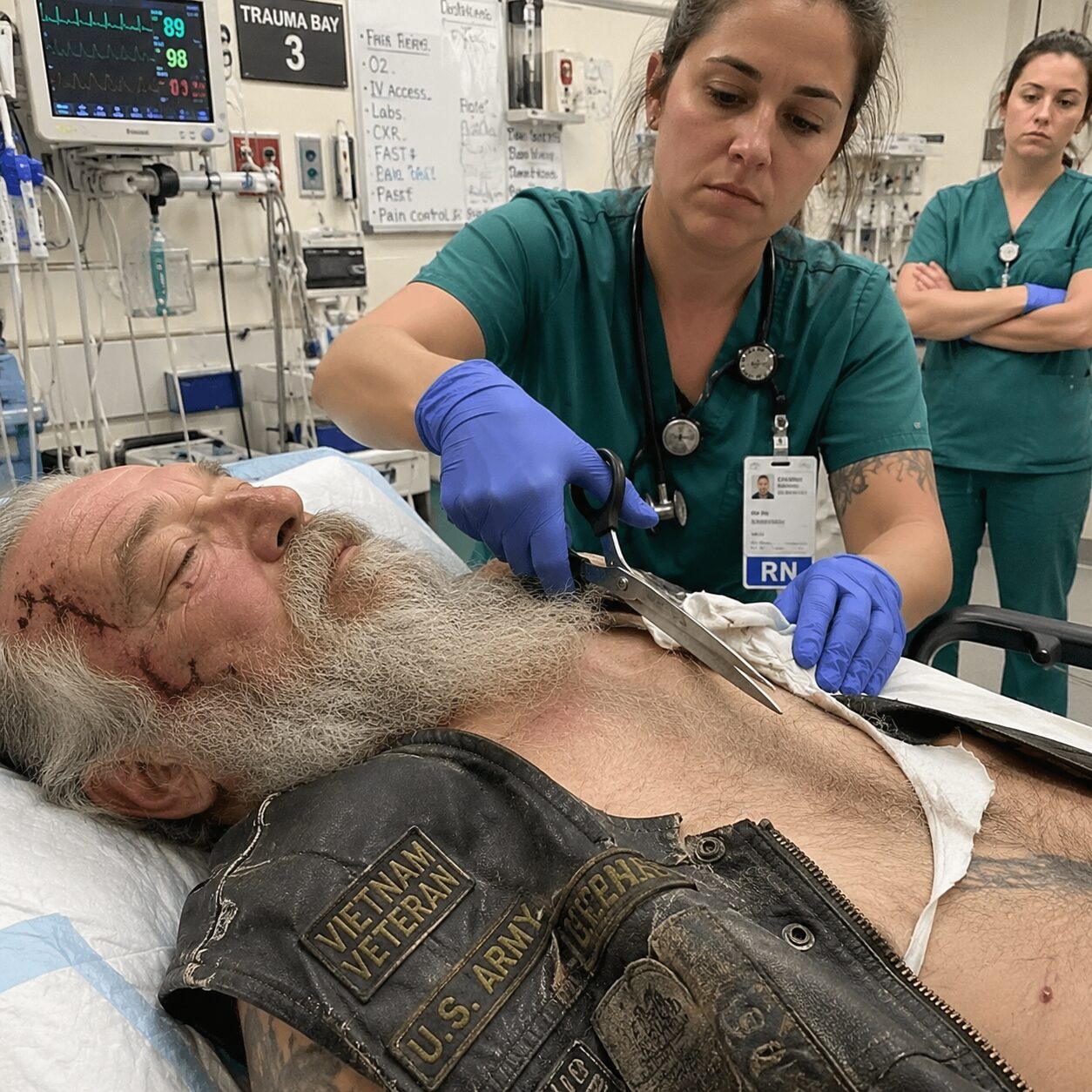
The grease under Herbert “Road Dog” Johnson’s fingernails was a permanent ledger of his sixty-eight years. It was a mixture of standard 10W-40, road grit from forty states, and the stubborn soot of a life lived in the open air. For thirty years, he had run Johnson’s Custom Cycles, a cavernous workshop on the city’s industrial fringe where the air always smelled of ozone, scorched steel, and stale black coffee.
To the world that didn’t understand the culture, Herbert was a formidable sight. Six-foot-two of weathered muscle, a silver-streaked beard that reached his collarbone, and a tapestry of ink covering his arms—most notably the faded insignia of the Veterans Motorcycle Association across his back. He looked like a man who had survived storms, and he had. But his greatest achievement, the one thing he treasured above his pristine Harley-Davidson Shovelhead, was his daughter, Alexandra.
When his wife, Sarah, died thirty years ago, the guys in the club didn’t tell Herbert to put his kid in daycare. They helped him raise her. The VMA, men with names like “Jake” and “Tack,” had taken turns rocking a pink-blanketed car seat on the grease-stained floor of the shop while Herbert rebuilt carburetors. Alex grew up with the roar of V-twin engines as her lullaby.
But then Alex went to college. She met a world that didn’t have grease under its fingernails. She became a high-powered corporate attorney, stepping into an world of tailored pantsuits, marble-floored boardrooms, and people who measured a man’s worth by his stock portfolio rather than his character. Slowly, quietly, a wedge of unspoken shame had driven itself between father and daughter. She loved him, but she had spent years asking him to park his Harley a block away from her apartment, hiding his motorcycle magazines when her colleagues visited, and desperately trying to distance herself from the “biker’s daughter” image.
Then came the rain-slicked Tuesday on Riverside Drive.
The stroke hit him mid-ride. The sudden neurological storm short-circuited his left side, but his muscle memory and combat instincts kicked in. Witnesses saw the big Harley swerve violently to avoid an oncoming silver Lexus that had recklessly cut into his lane. Instead of colliding head-on or letting the bike plow into a crowd, Herbert laid the machine down, absorbing the brutal impact against the steel guardrail. The Lexus sped off into the gray drizzle, leaving an old man bleeding on the asphalt.
When the ambulance wheeled Herbert into the emergency room at University Medical Center, the atmosphere was thick with casual, systemic contempt.
Jax sat in the corner of the trauma bay, paralyzed by shock. She was still wearing her thousand-dollar designer suit, but the medical staff ignored her, assuming she was just another bystander or a distraught associate of the “old biker.”
“Another organ donor who drove recklessly,” the ER doctor muttered under his breath, snapping on his latex gloves with an audible click. He didn’t realize Alex was within earshot, her ears ringing from panic.
Dad lay unconscious, still wearing his heavy leather vest. The back was adorned with combat patches from two grueling tours in Vietnam as a combat medic—medals of valor that these doctors didn’t bother to look at. His gray hair was matted with thick, dark blood, and his tattooed arms lay limp. The medical staff exchanged knowing, weary looks. One nurse even sighed loudly, complaining about the “smell of motorcycle grease and stale rain” as she aggressively cut away his clothes, tossing his prized leather vest onto a pile of medical waste.
They worked on him with obvious reluctance, writing him off as a reckless old man who had finally pushed his luck too far. To them, he was a drain on valuable ER resources.
Then, the nurse picked up his water-logged leather wallet to catalog his effects. Out fell a worn, laminated photograph. It was Alex, smiling brightly in her law school graduation gown, standing next to a fiercely proud Herbert who was wearing his only clean button-down shirt.
Alex watched the shift happen in real-time. Confusion replaced contempt. The staff looked from the photo of the prestigious university graduation to Alex standing in the corner in her power suit, and then down at the unconscious man. They realized this “old biker trash” had raised a daughter who became a successful attorney.
But the damage was already done. Alex had seen exactly how they treated her father when they thought no one who mattered was watching.
What they didn’t know was that Herbert wasn’t out joyriding. He was riding to his weekly volunteer shift at Children’s Memorial Hospital, where for ten years he’d been reading to kids in the cancer ward. They didn’t see the lives he had saved, or know about the motorcycle charity he’d founded that had raised over two million dollars for veterans’ PTSD treatment.
As Alex sat beside his hospital bed in the ICU that night, listening to the rhythmic, mechanical wheeze of the machine breathing for the strongest man she’d ever known, she gripped his calloused hand. The old shame she had carried for his lifestyle evaporated, replaced by a fierce, burning protective love and a cold, calculating fury. She made two promises to her unconscious father: that he would get the absolute respect and care he deserved from this moment forward—and that the hospital would deeply regret how they’d treated him.
Part II: The Ghost in the ICU
The morning after the accident, the ICU was quiet, save for the hum of monitors. Alex arrived early, her briefcase in hand, her eyes sharp and unforgiving. She had spent the night reviewing medical protocols and drafting formal complaints. She was prepared to raise hell.
What she found instead was her father awake, his eyes open but clouded with pain, struggling against the tubes in his throat. He was desperately trying to write something on a notepad the night nurse had left on his bedside table.
“Dad, don’t strain yourself,” Alex said, rushing to his side and gently holding his trembling right hand.
He shook his head frantically, his knuckles whitening as he forced the pen across the paper in shaky, uneven block letters. When he finished, he pushed the notepad toward her with a look of sheer desperation.
CHECK ON KATIE.
“Katie?” Alex asked, her brow furrowing. “Who’s Katie, Dad?”
Herbert made a weak writing motion again. Alex handed the pen back.
NEW GIRL. CANCER WARD. SCARED. PROMISED I’D BE THERE.
Alex stared at the note, a lump forming in her throat. Even lying in an ICU bed after cheating death, her father’s first thought was for a sick child who was waiting for him. That was the moment Alex knew exactly how she would dismantle the hospital’s prejudice. She didn’t need to threaten them with lawsuits yet; she just had to show them who Herbert “Road Dog” Johnson really was—beneath the leather, beyond the chrome, and behind the tattoos.
Dr. Mercer, the lead neurologist assigned to the case, delivered his assessment in the hallway outside. His tone was clinical, detached, and carrying a faint undercurrent of dismissiveness.
“The stroke occurred as a direct result of the head trauma from the crash,” Dr. Mercer explained, flipping through a digital tablet. “We’ve managed to temporarily relieve the pressure on his brain, but there’s still significant, unpredictable swelling. The next 72 hours are critical.”
“And his prognosis?” Alex asked, her voice steady, her professional armor firmly in place.
Dr. Mercer hesitated, offering a patronizing tilt of his head. “Ms. Johnson, given your father’s advanced age and the violent nature of his lifestyle choices, you should prepare yourself for the possibility of severe permanent deficits. Speech impairment, left-sided paralysis, cognitive decline—all are highly probable.”
“He is awake, and he is communicating,” Alex pointed out coldly.
“Yes, which is an encouraging reflex,” Dr. Mercer countered. “But it’s very early. Furthermore, I should mention that the trauma team noted cannabis in his toxicology report. It’s in his bloodwork.”
The implication hung in the air like a foul odor. Another strike against the old biker.
“Medical marijuana,” Alex clarified, her voice dropping an octave, striking with the precision of a cross-examination. “Legally prescribed by the Veterans Affairs administration for his severe, service-related PTSD. Which would be clearly indicated in his medical history if anyone on your trauma team had bothered to pull his file before making assumptions based on his appearance.”
Dr. Mercer shifted his weight, looking slightly abashed. “I see. Well, I’ll make sure that’s explicitly noted in his chart.”
“You do that, Doctor,” Alex said, stepping closer, her heels clicking sharply on the linoleum. “And while you’re updating his chart, you might want to include that before retiring, Herbert Johnson was a highly decorated combat medic with more field trauma experience than half your ER staff. He saved dozens of young men under enemy fire in Da Nang. He has been a verified volunteer at Children’s Memorial for a decade. And he has a daughter who is a partner at a major firm, who knows exactly what standard of care is legally required, and who will be personally auditing every single chart entry, medication dosage, and nursing log. Am I making myself clear?”
Dr. Mercer swallowed hard, his clinical detachment cracking. “Perfectly clear, Ms. Johnson. He will receive our utmost attention.”
Part III: The Wall of Witnesses
Alex returned to the room and found the afternoon nurse, Nurse Patel, adjusting the IV lines. Her movements were efficient but cold.
“Nurse Patel,” Alex said quietly. “My father is deeply concerned about a patient at Children’s Memorial named Katie. He was supposed to read to her today. Could you help me find a contact number for her ward so I can let them know he’s been delayed?”
Nurse Patel paused, looking over her shoulder. “He volunteers with sick children?”
“Every single Wednesday for ten years,” Alex said, pointing to the empty chair by the bed. “The kids call him ‘Grandpa Road.’ Some of them don’t have families of their own. He builds custom wooden toy motorcycles for them in his spare time.”
A look of genuine surprise flickered across Patel’s face. She looked at Herbert’s tattooed arm, then back to Alex. “I… I didn’t know that. I’ll get you the direct line to the oncology child-life specialist.”
“Thank you,” Alex said. “I imagine there’s a lot about my father that would surprise this unit.”
By mid-afternoon, Alex’s counter-offensive began. Her first call had been to Melissa, the head of volunteer services at Children’s Memorial. The reaction on the other end of the line had been instantaneous panic and profound grief. “Not Road Dog,” Melissa had gasped. “The kids will be devastated. Tell us what we can do.”
Alex’s second call was to Jake Martinez, her father’s oldest friend and the vice president of the VMA. Jake’s response had been simple: “The brotherhood is mobilizing, Alex. Give us the coordinates.”
Around 4:00 PM, the first crack in the hospital’s clinical wall occurred. A young orderly who had been curt and dismissive the night before quietly slipped into the room. He wasn’t holding medical supplies; he was holding a dog-eared, vintage copy of Classic Motorcycle Magazine.
“Found this in the breakroom,” the orderly mumbled, not looking Alex in the eye. “Thought… well, thought your dad might want something familiar to look at when he wakes up fully.” He glanced at Herbert’s unconscious form. “My older brother rides. Takes a lot of guts to handle a heavy Shovelhead on wet roads. Respect.”
“Thank you,” Alex said softly. “That means a lot to him.”
But the real shift happened at 5:30 PM. The ICU doors slid open, and a small, strange procession walked in, defying all standard visitation protocols.
It was Melissa from Children’s Memorial, accompanied by a pediatric nurse, wheeling a tiny, seven-year-old girl named Katie. The little girl’s head was covered by a bright purple silk scarf, her pale face dominated by massive, solemn brown eyes. In her lap, she held a large cardboard box overflowing with bright, chaotic colors.
“Ms. Johnson?” Melissa whispered. “We had to come. Katie refused to eat her dinner until she saw him. The hospital administration tried to block us, but we made a scene.”
Katie looked up at Alex, her voice small but fierce through her surgical mask. “Grandpa Road promised he’d be there when I had my scary red medicine today. He never breaks a promise. I knew he must be fighting a monster.”
Alex knelt down, her eyes tearing up. “He is fighting a monster, Katie. But he’s very strong. Would you like to see him?”
Katie nodded. Alex wheeled her right up to the bedside. Herbert’s eyes fluttered open at the sound of the child’s voice. The monitors gave a sudden, rhythmic spike as his heart rate quickened with recognition.
“Grandpa Road!” Katie chirped, reaching out her tiny hand to touch his uninjured right arm. “You look silly in that gown. Where’s your cool vest?”
Herbert couldn’t speak, but a profound, deep warmth filled his eyes. A single tear traveled down into his silver beard.
“I brought you the army,” Katie said, lifting the cardboard box. Inside were dozens of handmade cards, glitter-covered drawings of motorcycles, and letters from the children’s cancer ward. She then reached into her pocket and pulled out a small, well-loved plush dog wearing a miniature leather bandana.
“This is Brave,” Katie explained, placing the toy directly next to Herbert’s hand. “You gave him to me when I was scared of the needles. Now it’s your turn to borrow him. You have to keep him safe until you come back to finish Treasure Island. You do the best pirate voices, and nobody else can do Long John Silver right.”
Herbert’s fingers twitched, slowly curling around the small plush dog. He gave a weak, trembling thumbs-up.
In the doorway of the ICU room, a crowd had gathered. Nurse Patel, two other trauma nurses, an X-ray technician, and Dr. Mercer stood in absolute silence, watching the little girl comfort the terrifying old biker. The stark, undeniable reality of Herbert’s humanity hit the room like a physical blow. The cards were taped to the glass walls of the room—bright, colorful shields protecting an old warrior from the cold judgment of the institution.
Part IV: The Iron Vanguard
The following morning, the ground began to shake.
It started as a low, ominous vibration that rattled the windowpanes of University Medical Center’s executive suites. To the hospital staff, it sounded like an approaching storm. To Alex, standing by her father’s window on the fourth floor, it sounded like family.
Nearly fifty motorcycles rolled into the hospital’s main parking lot in perfect, military-grade double-file formation. There was no revving, no chaotic shouting. It was a silent, disciplined show of force. The riders—men and women, young combat vets from Iraq and Afghanistan, older survivors of Vietnam, mechanics, teachers, and business owners—dismounted in absolute unison. They took off their helmets, revealing a sea of determined faces, all wearing the leather vests of the Veterans Motorcycle Association.
The hospital security team panicked, immediately calling the local police. But within minutes, Officer Rivera, a veteran traffic cop, arrived on the scene. Instead of dispersing the crowd, Rivera dismounted his police cruiser, walked straight over to Jake Martinez, and shook his hand.
“How’s Road Dog?” Rivera asked loudly, loud enough for the gathering hospital executives to hear. “He’s been teaching our police cadets motorcycle safety for twelve years. Half the guys on the force wouldn’t be alive on these streets without him.”
“He’s fighting, Rivera,” Jake growled, his massive six-foot-four frame casting a long shadow. “And we’re staying right here until he wins.”
Upstairs, the shift in atmosphere was total. The hospital administration had realized that the man they had dismissed as “biker trash” was a community pillar with an army of protectors and a daughter who could legally dismantle their charter.
Dr. Mercer entered Herbert’s room with a stack of fresh neurological scans, his demeanor completely changed. He was no longer detached; he looked deeply concerned and intensely focused.
“Ms. Johnson, Mr. Martinez,” Dr. Mercer said, addressing Jake, who had come up as the sole club representative. “The latest MRI shows that the cerebral swelling has hit a critical threshold. The medication isn’t holding it back. We need to perform an emergency partial craniectomy to relieve the pressure on his brain.”
“Brain surgery,” Alex whispered, her hands tightening around her briefcase.
“Yes,” Dr. Mercer said. “We remove a portion of the skull to let the brain swell without crushing itself. Given his age, the survival and recovery rate is about sixty percent. Without it… it’s fatal.”
Herbert, awake but weak, held out his right hand. Alex placed the notepad in his lap. With immense effort, his hand shaking violently, he scrawled two words:
DO IT.
As they prepped him for surgery, the ER doctor who had made the cruel “organ donor” comment the night before slipped into the room under the guise of checking the arterial line. He looked pale, his eyes darting toward the walls covered in children’s drawings and veterans’ patches.
Alex stopped him before he could touch her father.
“I know what you said when he was brought in,” Alex said, her voice a dangerous, quiet whisper that cut through the room. “You thought he was a statistic. You thought nobody loved him. If my father dies on that table, Doctor, I won’t just sue this hospital. I will make it my life’s mission to ensure the medical board strips your license for premeditated bias and negligence. Walk away from him.”
The doctor went white, stuttered an apology, and backed out of the room.
Before the orderly wheeled Herbert toward the operating theater, Alex leaned down, kissing his weathered forehead. “Fight, Dad. Little lawyer’s orders.”
Herbert gave her hand one last, reassuring squeeze.
Part V: The Code of the Road
The surgery lasted an agonizing six and a half hours. Outside, in the waiting room and lining the sidewalks of the hospital property, fifty bikers sat in silent vigil. They didn’t leave. They bought coffee for the hospital staff, cleared trash from the parking lot, and stood like an iron vanguard protecting one of their own.
When Dr. Mercer finally emerged from the surgical suite, he was wiping sweat from his brow, but a genuine smile broke through his exhaustion.
“The pressure dropped immediately upon removal of the bone flap,” Mercer announced. “His vitals never wavered. His heart is incredibly strong. Now, we wait for the waking process.”
Over the next forty-eight hours, the ICU room became a sanctuary. The hospital staff no longer saw a stereotype; they saw a legend. Nurses took turns carefully adjusting “Brave” the stuffed dog next to his pillow. They played the CD that Katie and the children had recorded—a beautiful, chaotic track of children’s voices laughing, singing, and shouting, “Get better, Grandpa Road! We love you!”
On the third day, the sedation was completely removed. Herbert’s eyes snapped open, clear and sharp.
His speech was slurred, his left side heavily weakened, but the core of the man was entirely intact. He looked at Alex, then at the wall of cards, and finally at his daughter’s hand resting in his.
With great effort, he raised his right hand, extending his thumb, index finger, and pinky finger. The American Sign Language sign for ‘I love you.’
Alex broke down, burying her face in his shoulder, the last remnants of her childhood embarrassment and societal shame washing away in a wave of tears. “I love you too, Dad. I’m so proud to be your daughter.”
That afternoon, Officer Rivera returned to the room, accompanied by a senior investigator.
“We got him, Ms. Johnson,” Rivera said triumphantly. “The driver of the silver Lexus. A prominent corporate executive named Arthur Vance. He admitted to making the illegal cut, seeing your dad crash in his rearview mirror, and fleeing because he didn’t want his insurance rates to spike. We’ve charged him with felony hit-and-run, reckless driving causing severe bodily injury, and destroying evidence.”
Jake Martinez clenched his fists, a dark scowl crossing his face. “The bastard could have killed you, Road Dog. Alex, give the word. We’ll file a civil suit that will strip that executive down to his penny loafers.”
Everyone turned to Herbert, waiting for the righteous anger of an old warrior.
Herbert swallowed hard, his voice rough, raspy, and slow, but holding the absolute authority of a man who had seen the worst of humanity and chosen grace instead.
“Let it… go,” Herbert whispered, his slurred words cutting through the room.
“Dad, he almost took your life,” Alex protested, her legal instincts flaring.
Herbert shook his head slightly, his eyes resting on the children’s drawings, the plush dog, and the faces of the people packing his room.
“Guy has to live… with what he did,” Herbert said, a faint, beautiful smile breaking through his silver beard. “Don’t want to waste… what time I got left… on anger. Got too many stories… left to read.”
Alex looked from her father to the medical staff standing respectfully at the edge of the room, and then out the window at the brotherhood waiting below. The hospital had changed. She had changed. Her father hadn’t needed a lawsuit or a riot to demand respect; he had simply allowed the truth of his life to shine through the armor of his leather.
“Okay, Dad,” Alex said, letting go of her briefcase and smiling through her tears. “No anger. Let’s just get you back to the book room.”