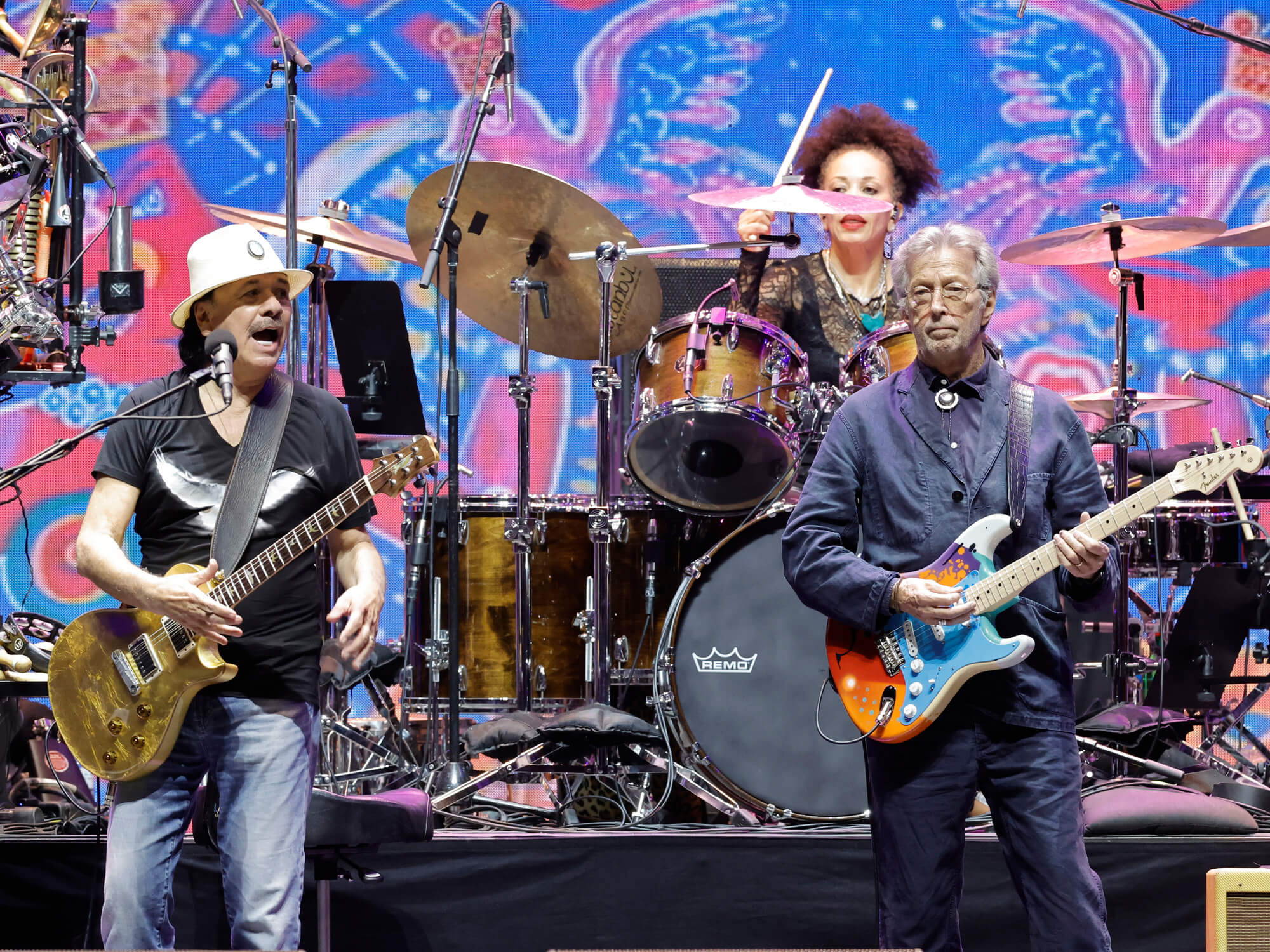
Carlos Santana occupies a position in guitar history that is both precisely defined and deeply mysterious — precisely defined in the sense that his tone, his vibrato, his specific relationship with sustain and with the space between notes, is immediately identifiable from the first second of any recording he appears on, and deeply mysterious in the sense that the guitarists who have spent the most time studying those qualities have been the most emphatic about their inability to replicate them. He sounds like himself in a way that very few guitarists achieve — a sound so singular that copying it requires first understanding how it is produced, and understanding how it is produced turns out to be more difficult than the apparent simplicity of his approach suggests.
1. John Mayer
Mayer has cited Santana as one of the primary influences on his understanding of tone and sustain — the qualities of his guitar sound that he has spent the most deliberate effort developing. He has said he spent years of his career attempting to produce the specific quality of Santana’s sustained note — the way Santana holds a note and allows it to develop after the initial attack, bending it, vibrating it, letting the overtones emerge — and has said that what he eventually understood is that the tone is not primarily about the guitar or the amplifier but about the relationship between Santana’s hands and the strings, which is not something that can be transferred by studying the equipment.
2. Gary Moore
Moore was a technically formidable Irish guitarist whose combination of blues sensibility and technical precision placed him among the most respected guitarists of his generation. He has spoken about Santana with the specific respect of one technically accomplished guitarist for another whose technique operates on different principles — Moore’s approach was rooted in blues precision and speed, Santana’s in melody and sustain, and Moore recognized in Santana’s approach something his own technique, however accomplished, did not produce. He said he could play faster than Santana. He said he could not play more beautifully.
3. Kirk Hammett
Metallica’s lead guitarist — a technically extraordinary player in the thrash metal tradition — has said that Santana was one of the first guitarists he studied seriously as a teenager, before the music he ultimately made found its form. He has said that understanding Santana’s relationship with melody — the way Santana constructs a solo as a narrative rather than as a demonstration — was foundational to his own understanding of what a guitar solo was for, even though what he subsequently did with that understanding was entirely different from anything Santana produced.
4. Slash
The Guns N’ Roses guitarist who became one of the most recognizable figures in rock has spoken about Santana with the specific combination of admiration and helplessness that characterizes the responses of guitarists who have tried to get inside what Santana does. He has said he can analyze the notes Santana plays — the scales, the patterns, the positions. He has said he cannot analyze what happens between the notes, which is where Santana’s actual music lives.
5. Robbie Robertson
The Band’s guitarist — one of the most respected musicians of his generation, a man who produced guitar work of extraordinary taste and restraint — has spoken about seeing Santana at Woodstock and understanding something that the performance communicated which his own approach to the guitar had not previously accessed. He has said Santana’s physical relationship with the instrument — the way his whole body participates in the sound — produced something that pure technique in the conventional sense cannot account for.
6. Prince
Prince’s admiration for Santana has been expressed most directly through his decision to invite Santana to play on specific projects — a form of acknowledgment that goes beyond verbal compliment. He has said in interviews that Santana’s tone is the most beautiful electric guitar tone in the history of the instrument — a statement that, from someone whose own tone is immediately recognizable and who has thought carefully about every element of his sound, is the most specific kind of compliment a guitarist can give another guitarist. He has not said he ever got close to replicating it. He hasn’t claimed to have tried.
Santana is in his seventies and still touring. The tone — produced by a combination of equipment, technique, and something that the people who have studied him most carefully have been unable to fully locate or name — is still there. He still sounds only like himself.