Three weeks ago, the phone shattered the silence of our quiet suburban house at 2:17 a.m. I bolted upright in bed, heart already hammering before my hand even found the receiver. My wife Sarah mumbled something beside me, but I was already speaking.
“Dad?” Kayla’s voice was barely a whisper, raw and shaking. “Dad, I think someone’s following me.”
I sat up straighter, every nerve suddenly on fire. My twenty-two-year-old daughter, the same little girl who used to hide behind my legs at the grocery store, sounded terrified. She lived thirty minutes away with her boyfriend Tyler in a small apartment near the edge of the city. She worked part-time at a coffee shop downtown while finishing her last semester of community college. She was supposed to be safe.
“Kayla, slow down. Tell me exactly what happened.”
She took a ragged breath. “I went to the gas station after my shift. It was late, but I needed to fill up before morning. This big Harley pulled up next to me at the pump. Same guy again. Gray ponytail, leather vest, tattoos all the way up his arms. He got off the bike and just… stood there watching me. When I tried to hurry, he started walking over. Said something like ‘You don’t have to be scared.’ I jumped in the car and locked the doors. He didn’t chase me, but Dad… he keeps showing up. Grocery store last week. Outside work two days before that. Always the same guy. Always trying to talk to me.”
I felt the old protective rage rise fast and hot. I wasn’t a fighter. I was an accountant who wore khakis and drove a sensible sedan. I balanced spreadsheets for fun on Saturday mornings and coached my daughter’s softball team until she turned eighteen. But nobody—nobody—scared my little girl.
I told her to lock every door, keep her phone charged, and call the police if she saw him again. She promised she would. I lay awake until dawn, staring at the ceiling, replaying every conversation we’d had in the last few months. She’d seemed tired lately. Distant. She canceled two Sunday dinners in a row, always with some excuse about Tyler needing her or being sick. I’d told myself it was just young love, the way couples get wrapped up in each other.
I was wrong.
By Saturday morning the worry had curdled into something darker. I went out to the garage, dug through the old sports equipment until I found the wooden baseball bat Kayla had used in high school. The grip still had her name written in faded marker. I wrapped my hand around it, tested the weight, and slid it into the trunk of my car. I didn’t tell Sarah. I didn’t tell anyone. I just drove.
Kayla had mentioned the biker worked on motorcycles and lived near the old industrial park on the west side. I spent two hours circling until I spotted the black Harley parked in front of a weathered single-car garage. The house was small, paint peeling, but the bike gleamed like it was someone’s pride and joy. I parked half a block away, killed the engine, and sat there gripping the steering wheel until my knuckles went white.
This was it. I was going to end this.
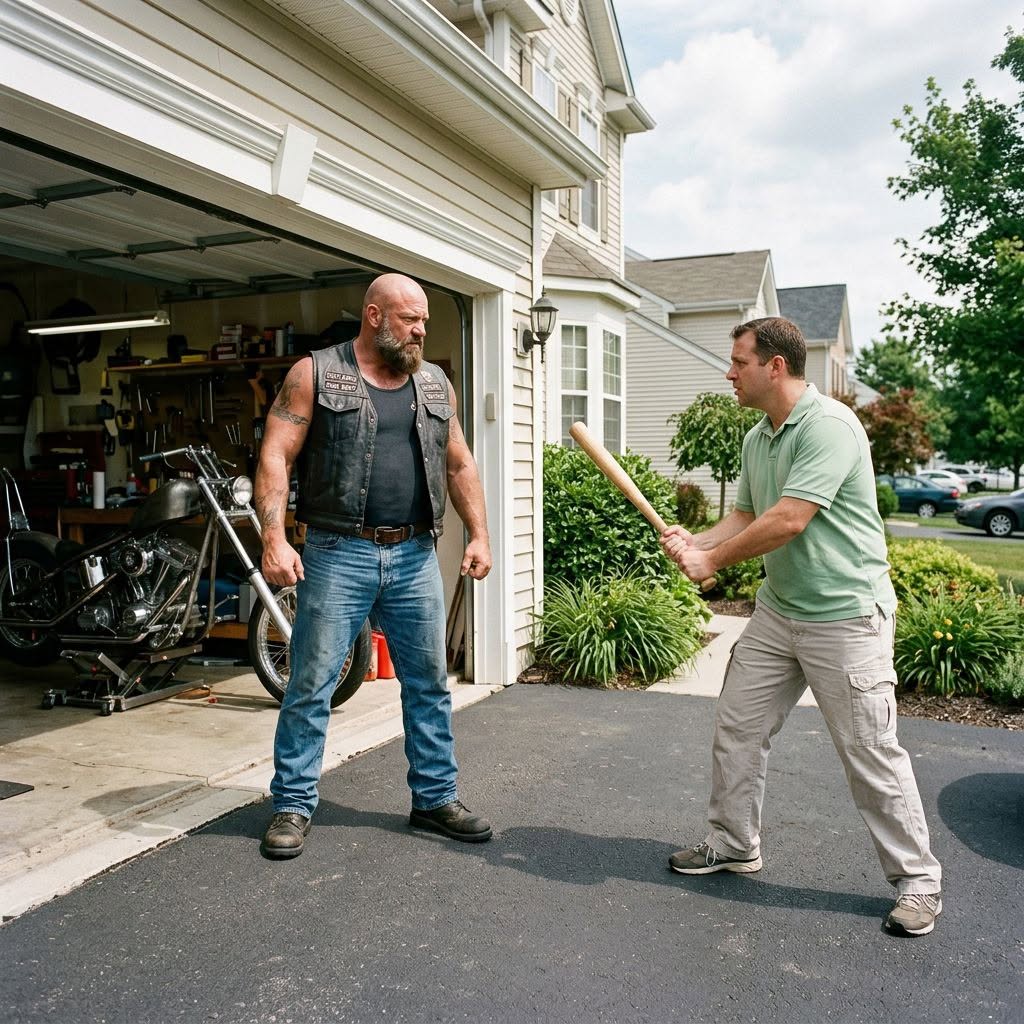
I grabbed the bat from the trunk and walked up the cracked driveway. My heart pounded so hard I could hear it in my ears. The garage door stood open. Inside, a big man in a black T-shirt and faded jeans bent over a motorcycle, wrench in hand. Gray ponytail hung down his back. Arms covered in faded tattoos—eagles, skulls, a name I couldn’t read from this distance. He looked exactly like the monster my daughter had described.
I stepped into the rectangle of sunlight spilling across the concrete floor.
“You Ray Dalton?”
He straightened slowly. His eyes flicked to the bat in my right hand, then back to my face. He didn’t flinch. Didn’t reach for anything. Just studied me the way a man studies a storm on the horizon.
“I’m Kayla’s father,” I said, voice shaking with fury I could barely contain. “Stay the hell away from my daughter.”
For a long second he didn’t move. Then something shifted behind his eyes—not anger, not even surprise. Sadness. Deep, bone-deep sadness that made him look older than his years.
“Put the bat down,” he said quietly. His voice was rough, like he didn’t use it much. “There’s something you need to see.”
I didn’t lower the bat. “I’m not here to talk.”
“I know why you’re here,” he said. “And I’m not gonna fight you. But if you want to help your daughter, you’ll put that bat down and look at this.”
He pulled a phone from his back pocket, thumbed the screen, and turned it toward me. The photo showed a gas station at dusk. My daughter stood at the pump, reaching for the nozzle. Her sleeve had ridden up past her elbow. Even in the grainy shot I could see the bruises—dark purple fingerprints circling her upper arm like a bracelet. Below them, older yellow-green marks layered on top of each other.
My stomach dropped so fast I tasted bile.
“That’s not from falling,” Ray said softly. “That’s someone grabbing her hard enough to leave marks that last.”
The bat suddenly felt impossibly heavy. It slipped from my fingers and clattered onto the concrete.
Ray swiped to another photo. A young woman with long brown hair and a smile that could light up a room. She looked so much like Kayla it hurt to breathe—same eyes, same tilt of the head, same brightness that had been missing from my daughter’s face for months.
“My daughter,” he said. “Melissa. She was twenty-four.”
He looked away for a second, jaw working like he was chewing glass.
“Her boyfriend beat her to death four years ago.”
The world narrowed to a pinpoint. I couldn’t hear the traffic outside anymore. Couldn’t feel my own heartbeat.
“She called me the first time he hit her,” Ray continued, voice cracking. “I drove over ready to kill the son of a bitch. But she begged me to back off. Said it was a misunderstanding, that he loved her, that it wouldn’t happen again. I backed off because I was scared she’d stop talking to me. Scared I’d lose my little girl.”
He swallowed hard.
“March 14th, the hospital called. Brain swelling. Internal bleeding. He’d beaten her for almost two hours straight. She never woke up. I sat by her bed for three days listening to machines breathe for her until the doctors said there was nothing left. I held her hand when they turned everything off.”
Tears burned behind my eyes. I couldn’t stop them.
Ray handed me a small, battered notebook. The pages were filled with neat, careful handwriting.
March 3: Long sleeves in 92-degree heat. Bruises visible when she reached for something on a high shelf at the store. Flinched when a car backfired in the parking lot.
March 17: New bruise near her collarbone. Covered it with a scarf even though it was eighty-five degrees. Boyfriend called her phone six times in twenty minutes while she was grocery shopping alone.
March 29: She parked three blocks from work and walked the rest of the way. Looked over her shoulder the whole time. Tyler’s truck was in the lot but she didn’t go near it.
April 4: Canceled dinner with her dad again. Said she had the flu. Voice sounded like she’d been crying.
The entries went on for pages. Dates, times, observations. Small, quiet details only someone who was truly watching would notice.
“When I first saw Kayla,” Ray said, “I saw Melissa all over again. Same fear in her eyes. Same way she tried to make herself smaller. And I wasn’t gonna lose another daughter. Not if I could help it.”
I sank onto an old metal stool in the corner of the garage. The bat lay forgotten on the floor between us. For the first time in my life I understood what it meant to have the ground drop out from under you.
I drove home in a daze. Sarah took one look at my face and didn’t ask questions. I sat at the kitchen table until three in the morning, the notebook open in front of me, and let every missed sign crash over me like a wave.
The bruised cheek Kayla blamed on a kitchen cabinet. The canceled dinners. The way Tyler always answered her phone now, cheerful and controlling. The turtlenecks in the middle of summer. The way she stopped sending photos of her and Tyler together. The way she stopped smiling in the ones she did send.
I had seen it all and explained it away because the alternative was too terrifying to face.
Monday morning I drove straight to the coffee shop where Kayla worked the early shift. I waited until she had a break and pulled her into the back hallway near the employee lockers.
“Is Tyler hurting you?”
She tried to laugh it off at first. Then she saw my face—the same face that had once promised her I would always protect her—and the walls crumbled. She slid down the wall until she was sitting on the linoleum, arms wrapped around her knees, sobbing so hard she could barely breathe.
Fresh bruises ringed her wrist where her sleeve had ridden up. Darker ones peeked above the collar of her shirt.
“He said if I leave again he’ll make it worse,” she whispered. “He said no one would believe me. That he’d tell everyone I’m crazy. He already made me quit seeing my friends. He checks my phone every night. Last week he…” Her voice broke. “He put his hands around my throat because I didn’t answer fast enough.”
I called Ray from the hallway while Kayla cried into my shoulder.
“When does he leave for work?” was all Ray asked.
“Six-thirty. Construction site across town.”
“I’ll be there at seven with two of my brothers. Tell Kayla to pack only what she can carry in one trip. We’ll do the rest.”
That night the three of us—me, Kayla, and Ray—met in the parking lot of a twenty-four-hour diner two blocks from her apartment. Ray had brought two other men, both built like brick walls, both wearing the same kind of leather vest. They didn’t ask questions. They just nodded when Ray introduced me and Kayla.
We waited until Tyler’s truck pulled out of the lot at 6:42 a.m. the next morning. Then we moved.
The apartment was on the second floor. One of Ray’s friends—everyone called him Tank—stayed downstairs with a radio, watching the parking lot. The rest of us went up.
Kayla’s hands shook so badly she could barely get the key in the lock. Ray took it from her gently and opened the door.
We worked fast and quiet. Black trash bags, boxes, anything we could find. Clothes, photo albums, her laptop, the few pieces of jewelry her grandmother had given her. Ray moved like a man who had done this before—efficient, respectful, eyes always scanning for anything that might be a threat.
In the bedroom I found the fist-sized hole punched through the drywall right beside the bed. The edges were jagged. A few dark spots that might have been old blood stained the carpet beneath it. I stared at it until Ray’s hand landed on my shoulder.
“Keep moving,” he said quietly. “We’ll deal with the rest later.”
One of the other bikers—younger, with a scar across his cheek—found a broken phone in the trash can. The screen was shattered. He didn’t say a word. Just wrapped it in a towel and put it in a box.
We were almost done when Tank’s voice crackled over the radio.
“Gray truck just turned into the lot. Looks like it might be him. Moving fast.”
Everyone froze.
Kayla made a small, terrified sound. Ray moved to the window, peered through the blinds.
“False alarm,” he said after a second. “Neighbor’s truck. Same color. Keep packing.”
We finished in under forty minutes. The pickup truck was loaded. Kayla’s entire life fit into the bed of that truck and two back seats. As we carried the last boxes down the stairs, I realized my hands had stopped shaking. For the first time in weeks I felt like I was doing something right.
Before we pulled away, Ray walked over to Kayla. He pulled a small laminated photo from inside his vest and pressed it into her hands. It was Melissa, smiling that same bright smile.
“I couldn’t save my daughter,” he told her, voice rough. “But I’ll be damned if I don’t try to save you. You ever need anything—day or night—you call me. You understand?”
Kayla looked at the photo, then at Ray. She didn’t say anything. She just stepped forward and wrapped her arms around him like she was drowning and he was the only solid thing left in the world. He held her carefully, like she might break, and patted her back with one big, tattooed hand.
We drove her to our house. Sarah had already made up the guest room. Kayla cried herself to sleep that first night. I sat in the hallway outside her door until dawn, the baseball bat leaning against the wall beside me. I didn’t need it anymore, but I couldn’t quite let it go.
The next morning we filed the police report together. Photos of the bruises. The notebook. The broken phone. The hole in the wall. Tyler was served with a restraining order before the sun went down.
He violated it three days later—showed up at the coffee shop, screaming. The police arrested him in the parking lot. He’s still in jail awaiting trial. The district attorney says the evidence is strong. Kayla will have to testify, but she says she’s ready. She’s stronger than I ever gave her credit for.
Six months have passed.
Kayla goes to therapy twice a week. Some nights she still wakes up gasping, but the nightmares are fewer now. She’s started smiling again—real smiles that reach her eyes. She got a new job at a bookstore downtown. She’s talking about finishing her degree in the spring.
Every Thursday night Ray comes over for dinner. He brings flowers for Sarah and a small gift for Kayla—sometimes a book, sometimes just a story about Melissa when she was little and fearless. Kayla started calling him her “bonus dad” after the third dinner. The first time she said it, Ray had to excuse himself to the bathroom for a few minutes. When he came back his eyes were red.
I watch them together and I still can’t believe how close I came to making the worst mistake of my life. I drove to that garage ready to hurt a man I thought was a monster. Instead I found the only person who had been paying enough attention to save my daughter when I was too blind to see what was happening right in front of me.
The baseball bat still sits in the corner of the garage. I haven’t touched it since that day. I don’t think I ever will again.
Because the real monster wasn’t the man with the gray ponytail and the Harley.
The real monster was sleeping in my daughter’s bed every night, and I almost missed him completely.
Ray taught me something that Saturday morning in his garage that no accountant’s spreadsheet ever could: sometimes the people who look the most dangerous are the ones willing to stand between a girl and the darkness. And sometimes the people who look the safest are the ones you should have been afraid of all along.
I will spend the rest of my life making sure I never make that mistake again.
And every Thursday, when Ray Dalton walks through our front door and my daughter runs to hug him like he hung the moon, I am reminded that sometimes the best fathers aren’t the ones who share your blood.
Sometimes they’re the ones who show up with nothing but a notebook, a broken heart, and the courage to do what you were too scared to do yourself.