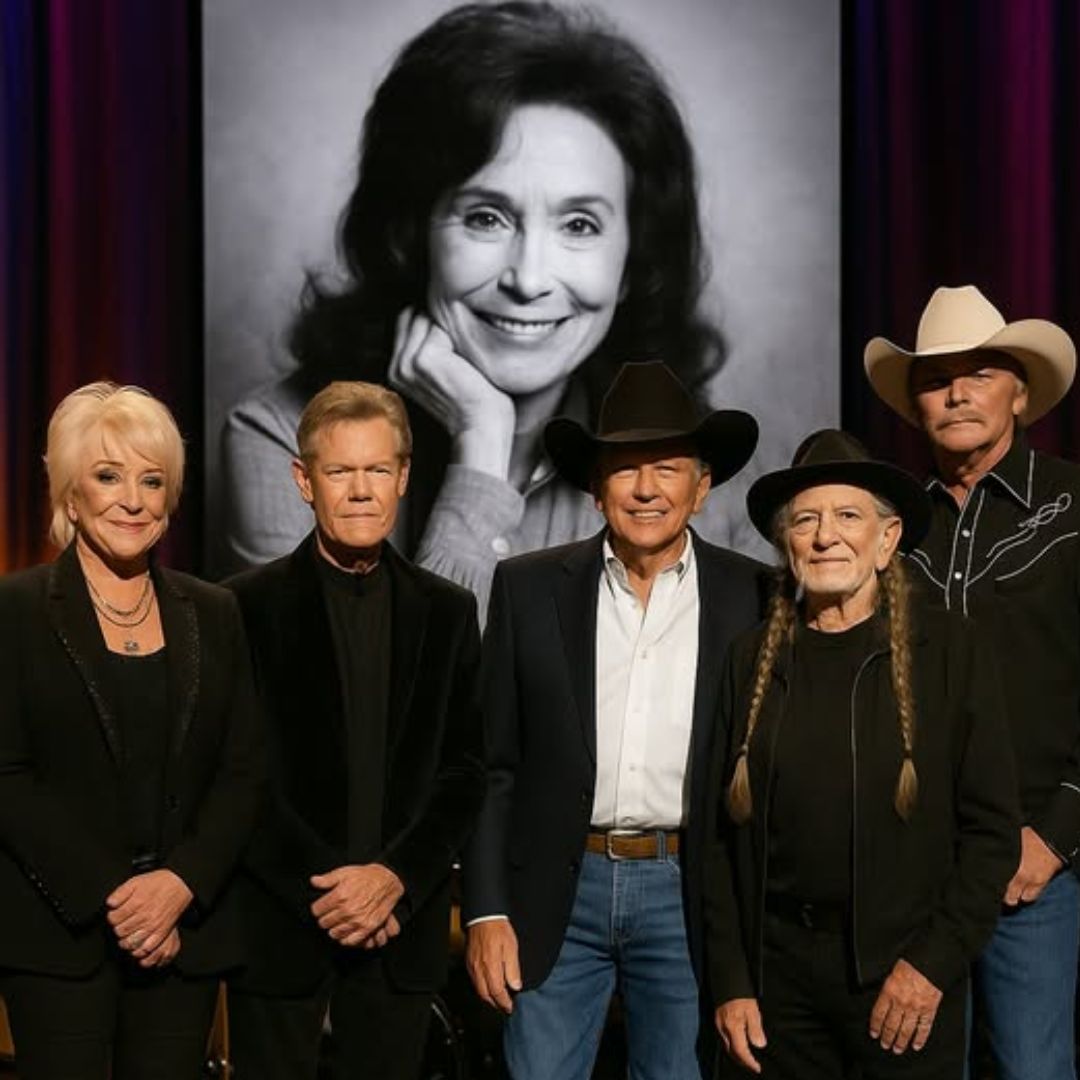
When Loretta Lynn—the indomitable “Coal Miner’s Daughter”—passed away, the silence she left behind was filled almost instantly with song. From Nashville to Los Angeles, from storied stages to candlelit gatherings, the music world came together in shared grief and gratitude to honor a woman who had not only shaped country music, but changed what it dared to say.
These tributes were not obligations or ceremonies. They were acts of love. Each performance, each story, each trembling note carried the same message: Loretta Lynn mattered—and she always will.
A Voice That Carried a Generation
Loretta’s journey began in the coal-mining hills of Butcher Hollow, Kentucky, where hardship was a fact of life and honesty was survival. She carried that truth with her onto the world’s biggest stages, turning lived experience into fearless anthems. When she sang “You Ain’t Woman Enough,” “Don’t Come Home A-Drinkin’,” or “Coal Miner’s Daughter,” she wasn’t chasing controversy—she was telling the truth as she knew it.
In doing so, she gave voice to millions of women who had never heard their lives reflected in song. At a time when country music was dominated by men, Loretta sang unapologetically about marriage, motherhood, desire, anger, and independence. She didn’t ask permission. She opened doors—and left them open.
Her passing united artists across generations in a shared understanding: without Loretta Lynn, the landscape of country music would look very different.
A Sacred Goodbye at the Grand Ole Opry
Nowhere was the farewell more deeply felt than at the Grand Ole Opry, Loretta’s artistic home. The stage she had graced for decades became a place of remembrance, glowing with reverence and emotion.
Reba McEntire, fighting back tears, spoke plainly and from the heart: “She paved the way for women like me.” Her performance of “If You’re Not Gone Too Long” felt less like a song and more like a conversation between friends—one final thank-you wrapped in melody.
Carrie Underwood honored Loretta with a powerful rendition of “How Great Thou Art,” her voice lifting a hymn that reflected Loretta’s faith and strength. Miranda Lambert followed with a stripped-down version of “Coal Miner’s Daughter,” as images from Loretta’s life played behind her—family photographs, early performances, quiet moments frozen in time. The crowd wept openly.
It was not spectacle. It was remembrance.
Beyond Nashville, Across Music
The tributes did not stop at country music’s borders. In Los Angeles, a star-studded gathering brought together artists from across genres, underscoring how far Loretta’s influence reached.
Kacey Musgraves, Brandi Carlile, and Sheryl Crow each took the stage, their performances shaped by the courage Loretta had modeled long before them. Between songs, stories flowed freely. Musgraves recalled Loretta once telling her backstage, “Sing your truth—and don’t let anyone shut you up.” Brandi Carlile spoke of how Loretta’s willingness to confront taboo subjects gave her permission to write honestly about her own life.
These weren’t anecdotes for applause. They were acknowledgments of debt.
Family, Legacy, and Love
Loretta Lynn’s family attended many of the tributes, watching as an industry—and a generation—returned the love she had given so freely. Her daughter, Patsy Lynn Russell, summed it up simply: “Mom always sang from the heart. Seeing so many people honor her this way proves her music will live forever.”
And it will.
Because these nights were more than concerts. They were affirmations of a legacy built on courage, truth, and unwavering authenticity. Every candle raised, every voice that cracked mid-lyric, every tear shed in the audience testified to the same truth: Loretta Lynn was not just a star.
She was a force.
A truth-teller.
A family member to millions who saw themselves in her songs.
As the final notes faded from stages across the country, one thing became unmistakably clear—Loretta Lynn may have left this world, but her voice still echoes, carried forward by every artist brave enough to sing their truth.