The scent of chain grease, sun-baked leather, and ninety-octane fuel will forever be the scent of my childhood.
I didn’t know it then, of course. To me, it was just Dad.
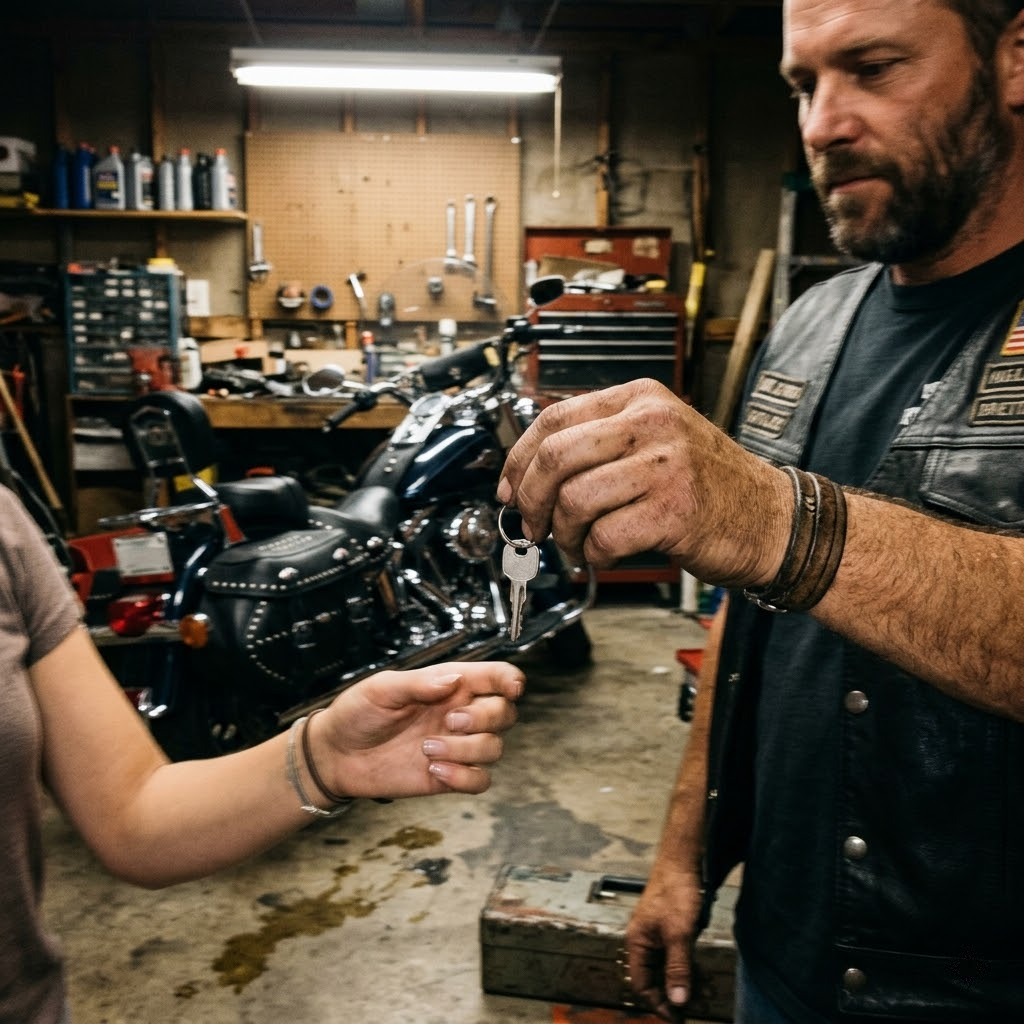
It was a Saturday. The air in the garage was thick, humid, and heavy with the promise of summer rain. In the center of the concrete floor sat the object of my affection and the bane of my mother’s existence: his 1998 Harley-Davidson Heritage Softail Classic. Black lacquer so deep it looked wet, chrome that could blind you at high noon, and the custom leather saddle bags he’d conditioned more times than he’d cut his own hair.
Dad was crouched beside the rear wheel, his back a broad expanse of faded black denim. The rhythmic click-tink of a socket wrench echoed against the cinderblock walls. His forearms, tanned to the color of saddle soap and traced with the ghost of a military tattoo, flexed with each rotation.
He didn’t need to look up to know I was standing there. He never did.
“You’re checking the spokes again,” I said, leaning my back against the closed garage door, my arms crossed tightly over my chest.
He paused, the wrench resting against the chrome hub. A sigh, barely audible over the ticking of the cooling engine blocks, escaped him. “There’s thirty-two on the rear, Maya. Each one is a promise to stay upright. You don’t neglect a promise.”
“But they were fine yesterday,” I pressed.
He finally stood, his knees popping—a sound that always made me wince. He wiped his greasy hands on a rag that was already past saving. When he turned to look at me, his eyes weren’t smiling like they usually did when we talked about the bike.
“This afternoon is different,” he said.
This afternoon was the day I turned twenty-two. It was the afternoon I was scheduled to leave for my internship at the architectural firm in Chicago—four hours away. The afternoon I was supposed to drive away in the beige Honda Civic Mom had insisted on buying me “for safety.”
Dad threw the grease-stained rag into his toolbox. The heavy metal drawer slid shut with a definitive thwack. He reached into his pocket and pulled out his key ring. It was heavy, a cluster of brass and silver anchors.
But separated from the rest, on a single, plain steel loop, was a solitary key. It wasn’t the car key.
It was the short, tubular key that opened the Softail.
He held it out to me.
I froze. “What are you doing?”
“You said you wanted to learn the routes,” he said, his voice unusually level.
“Yeah. The routes with you. On the back.”
“You’re a grown woman now, Maya,” he said. The hand holding the key didn’t move. It was the calloused hand that had held mine when I learned to walk, the hand that had taught me to change an air filter before I knew how to put on eyeshadow, the hand that had gripped the handlebars of that very machine across thirty states. “I told your mother I’d keep you safe. Part of being safe is knowing how to handle the machine, not just how to be the passenger.”
“Dad, I have the Civic.”
“The Civic will get you to Chicago,” he agreed. “The Softail will teach you how to see the road.”
He stepped closer, his shadow swallowing mine. His leather vest, the one with the patch from his old unit, smelled faintly of miles and memories. He dropped the key into my palm. It felt impossibly cold against my sweating skin.
“She’s yours, Maya. For the drive.”
I stared down at the key, the implication of his gesture starting to seep in like motor oil through a rag. It wasn’t just a loan. It wasn’t just an anniversary present.
He had ridden that bike almost every day since he bought it new, two years before I was born. It was his sanctuary, his identity, his freedom. He’d cleaned it more than he’d cleaned the house. He’d spend five hours detailing it after a ten-minute ride. My mother joked that he loved that motorcycle more than us, and though he always denied it with a kiss, we all knew that the bike held a piece of his soul that nothing else touched.
For him to give me the key, not just for a ride around the block, but for a four-hour journey into the unknown chaos of the highway…
My chest constricted. “Dad, you… you never let anyone touch her. Not even Mr. Henderson, and he’s known you since the Navy.”
“Mr. Henderson doesn’t respect the clutch like you do,” Dad said, a small smile finally cracking the corner of his mouth. “You grew up watching me shift, Maya. You know how the machine sounds when it’s happy.”
“But four hours? On the highway? What if… what if something happens to it?”
His face went serious again. “Maya, I am much less worried about what happens to the bike than I am about what happens to you when you don’t understand what it means to be responsible for two wheels.”
He walked over to the workbench, where a small stack of leather lay. He picked up his gloves—the heavy-duty ones, with the armor over the knuckles, the ones he wore for touring, not for posing. He threw those to me, too.
“They’ll be too big, but they’ll keep your palms whole if you slide,” he said simply.
The realization hit me in waves, each one colder than the key in my hand. He wasn’t giving me his prize possession. He was making a transaction. He was trading his own peace of mind, his own connection to his passion, for a microscopic increase in my safety. He believed that if I knew the physics of a lean, the responsiveness of the brakes, and the alertness required to survive an hour in traffic on a machine that offered no protection but speed, I would be a safer, smarter person.
He was giving me the single greatest danger he knew, believing that experiencing it, mastering it, was the only way I could ever truly be safe in the world he was sending me into. He was sacrificing his beloved freedom on the altar of my potential survival.
“You’re sacrificing the paint job for me,” I whispered, my voice cracked.
He didn’t laugh. He looked at me with an intensity that made me feel small. “I’m sacrificing the sound of that V-twin, Maya. Every time I don’t hear it start, I’m going to wonder if you made it.”
He didn’t hug me. He didn’t offer any dramatic final words. He just turned back to his toolbox, the heavy metal clack of the drawers signaling that the conversation, and his responsibility for the machine, was over.
“Check the oil before you leave,” he said, not looking up. “And Maya?”
I looked at him.
“You remember the routes.”
He didn’t need to tell me to remember to wear my helmet. He didn’t need to tell me to respect the speed limits. He knew I’d do it.
I walked the four steps to the Softail. My boots, the old, scuffed combat boots he’d bought me, felt light. I swung my leg over the leather saddle. It was wider than it looked, and heavy. I’d sat here a thousand times, but never as the captain.
I put the key into the ignition on the console. It clicked. I turned it to “Ignition.” The bike came to life, fuel pump priming with a high-pitched whine. The dashboard lit up.
I squeezed the clutch. It was smooth, but heavy. This machine demanded attention.
I lifted the kickstand. I thumbed the starter.
The engine erupted with a roar that shook the entire garage. It wasn’t a purr. It was the defiant, rattling thunder of American steel. The vibration travelled up through the chassis, into the seat, through my legs, and settled in my bones.
Dad still didn’t look up, but his shoulders relaxed slightly.
I knew he was listening, checking the idle, the rhythm, making sure his girl was treating his other girl right.
I eased the clutch out. The bike lurched forward, eager, powerful, terrifying.
I rode out of the humidity of the garage and into the uncertain, bright daylight of the road ahead, carrying with me four hours of highway, twenty-two years of memories, and the heavy, metallic weight of my father’s sacrifice.
I didn’t just learn how to ride that day. I learned what it meant to love someone enough to give them the thing that scares you most, just so they’d know how to survive it. And I never looked at a motorcycle—or my father—the same way again.