The heavy, thumping bass line of a classic rock and roll anthem vibrated through the concrete floor of my garage, shaking the dust off the rafters. I had my hands buried deep in the guts of my 1978 Harley-Davidson Shovelhead, grease stained so deeply into the creases of my knuckles that it had practically become part of my DNA. At seventy-two years old, my knees popped when I stood, and my back carried the ache of a thousand cold nights spent sleeping on the hard ground next to a campfire. But when I held a wrench, and when the scent of high-octane fuel hit my nose, I was twenty-five again.
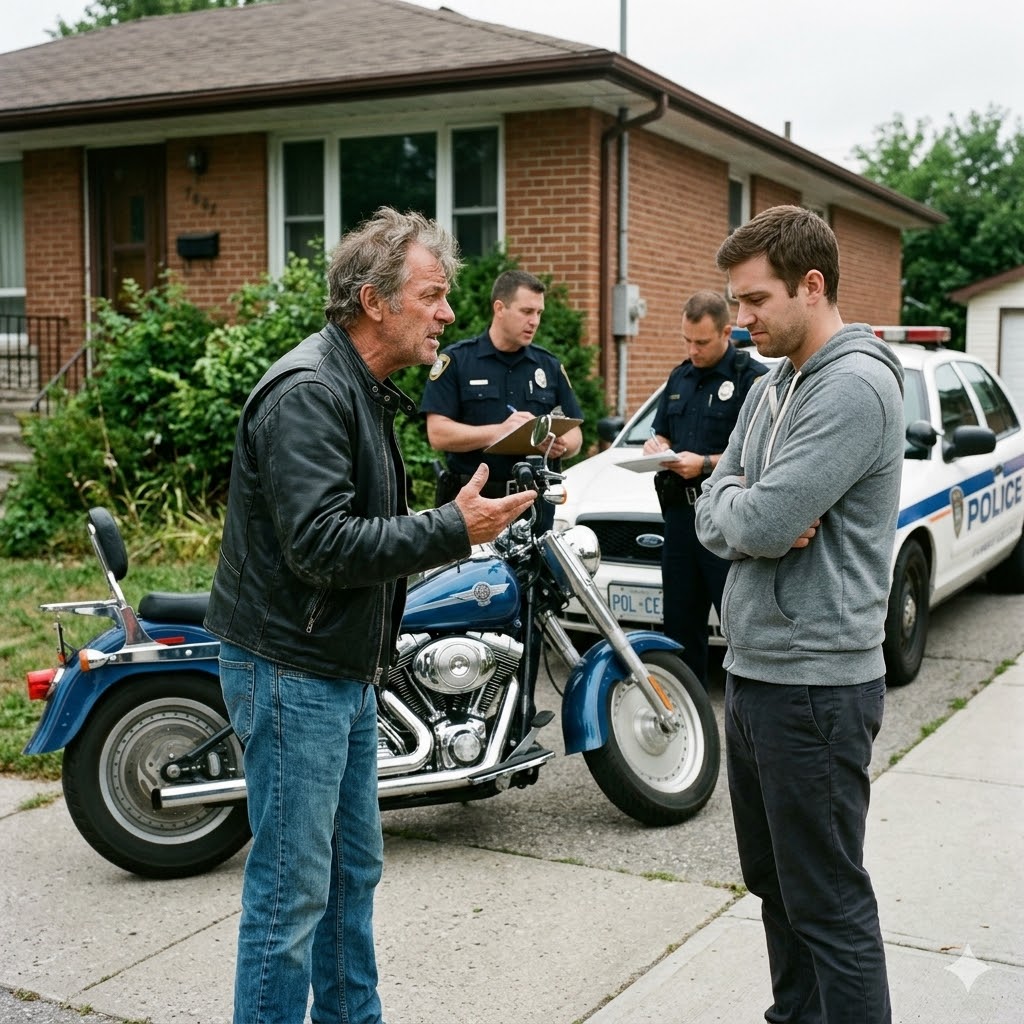
I was just tightening down the primary cover when the flashing red and blue lights cut through the dim, golden light of the late afternoon, painting the walls of my garage in frantic, swirling colors.
I wiped my hands on an old shop rag, my heart doing a slow, heavy thud in my chest. You don’t spend twenty years riding with an outlaw motorcycle club without developing a sixth sense for trouble when the law shows up. Even though I’d handed in my patch decades ago, trading the chaotic, violent loyalty of the 1% life for the quiet responsibilities of fatherhood, seeing a black-and-white cruiser at the end of my driveway still made the hairs on the back of my neck stand up.
I hit the power button on the boombox, cutting the soaring guitar solo short, and stepped out onto the driveway. The evening air was cool, biting at the sweat on my forehead. Two officers stepped out of the cruiser. They looked young, their uniforms crisp, their hands resting cautiously near their utility belts.
But it wasn’t the cops that made my stomach drop. It was the car that pulled up directly behind them.
The door opened, and my son, Connor, stepped out. He was dressed in his sharp, tailored work suit, his tie loosened, looking everywhere except at me.
“Evening, gentlemen,” I said, my voice carrying the gravelly weight of a man who had swallowed too much highway dust over the years. “Is there a problem?”
The older of the two officers, a guy with a salt-and-pepper mustache and tired eyes, stepped forward. “Sir, we received a call requesting a wellness check. We’re responding to concerns about your ability to safely operate a motor vehicle. Specifically, a heavy motorcycle.”
I stared at him, uncomprehending. Then my eyes drifted to Connor. My own flesh and blood. The boy I had taught to ride a bicycle, the boy whose first baseball glove I had bought by selling my favorite leather riding jacket when times were tough.
“Connor?” I asked, the betrayal tasting like ash in my mouth. “What the hell is this?”
Connor finally looked at me, his face tight with a mixture of fear, frustration, and misplaced righteous anger. “I had to do it, Dad. I’m sorry, but I had to. You’re seventy-two. You dropped the bike in the driveway last week. You’ve got a bad hip, your reaction times aren’t what they used to be, and you’re riding a seven-hundred-pound machine that has no anti-lock brakes and no safety features. You’re going to get yourself killed.”
“I laid the bike down gently because the kickstand sank into the hot asphalt,” I growled, taking a step toward him. The officers tensed, but I kept my hands where they could see them. “It wasn’t a crash. It was a parking slip. You called the police on me for a parking slip?”
“I called them because you won’t listen to reason!” Connor shouted back, his composure cracking. “I told you it was time to sell it. I told you it’s time to hang up the keys. You refused. I want them to issue a medical review for your license. I want the bike impounded if I have to. I am not going to sit around and wait for the phone call telling me my father was scraped off the interstate!”
The silence that followed was deafening. The neighborhood was perfectly quiet, the manicured suburban lawns a sharp contrast to the raw, visceral pain bleeding out into my driveway.
I looked at the motorcycle sitting in the garage behind me. The chrome gleamed in the fading light. That bike wasn’t just metal and rubber. It was a diary of my life. It was the machine I had ridden to the hospital the night Connor was born, pushing the engine so hard the pipes glowed red in the dark because I was terrified I’d miss his first breath. It was the bike that had carried me away from the darkest moments of my outlaw days, the thunder of its exhaust drowning out the demons of a life I had sworn to leave behind so my children wouldn’t grow up visiting me through thick reinforced glass.
I gave up the club. I gave up the brotherhood. I gave up the wild, untethered freedom of the road to work fifty hours a week in a sheet metal factory to put food on the table. The only piece of my soul I had kept for myself was that Shovelhead. And now, my son was standing in my driveway with the police, trying to rip it away.
Before I could speak, another car turned onto the street, tires squealing slightly against the pavement. It was my daughter, Kary.
She threw the car in park and marched up the driveway, her boots clicking sharply against the concrete. Kary had always had the fire that Connor lacked. She inherited my stubborn streak, my temper, and my absolute refusal to back down from a fight.
“Connor, tell me you didn’t actually do this,” Kary said, her voice shaking with disbelief as she looked at the police cruiser. “Tell me you didn’t call the cops on our father.”
“He’s a danger to himself, Kary!” Connor argued, throwing his hands up in the air. “Look at him! He’s getting old. I love him too much to let him commit slow-motion suicide on that death trap.”
“That ‘death trap’ is the only thing keeping him alive!” Kary fired back, stepping between her brother and me. She turned to the officers. “My brother made a mistake. Our father is perfectly lucid, he has a valid license, his registration is up to date, and he isn’t breaking any laws. You have no legal right to be here.”
The older officer sighed, rubbing the back of his neck. “Ma’am, we’re just responding to a family concern. We can’t confiscate the vehicle without cause, but if there is a legitimate medical concern, we can recommend a DMV re-evaluation.” He looked at me, his eyes scanning my grease-stained clothes, my weathered face, and the club tattoos fading into my wrinkled skin. “Sir, can you honestly tell me you can still handle that machine?”
“Let me show you something,” I said quietly.
I turned my back on the cops and my son, walking into the garage. I didn’t grab my helmet. I didn’t grab my jacket. I just swung my leg over the leather saddle of the Shovelhead. The familiar weight of the bike settled beneath me, an extension of my own body. I reached down, flipped the petcock to let the fuel flow, pumped the throttle twice, and kicked the starter pedal with every ounce of strength I had left in my old bones.
The engine caught on the first kick.
The garage exploded with the deafening, uneven, heart-pounding potato-potato-potato roar of a perfectly tuned Harley-Davidson V-twin. The sound bounced off the walls, raw and unapologetic, vibrating right through the soles of everyone’s shoes.
I kicked it into gear, eased out the clutch, and slowly rolled the massive machine out of the garage and down the driveway, stopping mere inches from where the officers stood. The front brake locked with a sharp hiss. I held the seven-hundred-pound motorcycle upright with just my left leg, balancing it perfectly, the engine rumbling like an angry beast tamed only by the hands on the handlebars.
I looked at the older officer. I didn’t have to say a word. The absolute control, the steady idle, the lack of a single tremor in my hands—it spoke for itself.
The officer watched me for a long moment, then nodded slowly. A faint smile ghosted across his lips. He was probably a rider himself.
He turned to Connor. “Son, I understand your concern. Truly, I do. But your father is of sound mind, and he is fully in control of that vehicle. Being old is not a crime. And from where I’m standing, he rides better than half the kids I pull over on the weekends. We’re leaving. Don’t call us for this again.”
The officers tipped their hats to Kary, got back into their cruiser, and slowly drove away, leaving the three of us standing in the exhaust-scented air.
I killed the engine. The sudden silence in the driveway felt heavier than the noise. I kicked the stand down and stepped off the bike, turning to face Connor.
He looked defeated. The anger had drained out of him, leaving only the terrified little boy who used to wait up by the window for me to come home from the factory. Tears were pooling in the corners of his eyes, his professional facade completely crumbling.
“I just don’t want to lose you, Dad,” Connor whispered, his voice cracking. “Mom’s gone. You’re all Kary and I have left. When you laid it down last week… all I could see was a coffin. I just want you safe.”
I felt the tight knot of anger in my chest dissolve, replaced by a deep, aching sadness. I walked over to my son, reaching out with my grease-stained hands, and pulled him into a fierce embrace. He stiffened for a second before collapsing against my shoulder, burying his face in my jacket.
“Connor, listen to me,” I said, my voice thick with emotion. “A ship in a harbor is safe. But that is not what ships are built for. And it’s sure as hell not what I was built for.”
I pulled back, holding him by the shoulders, making sure he met my eyes. Kary stepped up beside him, resting her hand on his back.
“I gave up the club,” I told him, the memories of leather, violence, and brotherhood flashing behind my eyes. “I walked away from the only family I knew outside of this house so that I could be a real father to you two. I traded the highway for a punch clock. I don’t regret it. I’d do it a hundred times over for you and your sister. But this bike…” I looked back at the Shovelhead, the chrome catching the last light of the setting sun. “…this bike is the last piece of the man I used to be. It’s my wind. It’s my church. It’s the only place I can go where my knees don’t hurt and my past doesn’t haunt me.”
“But what if something happens?” Connor asked, swiping at his eyes.
“If something happens,” Kary interrupted softly, her eyes shining with unshed tears, “then it happens while he’s doing the thing he loves most in this world. We don’t get to lock him in a padded room just to make ourselves feel better, Connor. We don’t get to kill his spirit just to keep his heart beating.”
Connor looked at Kary, then looked at the motorcycle, finally seeing it not as a weapon, but as an old friend that had kept his father sane through decades of sacrifice.
He took a deep, shuddering breath, straightening his tie. He wiped his face, attempting to gather whatever scraps of dignity he had left.
“I crossed a line,” Connor said quietly. “I shouldn’t have called them. I’m sorry, Dad. I was just… I was so scared.”
“I know, son,” I said, clapping him on the shoulder. “I know.”
“But if you’re going to keep riding it,” Connor added, a tiny, watery smile breaking through the tension, “you’re going to let me buy you a new helmet. One of those full-face ones. With Bluetooth. So I can call and check on you.”
I let out a loud, barking laugh, the tension finally breaking completely. “A full-face helmet on a Shovelhead? The old boys from the club would roll over in their graves. But… yeah. Okay, Connor. You can buy me a helmet.”
Kary laughed, stepping in to hug us both. For a long moment, the three of us just stood there in the driveway, a fractured family piecing itself back together in the shadow of an old motorcycle.
“Now,” I said, pulling away and wiping my hands on my jeans. “If the police are done trying to confiscate my property, I’ve got to finish tuning this carburetor.”
“Do you want some help?” Connor asked, surprising me. He hadn’t touched a wrench since he was sixteen.
I looked at my son, standing there in his expensive suit, offering to get grease on his hands. It was the greatest olive branch he could have ever offered.
“Yeah, Connor,” I smiled, tossing him an old shop rag. “I’d like that very much.”
As the sun finally dipped below the horizon, the three of us walked back into the garage. Kary walked over to the boombox, cranking the classic rock back up to an unapologetic volume, the wail of the guitars filling the space once again. I showed Connor how to hold the flashlight, teaching him the rhythm of the machine, passing down the only kind of religion I had left to give.
I don’t know how many miles I have left in me. Maybe I have a decade; maybe I have a week. But I know that when the time finally comes for me to park the bike for good, it won’t be because the law told me to, and it won’t be out of fear. It will be on my own terms. Until then, the tank is full, the oil is clean, and the road is wide open. And sometimes, if you’re lucky, the people who love you finally understand that for some men, riding isn’t just about moving forward. It’s about staying alive.