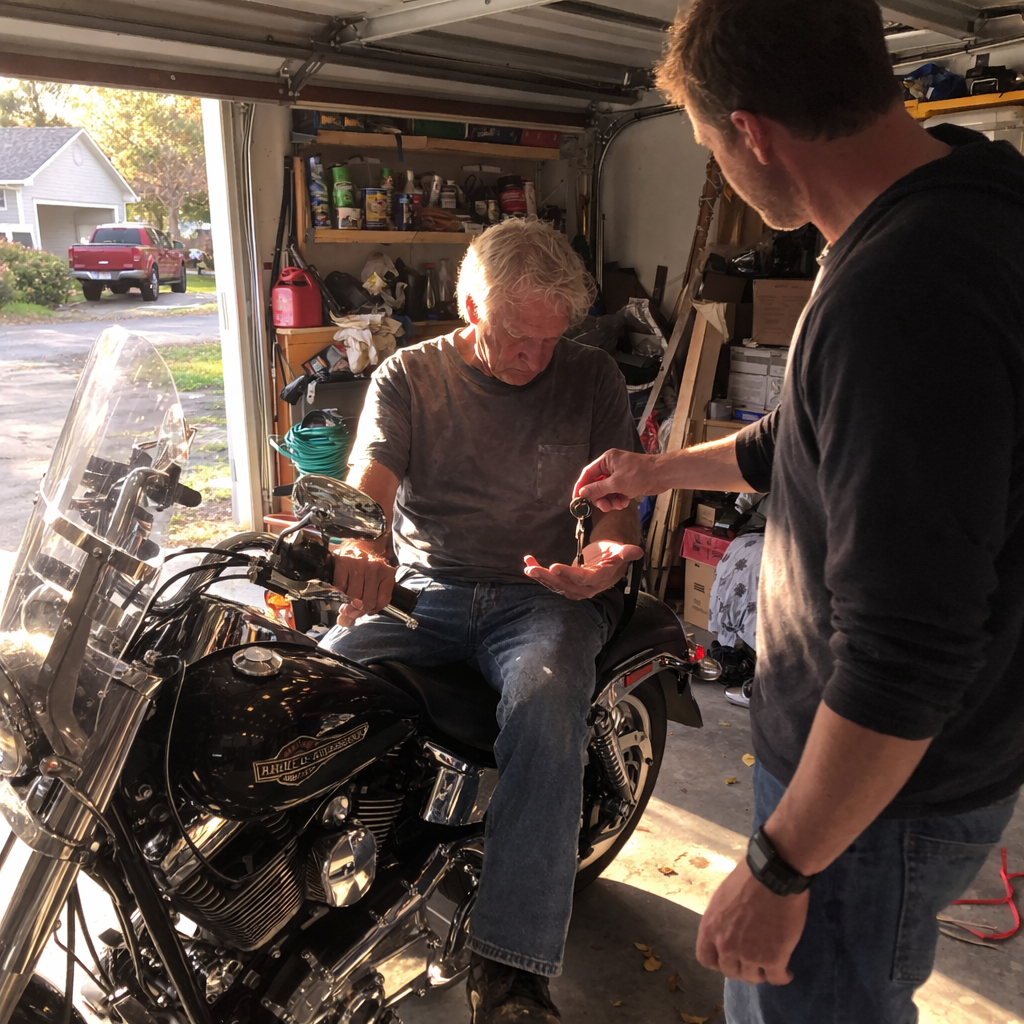
I used to be proud of my father. I remember a time when his strength and vitality were the things I admired most. When I was a kid, he seemed invincible—no one could do it better, faster, or with more confidence than my dad. But somewhere along the way, I lost that feeling. Somewhere between adolescence and adulthood, I became ashamed of him. I became embarrassed by the things he held dear, by the way he lived his life, by the things he refused to let go of. One of those things was his Harley Davidson motorcycle.
It’s funny, isn’t it? How things you once found heroic and brave can later become sources of shame. How admiration can turn into disdain when the person who inspired you seems out of place in the world you now live in. My father was 72 when he fell off his motorcycle last week. It wasn’t a major accident—a minor spill in a parking lot. But it was enough. It was the moment I had been waiting for, the excuse I needed to finally force him to sell his Harley.
He had always been the man on two wheels, the one who rode through life with a freedom I didn’t understand. When I was little, he would take me on the back of that motorcycle, the wind whipping through my hair, the rumble of the engine filling my chest with excitement. I used to think it was the most thrilling experience in the world. I remember how my mother would always fuss, telling him that he was crazy for riding like that. But Dad didn’t care. He loved that bike more than anything. It was a symbol of his freedom, his youth, his sense of adventure.
But somewhere, sometime over the years, I had started to see it differently. I began to see it as reckless, dangerous, irresponsible. I didn’t want to be the child of the man who took foolish risks, who clung to his youth when he should have been slowing down. I couldn’t bear the thought of my father being the old man who refused to accept that it was time to grow up, time to let go of the past.
The first time I mentioned selling the Harley was about three years ago. He laughed me off, told me that he wasn’t ready to give up riding. “I’m not dead yet,” he’d said with a wink, brushing off my concern. But the truth was, I didn’t want to hear him make jokes about it. I didn’t want to hear him act like he was still young, still the same man who’d been riding in his twenties and thirties. It felt like he was in denial, and I was the one who had to face reality for him.
“I’ll be fine,” he would always say. “I’m just getting older, not getting weak. You’re worrying too much.”
But I couldn’t help it. I worried. I saw the toll time had taken on his body. His back ached, his hands shook a little more than they used to. He wasn’t as quick to get up from a fall, and he had started to look… old. I hated seeing it, hated seeing the man who had always been invincible suddenly become mortal. And that Harley, that damned Harley, was just a constant reminder of the man I feared he might become.
The thing about my father is, he’s stubborn. He’s always been stubborn, and that’s something I’ve inherited from him, whether I like it or not. He wouldn’t listen when I said it was time to let go of the bike. He wouldn’t listen when I told him I was afraid for him. I knew that deep down, I was just trying to protect him, but it felt like he didn’t care. Like my concerns didn’t matter. He would smile, pat me on the back, and say something like, “I’m still here, kid. Don’t worry about me.”
But I couldn’t stop worrying. I couldn’t stop thinking about the worst-case scenarios—the idea that one day, I’d get a phone call telling me my dad had been in an accident. And I couldn’t bear the thought of it.
So, last week, when he fell off his bike in that parking lot, I saw it as the moment I had been waiting for. It was the perfect excuse. He wasn’t injured badly, thank God, but he was shaken up, and I could tell he was embarrassed. He tried to laugh it off, say it was nothing, but I could see the look in his eyes. He wasn’t invincible anymore. And neither was I.
“You need to sell the bike, Dad,” I told him later that day. “You’re too old for this. You’re lucky it wasn’t worse. You don’t need to be riding around like that anymore. It’s not worth the risk.”
He stared at me, his eyes tired but not angry. “I don’t think you understand,” he said quietly. “It’s not just a bike. It’s part of me.”
“I don’t care,” I snapped, my voice sharper than I intended. “You’re not 25 anymore. You can’t keep pretending like you are.”
It felt like a weight was lifted off my shoulders, but I immediately regretted the words. I had forced him into a corner. I had taken away something that meant the world to him. And for what? For my own comfort, for my own fear?
Later that evening, after we’d had dinner, I sat on the porch, feeling the cool breeze on my skin. I could hear my father out in the garage, tinkering with the motorcycle as he always did. It was his time to relax, to focus on something that made him happy. I hadn’t meant to ruin that for him, but it felt like I had.
I could hear the faint sound of the Harley’s engine starting up. I walked to the door, and through the glass, I could see my father sitting on the bike, his hands on the handlebars. For a moment, he looked like the man I remembered—young, confident, unstoppable. But then he glanced at me through the window, and the moment passed. He killed the engine.
“I’ll sell it,” he said, his voice calm, almost resigned. “But I want you to know something.”
I stepped outside, my heart heavy.
“I didn’t get rid of the bike because I’m too old to ride,” he continued. “I’m giving it up because you asked me to. And that’s something I haven’t done in a long time—listen to you.”
I swallowed hard. “I just don’t want anything to happen to you, Dad.”
“I know,” he said. “I know you’re trying to protect me. And I’m grateful for that. But sometimes, kid, the things we love the most are the things we’re willing to fight for, no matter how old we are.”
I wanted to say something, but I didn’t know what to say. I didn’t have any words that could fix this, that could undo what I had just done.
He stood up, took off his gloves, and walked toward me. “You don’t need to worry about me. I’ll be alright.”
We stood there for a moment in silence, father and son, two people who had seen life differently but were bound by the same blood. And in that moment, I realized something—I hadn’t been worried about him at all. I had been worried about myself. I had been embarrassed by the man who was too proud to give up his Harley, too proud to grow old the way I thought he should.
But now, I understood. His refusal to let go of the bike wasn’t about denying his age. It was about holding onto something that made him feel alive, that made him feel free. And in a way, I could respect that. I could understand that.
That night, after we had a long conversation, I apologized. I told him that I hadn’t meant to take away something so important to him. And he smiled at me, the same way he had when I was a little boy, as though he had never been hurt by my actions at all.
“I know you were only trying to protect me,” he said. “But sometimes, you have to let go of the things that scare you. You have to let the people you love live their lives, even if it means taking risks. Even if it means falling.”
I didn’t have all the answers, and I still don’t. But I’ve learned that some things in life aren’t about protecting someone from danger—they’re about trusting them to make their own choices, even when we don’t understand them.
And maybe, just maybe, we can find a way to let go of our own fears and let those we love keep riding.
A week later, I found myself standing in the garage, staring at the empty space where my father’s Harley used to be. I couldn’t help but smile, knowing he would keep riding—just in his own way, on his own terms. And for the first time in a long while, I was proud of him again.