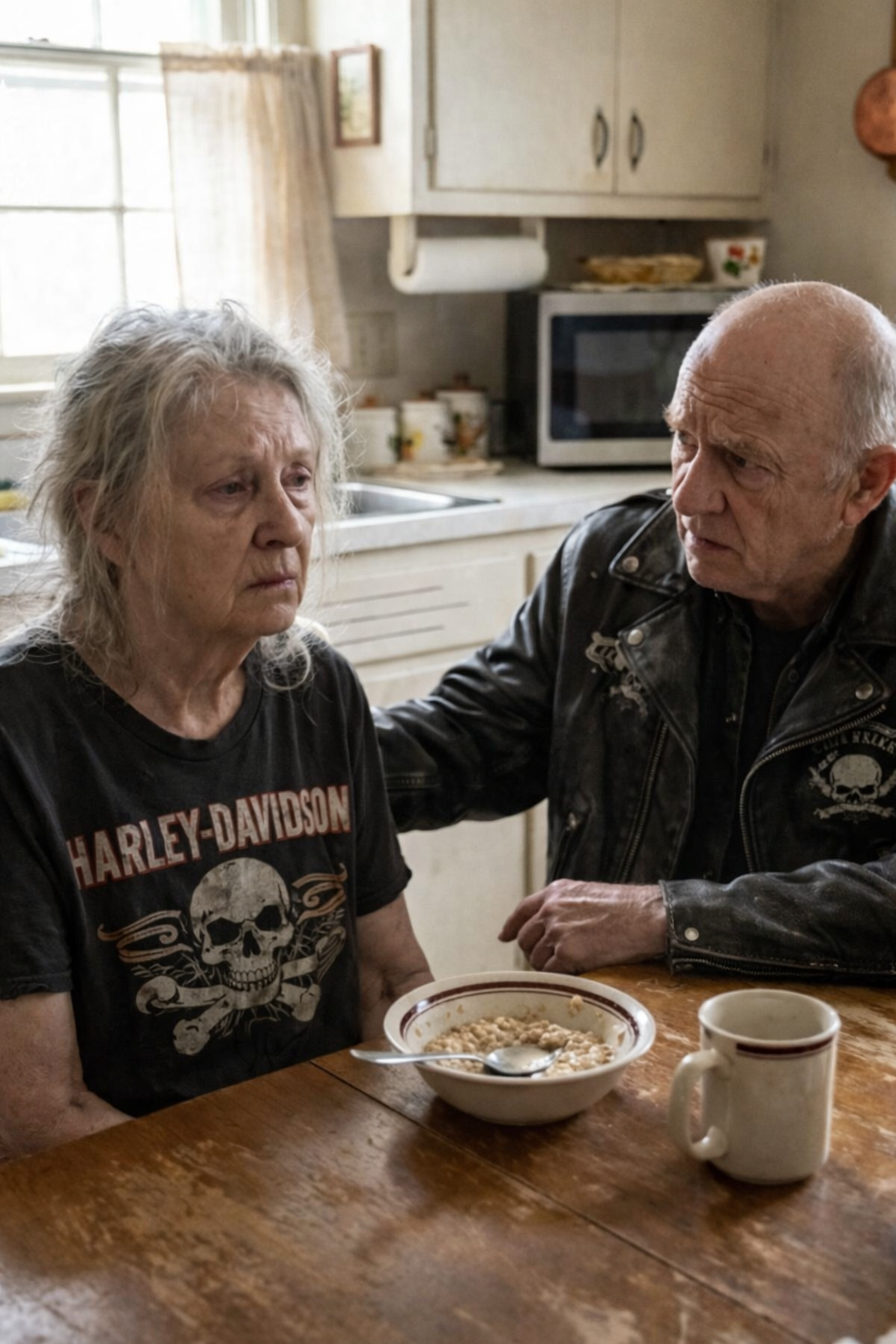
“Ma’am, you the one who brings the coffee?”
That was the first thing Ryder said to me that morning.
Not baby.
Not June.
Not the name he’d been growling across smoky bars and quiet kitchens for forty-six years.
Just ma’am—like I was some waitress passing through his life instead of the woman who had ridden beside him through every mile of it.
I set the mug down slowly and looked at him across our scarred wooden table.
He was wearing his old leather vest over a faded thermal shirt, patches stitched crooked from years of road dust and bar fights. His gray hair hung loose around his shoulders. His hands—God, those hands—still looked like they could fix an engine blindfolded or break a man’s jaw if they had to.
But his eyes…
His eyes were somewhere else.
Not here.
Not with me.
The phone rang before I could answer him.
I let it ring twice, three times, before picking it up.
The caseworker.
Again.
She used that careful, gentle tone like she was talking to someone already halfway broken.
“Mrs. Carter, we need to revisit the home-care plan. Given his condition, this may no longer be sustainable.”
I let out a small laugh before I could stop it.
Not because it was funny.
Because if I didn’t laugh, I might throw the phone through the wall.
Unsustainable.
That word has been chasing us for six years now.
Not the disease.
Not the nights I wake up to the sound of the front door rattling because he thinks he’s late for a ride that happened in 1993.
Not the way a man who once led a pack of roaring Harleys can’t remember how to button his own shirt.
No.
What’s “unsustainable” is me trying to keep him in the only place that still feels like his.
Ryder Carter rode hard for most of his life.
Not just any biker—an outlaw. The kind people cross the street to avoid. The kind with stories inked into his skin and scars no one ever asked about twice.
He wasn’t reckless.
He was loyal.
There’s a difference.
He spent years riding with his club, crossing state lines, fixing bikes for cash when money ran thin. When he got older, he opened a small garage. Said he was “done running.” Said he wanted something steady.
That garage paid for this house.
Paid for our kids’ school clothes.
Paid for the quiet life we built after the noise.
Then his hands started shaking.
At first, he laughed it off. Said it was just age, too many miles on the road.
Then he forgot a customer’s name.
Then he forgot how to reassemble a carburetor he’d fixed a hundred times.
Then one day, he rode out… and didn’t remember how to get back home.
By the time the doctor said dementia, I already knew.
We lost the garage first.
Then we lost the steady money.
Then we lost the version of him that never got lost.
I sold his spare bike.
That nearly killed me.
I took shifts cleaning at the church for a while, until I realized I couldn’t leave him alone anymore. I learned how to guide a man twice my strength without making him feel small. Learned how to hide the car keys. Learned how to sleep light, like a guard dog.
People say, “You’re so strong.”
I’m not.
I’m just still here.
There’s a difference.
Our son moved west years ago. Our daughter comes when she can. They help. They do.
But help isn’t the same as being here at 2:14 a.m. when a confused outlaw biker is trying to kick open the front door because he thinks his crew is waiting outside.
Last month, our grandson came over wearing his little baseball uniform.
Ryder looked at him, squinted, and said, “You here to pick up the bike?”
The boy is ten.
He nodded anyway.
“Yeah, sir.”
Then he went outside and cried behind the garage.
That night, I sat in the car with the engine off, hands on the steering wheel, and thought about driving.
Not leaving forever.
Just… driving.
One hour.
One stretch of road where nobody needed me.
Because caregiving doesn’t just make you tired.
It makes you invisible.
You become the person who fills the pill boxes.
The one who says gentle lies:
“You already ate.”
“No, your brothers aren’t riding tonight.”
“Yes, you fixed that already.”
Yesterday was our anniversary.
Forty-six years.
I didn’t say a word.
What was the point?
Most days he doesn’t know the year.
Some days he calls me by names from women long gone.
Once, for a full afternoon, he thought I was someone he met in a bar in 1978.
So I made breakfast, cleaned up, and told myself it was just another day.
He sat by the window most of the morning, staring out at the empty driveway like he was waiting for engines that would never come back.
Around noon, he said it.
My name.
Not ma’am.
Not hey you.
“Junie.”
I froze.
Nobody calls me that except him.
I turned so fast my heart nearly stopped.
He was looking straight at me.
Clear.
Present.
My Ryder.
“Come here,” he said.
My legs felt weak walking toward him.
He reached into his vest pocket, fumbling like it had betrayed him. Then he pulled out a small, worn velvet box, edges crushed like it had been carried too long.
My breath caught.
“I had the girl at the counter put it aside,” he said slowly. “Back when I still knew I might forget.”
My hands shook as I opened it.
Inside was a small gold charm shaped like a motorcycle.
Not expensive.
Simple.
Worn, even.
But perfect.
There was a tiny hinge.
I opened it.
Inside was a folded piece of paper.
His handwriting—rough, uneven, but his.
If you’re reading this, it means you stayed when I started disappearing.
Thank you for not leaving me behind.
I dropped to the floor.
Not on purpose.
My knees just… gave out.
The kind of crying that came out of me wasn’t quiet.
It was years of swallowed fear, exhaustion, love, and grief all breaking loose at once.
Ryder reached down, his hand trembling, and touched my hair.
“There’s my girl,” he whispered. “Knew you’d still be here.”
For ten minutes, I had him back.
The man who rode beside me through storms and sunshine.
The man who chose me every day of his life—even when life got hard.
By supper, he was gone again.
By evening, he asked if the guys had called for a ride.
By night, he wanted his mother.
But I had those ten minutes.
Ten minutes where he saw everything.
The bills.
The exhaustion.
The staying.
Ten minutes where the outlaw biker I married—hard, stubborn, loyal to the bone—fought his way through the fog just long enough to say the one thing no doctor, no caseworker, no system ever could.
He knew what it cost.
And he knew I paid it anyway.