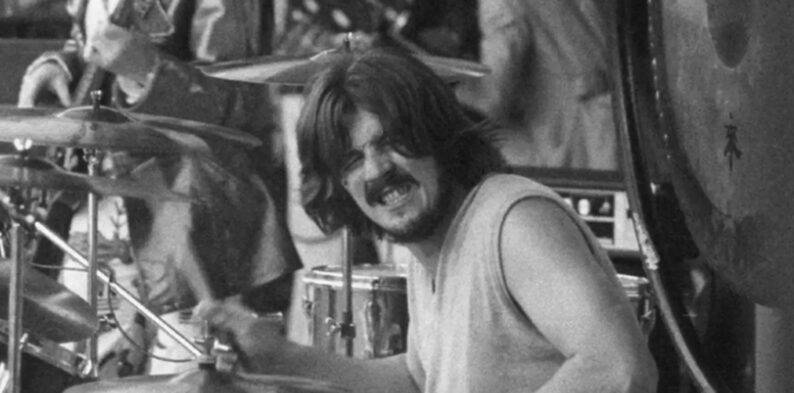
In 1970, Led Zeppelin set up their recording equipment in the main hall of Headley Grange, a 19th-century English workhouse with stone staircases and high ceilings, and John Bonham sat down at his drum kit at the bottom of the staircase while the microphones were placed two floors above him. The result — the opening drum sound of “When the Levee Breaks” — has been sampled, studied, replicated, and obsessed over by producers and engineers for more than fifty years. Nobody has fully reproduced it.
The sound is not just the drums. It is the room. The way Headley Grange’s stairwell acted as a natural echo chamber, amplifying the low end of Bonham’s kick drum while adding a controlled decay to his snare hits, created a sonic signature that cannot be rebuilt with modern digital reverb because the reverb itself is structural — it is the building responding to the drummer. Andy Johns, who engineered the session, later said that he set up the microphones, pressed record, and stepped back, because what Bonham was producing was already complete. “There was nothing to add,” Johns said.
The drum pattern itself is deceptively simple — a half-time shuffle groove at a deliberately slow tempo that creates an almost hypnotic weight. Bonham’s ability to lock that groove in place without a click track, at that tempo, for the duration of the take, is something that session drummers and drum scholars still discuss as a near-supernatural feat of internal rhythm.
When hip-hop producers in the 1980s began sampling “When the Levee Breaks,” they weren’t just using a drum sound. They were borrowing a room, a staircase, a building, and a man whose relationship with time made ordinary metronomes seem like rough approximations. The sample has appeared on hundreds of records. It never gets old because it was never quite of its time to begin with.