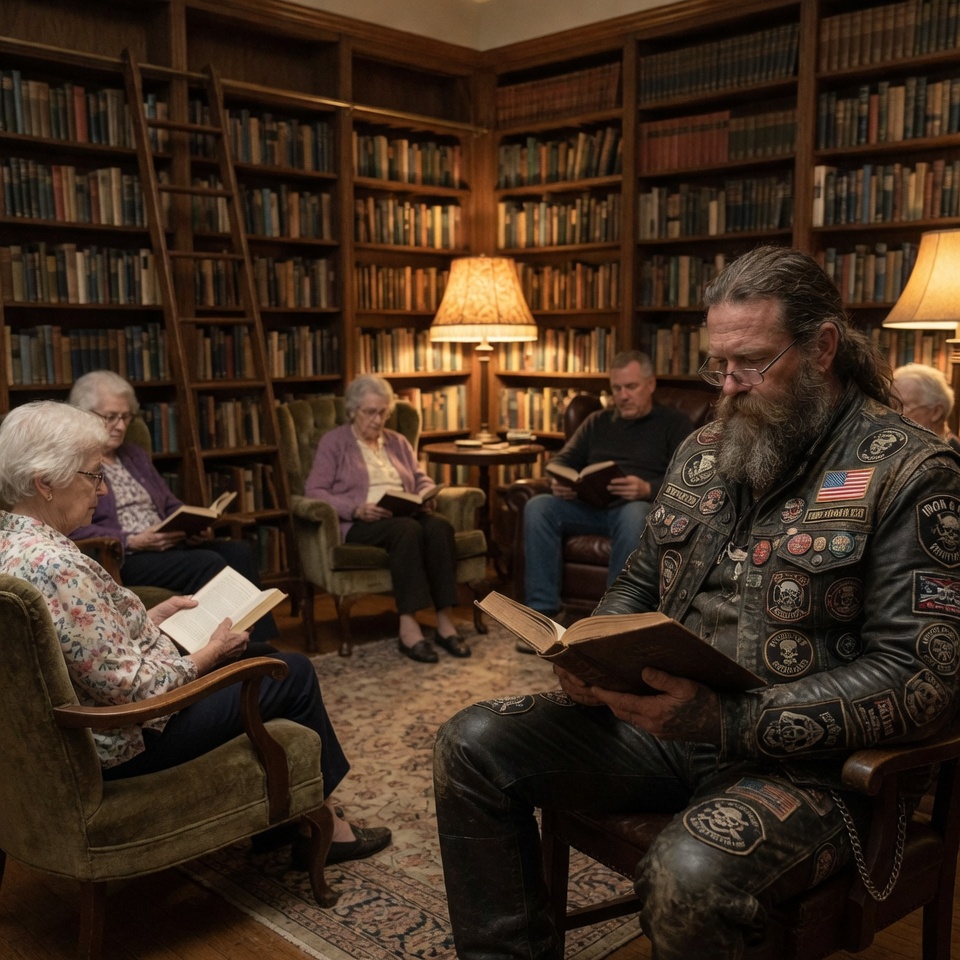
I have run the Thursday Evening Reading Circle at the Harmon County Public Library for twenty-one years. In that time we have read one hundred and twelve books, lost seven members to death, gained twenty-three new members, had one romantic relationship develop between attendees that resulted in a marriage.
I was honored to attend, and experienced a total of one screaming argument — over Cormac McCarthy, which if you know the reading group demographic will surprise no one.
We are not, as a group, particularly adventurous in our membership criteria. The circle has historically skewed toward retired women between the ages of sixty and eighty-five, with a smattering of younger members who tend to cycle through over two or three years before their lives fill up with children or careers or both.
I am sixty-five, which makes me one of the younger regulars, which I find both amusing and sobering. My name is Patricia, though I’ve been Pat to everyone I’ve known for more than a week for approximately four decades.
What I am trying to communicate is that the Thursday Evening Reading Circle was not, in October of the year in question, an environment that anticipated being joined by a sixty-one-year-old man with knuckle tattoos and a vice president patch on his vest.
His name was Howard, which he introduced himself as, which was not his road name — I learned his road name later, and I will say it was considerably more dramatic than Howard, as road names tend to be.
He came in at six forty-five on the first Thursday of October, when we were already seated and midway through the pre-meeting conversation that is technically not part of the meeting but which has its own protocols and is not to be disrupted.
He stood in the doorway for a moment — he was very large, Howard, the kind of large that makes doorways relevant — and asked, quietly, if this was the book group.
I said it was. I said we were discussing Thomas Hardy this month, Far from the Madding Crowd, and that he was welcome if he’d had a chance to read it.
He reached into the left interior pocket of his vest — several people around the circle went slightly still, which he either didn’t notice or pretended not to — and produced a library-issue paperback copy of Far from the Madding Crowd that was flagged with approximately fifteen sticky notes.
He sat down in the empty chair between Geraldine, who is eighty-one and built like a sparrow and absolutely terrified of nothing on this earth, and a younger member named Brian, who teaches high school English and who had the particular expression of a man recalibrating his expectations in real time.
“I’m Howard,” he said to the group.
There was a brief silence.
Geraldine said, briskly, “I’m Geraldine. I think Gabriel Oak is the most boring hero in English literature and I’m curious what a fresh perspective thinks.”
Howard looked at her. Something in his expression opened, slightly, like a window being cracked.
“He’s not boring,” Howard said. “He’s steady. People call men boring when what they mean is reliable. It’s a failure of imagination.”
Geraldine stared at him for a moment.
“Oh,” she said. “You’re going to be interesting.”
Howard came every Thursday for the next three years and has never missed a session except for two weeks in the spring when he was in the hospital for a hip replacement, during which he texted me his notes on Wolf Hall so that I could read them aloud in his absence, which I did, and which were, as his notes always were, meticulous and thoughtful and occasionally profane in a way that the group had come to appreciate.
He brought in members. Not bikers — though once, memorably, a man from his club came on a guest-pass evening and was so thoroughly out of his depth with Toni Morrison that it became a recurring story — but people he knew, recommended the group to, pressed library cards into the hands of. A mechanic named Steve who turned out to be an extraordinary close reader of dialogue. A young woman who worked at the garage Howard’s club used and who wrote, Howard mentioned casually one night, very good poetry, which turned out to be true when she started sharing it.
I learned about Howard in the way you learn about people through books — not directly, but sideways, through what they respond to and what they don’t, what makes them quiet and what makes them lean forward. He responded intensely to depictions of loyalty and what he called the cost of codes — characters who lived by sets of rules that the world around them had stopped observing, at considerable personal expense. He was drawn to antiheroes with genuine principles. He was impatient with cruelty for its own sake and with writing that he felt was cruel to its characters without purpose or acknowledgment.
Once, when we were reading A Fine Balance by Rohinton Mistry — which is one of the most devastating novels I know and which I perhaps assigned with insufficient warning about its emotional trajectory — Howard sat for almost ten minutes after the closing discussion without speaking. The group filtered out. I was gathering my materials. He was still sitting in his chair with the book on his knee.
“You all right?” I asked.
“I’ve known people,” he said, “that this happened to.” He meant, I understood, the novel’s central unraveling. The systematic destruction of ordinary people by systems indifferent to their existence. “Not exactly. But the shape of it.”
“I know,” I said.
“How do you keep reading this stuff?” he asked. Not rhetorically. He genuinely wanted to know.
I thought about it. “Because the alternative is not knowing,” I said. “And I find not knowing harder than knowing.”
He thought about this for a while. “Yeah,” he said finally. “I think that’s why I started coming here.”
I met Karen, his wife, at the library’s annual fundraiser gala — a modest affair, given that we are a county library, but we do have a caterer and tablecloths and Geraldine’s extraordinary lemon pound cake. Howard had mentioned he might bring her and I’d said of course, and she arrived and was the precise opposite of what the word biker wife had conjured in whatever dusty corner of my imagination it had conjured anything: a compact, quick-moving woman who had clearly been beautiful in the way of old photographs and was now, at sixty, handsome in the more durable way that suits people better. She was a retired schoolteacher. She had opinions about the library’s mystery section that were both specific and correct.
She pulled me aside at one point, while Howard was having an animated disagreement about the buffet arrangement with our director (a very Howard interaction), and she said: “I want to thank you for this. For the group. For including him.”
“He’s one of our best members,” I said, which was true.
“He needed somewhere,” she said. “Where he could be this part of himself. He’s always had it — the reading, the thinking — but he didn’t have anywhere to put it. His whole life, the world he’s been in, it doesn’t always have space for it.” She paused. “He comes home on Thursday nights like a different person. Lighter.”
I thought about Howard with his sticky notes and his passionate defense of Gabriel Oak and his ten-minute silence over a novel about structural cruelty and the way he argued about Cormac McCarthy with the same focused energy that I suspected he brought to everything he cared about.
“The group needed him too,” I said, which was also true.
She looked at me for a moment as if she was deciding whether I meant it. She decided I did.
“Good,” she said.
Howard won his disagreement about the buffet arrangement. The tables were moved. The flow of traffic to the caterer improved noticeably. I think, in retrospect, that he was right.
He usually is about spatial organization. I have come to think this is a skill that transfers from certain kinds of operational experience. I don’t ask him to explain it. I just let him rearrange the chairs.