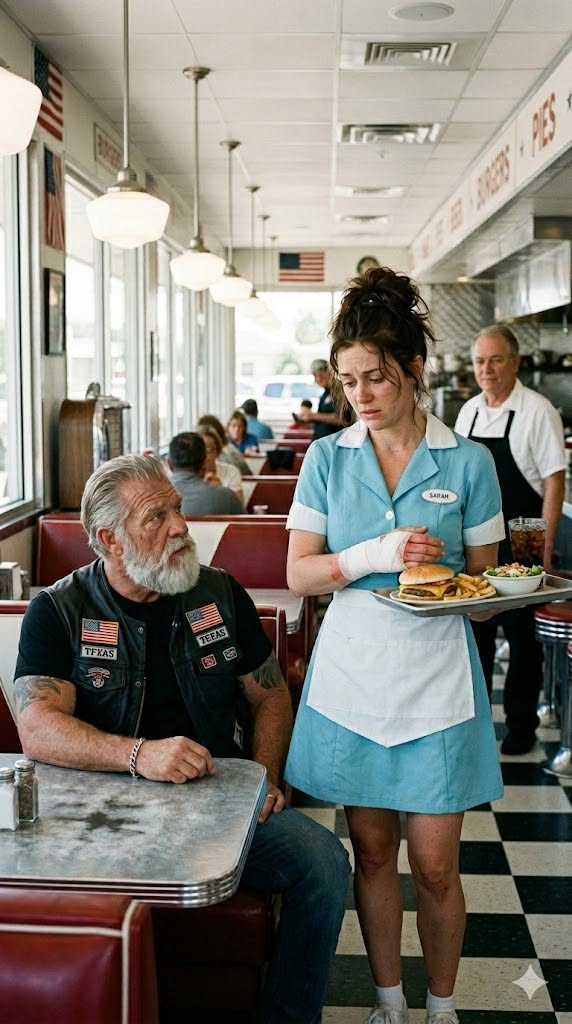
The morning sun baked the asphalt outside Canyon Ridge Diner like it had a personal grudge against Prescott, Arizona. Inside, the air smelled of scorched coffee, frying bacon, and the faint metallic tang of desert dust that never quite left the place. Owen Rourke sat in his usual booth at the back, sixty-eight years old, broad as a barn door, gray beard trimmed short, and hands that still knew the weight of a wrench better than they knew peace. He had once led the Iron Hollow Riders through the kind of years that left scars on the soul and ink on the skin. These days he fixed bikes in a quiet garage on the edge of town, drank his coffee black, and tried not to remember the man he used to be.
Then Callie poured his coffee, and everything changed.
Her name tag read CALLIE. She moved with the careful grace of someone trying not to draw attention, but Owen noticed the tremor in her left hand the second she set the mug down. A white bandage wrapped her wrist and disappeared under the cuff of her uniform. Above it, purple bruising bloomed like storm clouds under skin that had no business looking that way on a twenty-something waitress.
“You okay, miss?” he asked, voice low and rough from decades of cigarettes he no longer smoked.
Callie forced a smile that didn’t reach her eyes. “Just clumsy, sir. Dropped a tray last night.”
Owen had seen enough pain in his life—bar fights, prison yards, hospital rooms—to know the difference between accident and intent. The bruise was too high, too precise. Someone’s hand had closed around that wrist hard enough to leave fingerprints.
She set his plate down and turned too quickly. A small white handkerchief slipped from her apron pocket and fluttered to the floor. Owen bent, picked it up, and froze.
Three blue-stitched initials stared back at him: C.M.R.
Callie Mercer Rourke.
His hands, steady through a thousand dangerous miles, shook as he handed it back. Her face went the color of old bone.
“Thank you,” she whispered, and the fear in that whisper followed him out the door like a ghost.
Outside, the heat hit like a fist. Owen walked past the old silver sedan parked crooked in the employee lot and felt the old instincts rise—the same ones that had kept him alive when the world wanted him dead. He glanced under the rear bumper out of habit.
A small black device clung to the frame, no bigger than a matchbook, wires tucked neat. Professional. GPS tracker. Someone wasn’t just watching Callie. They were hunting her.
Fourteen years of quiet living told him to keep walking. He had paid his debts. He had buried the past. But one memory stopped him cold: his sister’s voice on the phone years ago, begging him to come. He had waited too long. By the time he arrived, there had been nothing left to save except a closed casket and a lifetime of what-ifs.
Owen dropped to one knee, pried the tracker free with a pocket knife, and slipped it into the open window of a passing delivery truck headed for Phoenix. Then he called the only man in town who still owed him a favor.
Sheriff Amos Keene answered on the second ring. “Owen. You retired or just pretending?”
“There’s a girl at Canyon Ridge Diner,” Owen said, eyes locked on the window where Callie moved like a rabbit expecting the hawk. “Someone put a tracker on her car. She’s scared enough to lie about it. I’m calling so somebody knows where to start looking if this goes sideways.”
Amos sighed. “You’re not the law anymore.”
“I called the law. Now I’m telling you I’m not walking away this time.”
By three o’clock the diner’s front window exploded inward in a shower of glass and screaming customers. Three black SUVs blocked the lot. Four men in dark clothes pushed through the broken frame, grabbed Callie by the arms, and dragged her out while Maggie, the owner, shouted and swung a coffee pot that shattered against one man’s shoulder. The SUVs peeled away in a spray of gravel and dust before anyone could get a plate number.
Owen arrived ten minutes later, drawn by the sirens and the sick feeling in his gut. Maggie met him at the door, shaking so hard she could barely stand.
“She left something for you,” Maggie said, voice cracking. “Under the register. Said if anything happened, give it to the old biker who sits in the back booth.”
It was a cheap blue jewelry box. Inside lay a thumb drive and a folded note written in hurried, slanted handwriting.
*My name is Callie Mercer Rourke. Owen Rourke is my grandfather. If I don’t make it back, please get this to someone honest. They’re moving dozens of women in the next forty-eight hours. Please don’t let them disappear like the others.*
Owen read the line about being her grandfather three times before the words sank in. His knees went weak. He had one daughter—Lila—born when he was twenty-two and too drunk on freedom and bad choices to be a father. Her mother had taken her away before Lila could walk. Owen had tracked them once, years later, stood outside a little house in Tucson, saw Lila playing in the yard, and walked away because he believed she deserved better than the man he was.
Now his granddaughter had come looking for him.
And he had almost let her vanish.
At the sheriff’s office, with Amos watching over his shoulder, Owen plugged in the drive. A video filled the screen. Callie sat on the floor of a gas-station bathroom, harsh fluorescent light turning her face ghostly. Her bandaged hand rested against her chest. She looked straight into the camera and spoke like someone recording her own last will.
“My name is Callie Mercer Rourke. I worked as a bookkeeper for a casino group outside Las Vegas. I found ledgers that didn’t add up—money moving through shell companies, payments for ‘entertainment’ that was really women being moved across state lines. I copied everything. My mother, Lila, told me before she died that if I ever needed real help, I should find Owen Rourke in Prescott. She said he made mistakes, but if he got one more chance he would do the right thing.”
Callie’s voice broke. “They know I have the files. They’ve been following me for weeks. If you’re watching this, Grandpa… please. They’re moving dozens of women soon. Don’t let them disappear.”
Owen turned away from the screen, jaw clenched so tight his teeth ached. That single word—*Grandpa*—hit harder than any punch he had ever taken in a ring or a prison yard.
He made three calls before midnight.
Clay Mercer arrived first—seventy, built like a cinder-block wall, still riding the same old Indian Chief he had owned since 1987. Ben Hollis came next, former Army medic with steady hands and eyes that had seen too many young soldiers die. June Walker rolled in last on a matte-black Harley, retired Marine, best shot Owen had ever known, and the only person alive who could still make him laugh on his worst days.
They gathered around the workbench in Owen’s garage while the desert wind moaned outside. Clay studied the printed files and camera stills.
“Four old riders against men with money, private security, and federal connections? We’re not exactly spring chickens anymore.”
Owen looked at each of them. “That girl is my granddaughter. Lila’s daughter. I failed her mother. I won’t fail her.”
June crossed her arms. “Then we stop talking and start planning.”
By dawn they had the layout. Callie was being held in a soundproofed basement room beneath a private office attached to a members-only casino on the outskirts of town. Security was tight but not military. The men holding her were professionals who had gotten lazy because no one had ever pushed back.
They moved before sunrise.
Clay cut the building’s security feed from a utility box two blocks away. June took a sniper position on the roof of a neighboring warehouse with a suppressed rifle and night-vision scope. Owen and Ben went in through the loading dock, moving like ghosts in the gray light. Owen’s bad knee from an old crash screamed with every step, but he kept going. The scar tissue across his ribs pulled tight under his vest. He ignored it.
In the basement they found Callie zip-tied to a metal chair, one eye swollen shut, blood on her lip. When she saw Owen her eyes widened with something between shock and desperate hope.
“You came,” she whispered.
Owen cut the ties with a folding knife. “Always.”
Ben helped her to her feet. She was lighter than she should have been. The alarm started blaring before they reached the stairs. Footsteps pounded down the hall. June’s voice crackled in the earpiece.
“Two coming your way. Move.”
They burst into the parking garage as the first guard rounded the corner. A shot cracked past Owen’s head and punched into a concrete pillar, showering dust across his jacket. Ben returned fire once—controlled, precise—dropping the man’s leg out from under him. They reached Clay’s truck as more guards poured out. June’s rifle cracked twice from above. Tires screamed. They threw Callie into the back and tore out onto the highway with bullets sparking off the tailgate.
For the first time in decades, Owen held family in his arms while the desert blurred past. Callie was shaking but alive. He pressed a clean rag to the cut on her shoulder and felt something inside him crack open that had been sealed for thirty years.
Callie told them her mother had left another drive hidden in an old wooden box at her trailer. When they reached the address, the trailer was still smoldering. Fire crews were just leaving. Owen thought the evidence was gone forever.
Then Maggie pulled up in her old station wagon, face streaked with soot, holding a small charred wooden box she had pulled from the ruins before the officials sealed the site. The initials L.M.R. were burned into the lid.
Inside was a second drive and a sealed letter addressed in Lila’s handwriting.
Owen opened it with hands that hadn’t trembled since the day he buried his best friend in a roadside ditch twenty years earlier.
*Dad, if Callie found you, then I was right to believe there was still good left in you. I saw you outside my house that day in Tucson. I wanted to run to you, but I was scared of what you might have become. I forgave you long before you forgave yourself. I collected records from women who came through the hospital scared and broken. I didn’t know who else to trust. If Callie is in danger, protect her. Do what you couldn’t do for me when I was little. I love you, Dad. I always did.*
Owen folded the letter against his chest and cried in the ashes of his daughter’s life while the desert wind carried the smell of burned memories past them.
The drives together painted a picture that made Owen’s blood run cold: names, wire transfers, medical records of women forced into “private entertainment” for powerful men, a network that stretched from Las Vegas to Phoenix and beyond. Dozens of women were scheduled to be moved out of the country within forty-eight hours through a container yard outside Phoenix.
There was no time for warrants or slow justice.
Callie insisted on being part of the plan. “My mother spent years collecting this. I won’t hide while they disappear the rest.”
Owen hated it. She was hurt, exhausted, still bleeding through fresh bandages. But he saw Lila’s fire in her eyes and knew he couldn’t stop her without breaking something that had only just begun to heal between them.
They set up a meeting with Vincent Carrow—the polished, smiling face behind the entire operation—at an abandoned warehouse on the industrial edge of town. Callie would offer the drives in exchange for the women’s release. It was a lie they all knew Carrow wouldn’t honor, but it bought them proximity.
The night was thick with heat and the smell of creosote. Carrow arrived in a black Escalade with four guards. Behind him, ten terrified women stood zip-tied near an idling panel truck. Callie held up the drive.
“Let them go first.”
Carrow smiled like a man who had never lost anything that mattered. “You still think this is a negotiation.”
More SUVs appeared from side streets. It was a trap. Guards moved in from every direction. Owen grabbed Callie and pulled her behind a stack of pallets as the first shots rang out. Chaos erupted—muzzle flashes, shouting, the sharp smell of cordite. Clay’s truck smashed through a chain-link gate. June’s rifle sang from the darkness. They got Callie and one woman named Hannah into the truck, but the others were already being driven away. Owen took a grazing bullet across his ribs that burned like fire but didn’t slow him. They escaped with blood on the seats and sirens already wailing in the distance.
Hannah, shaking but lucid, gave them the final location: a rusted container yard ten miles outside Phoenix where the remaining women were being held before the final transport.
They went in before first light—Owen, Clay, Ben, and June—moving through the maze of shipping containers like old ghosts who had done this before. The target container was at the far end, padlocked and silent. Ben cut the lock. Inside, ten women blinked against the sudden daylight, weak, dehydrated, but alive.
“We’re here to help,” Owen said, voice steady even though his heart hammered. “Can you walk?”
One by one they climbed out, some leaning on each other. Then Vincent Carrow stepped out from behind a container, flanked by two remaining guards, face twisted with fury.
“You should have stayed retired, old man.”
Owen stepped between Carrow and the women, bad knee screaming, blood soaking through his shirt from the earlier graze. “I tried that. Didn’t suit me.”
Carrow raised his pistol. June’s suppressed shot took the gun from his hand before he could fire. Owen tackled him to the dirt, knees and back burning, age and old injuries screaming, but he held the man down with every ounce of strength left in him until federal agents—called by Callie from a burner phone—swarmed the yard with lights and sirens.
For one heartbeat Owen wanted to finish it. One twist. One final debt paid in blood. Then he remembered Lila’s letter in his pocket.
*Doing better today.*
He stood up, let the agents cuff Carrow, and walked away without looking back.
The case took months. The evidence Lila and Callie had gathered brought down businessmen, crooked cops, doctors, and men who had hidden behind titles and clean suits. Callie testified with her injured hand resting on the stand, voice steady and clear. Owen sat behind her every single day, silent and present.
When it was over she turned to him in the courthouse hallway. “Mom was right about you.”
Owen swallowed hard. “I wish I had been right about myself a long time ago.”
With reward money he refused to keep for himself, Owen opened Lila House Garage on the edge of Prescott—a place for veterans, single mothers, survivors, and anyone trying to rebuild after the world had tried to break them. Under the sign he added two smaller names in quiet letters:
*For Lila Rourke and Rose Rourke — the women we should have protected sooner.*
Callie became a nurse, just like her mother had been. Clay, Ben, and June kept showing up at the garage, fixing engines, driving people to appointments, teaching kids how to change oil, proving that old riders could still carry light into dark places.
Owen never forgot the women they couldn’t save. Some nights the guilt still woke him. But he had learned that regret can either bury a man or teach him how to stand back up and keep moving.
Years later, when Callie asked him to help expand the foundation they had built together, Owen smiled through tired eyes and said, “Tell me where to start.”
She hugged him carefully, the way someone hugs a man who is still learning how to be held.
“You already did.”
And every morning after that, when the bell above Canyon Ridge Diner rang and a new face walked in looking lost or scared or alone, Owen looked up—not because he feared what the past might still demand of him, but because he had finally learned the hardest lesson of all.
Never look away when someone needs help.
The past cannot be rewritten.
But one brave choice can still change everything that happens next.