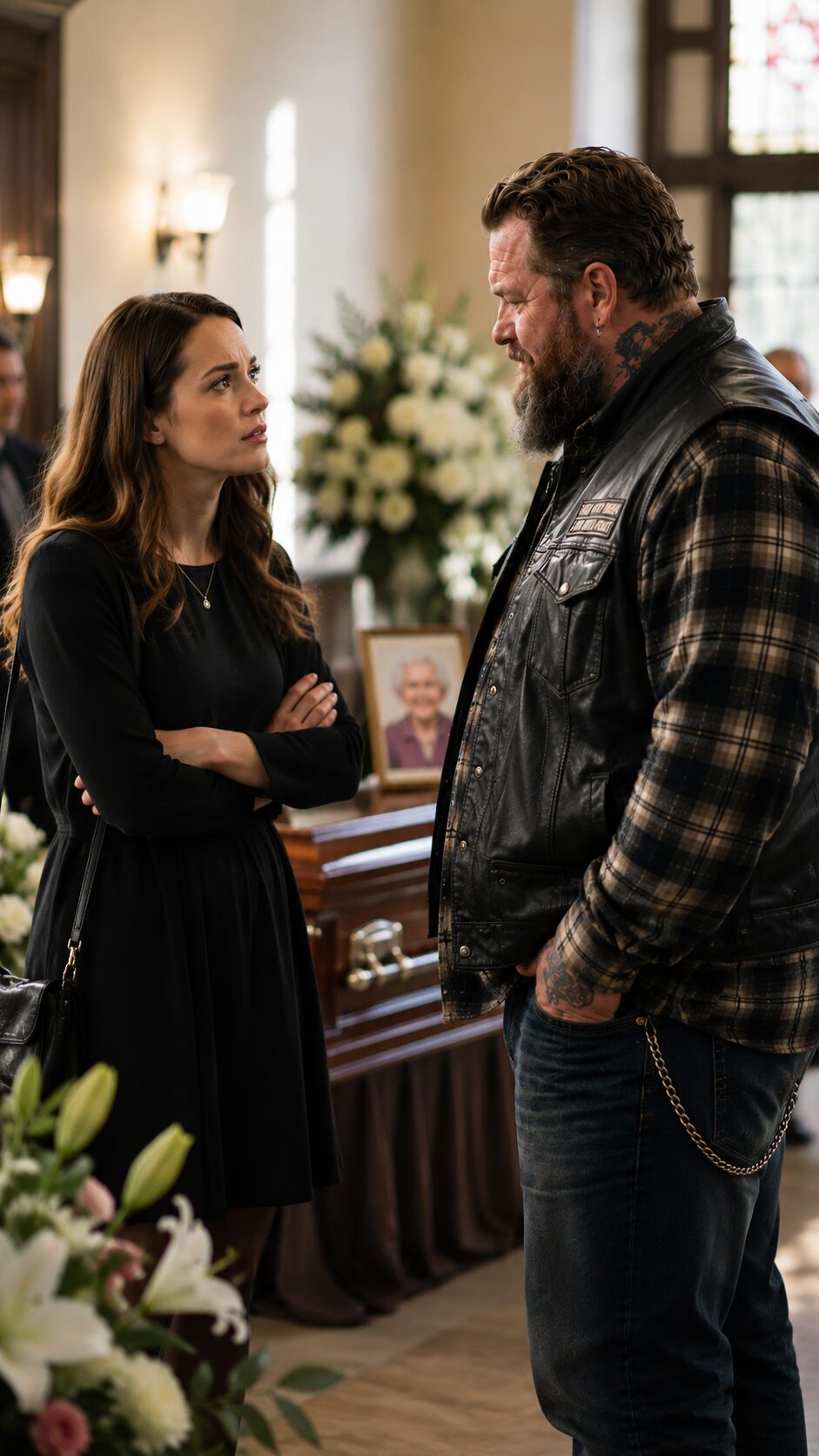
The rain came down in sheets the day we buried my mother, hammering the stained-glass windows of the old chapel in Zelienople like it wanted to wash the whole town away. I stood at the back, numb, watching the spray of white roses on her casket and feeling the familiar weight of guilt settle heavier than the damp air. I had driven in from Cleveland the night before. I had called every Sunday. I had sent the checks for the home health aide. But I had not been there. Not really. Not enough.
That was when I saw him.
He stood near the front, just left of the photograph of my mother that rested on an easel. Tall, broad as a doorway, dressed in a black button-down that had been ironed within an inch of its life. A faded leather vest stretched across his chest. Gray beard trimmed neat. Heavy boots planted like he planned to stay until the last amen. Even from thirty feet away I could see the tattoos climbing his forearms, the kind that told stories most people in this chapel would cross the street to avoid.
A biker. At my mother’s memorial.
People noticed. I heard the whispers. My aunt’s sharp intake of breath. A cousin leaning in to ask who the hell that was. My stomach tightened. In the last year there had been three cases in Butler County of elderly women being sweet-talked out of their savings by strangers who showed up “just to help.” One woman had lost her house. Another had died alone after signing papers she didn’t understand. I had warned my mother about it on the phone more than once. She had laughed and told me not to worry.
Now here he was. Standing like he belonged.
I waited until the final prayer ended and people began drifting toward the coffee urns in the fellowship hall. He didn’t move. Just stood there, head slightly bowed, one scarred hand resting on the back of a pew, staring at her photograph like he had lost something irreplaceable. When he lifted his thumb to his eye and wiped quickly, something in me snapped.
I walked down the center aisle before I could talk myself out of it.
“Excuse me,” I said, voice low but sharp enough to cut. “Who are you, and what are you doing at my mother’s service?”
He turned. His eyes were red-rimmed but steady. Up close he was even bigger—six-five, easy, with a presence that made the air feel smaller. For a split second I wondered if I had just made a very stupid decision in an almost empty chapel.
“Ma’am,” he said quietly, “my name is Owen Maddox. I’m sorry for your loss. Your mother was… she was family to me.”
Family.
The word hit like a fist. I glanced toward the door, half expecting to see someone I could call if this went sideways. “My mother never mentioned any biker friends. And I don’t know you. So I’m going to ask you again—what do you want here?”
He didn’t flinch. Didn’t raise his voice. Just looked at me with something that might have been pity or understanding or both.
“I’ll tell you everything,” he said. “Outside, if you’d rather. I don’t want to upset anyone else.”
We stepped into the narrow vestibule. Rain drummed on the roof. Through the glass doors I could see the hearse waiting in the downpour. I kept my back to the wall, arms crossed, heart still hammering.
Owen reached into the inside pocket of his vest and pulled out a small plastic sleeve. Inside was an old black-and-white photograph—my parents on their wedding day in 1951. My mother young and laughing, holding lilies. My father looking proud and slightly terrified in a suit that didn’t quite fit. On the back, in my mother’s shaky handwriting from the last few years:
*To my biker, Owen. The best grandson I never expected. Thank you for bringing me back to him every Sunday. Love, Evelyn.*
My throat closed. “She gave you this?”
“Two years ago,” he said. “I carry it every day.”
Then he told me the story I should have known years earlier.
Four years ago my mother was eighty-nine. It was late November, the kind of Pennsylvania afternoon where the sky turns the color of old nickel and freezing rain turns every road into a trap. Her car had died in the driveway that morning—starter or alternator, she never knew which. Most women her age would have stayed home and called someone. My mother did not.
Every afternoon for the five years since my father died, she had driven to the little cemetery on the hill outside town to sit with him. She talked to the stone like he could still hear her. The weather, the neighbors, the ache in her hip, the way the light hit the kitchen window at four o’clock exactly the way it used to when he was alive. It was how she kept breathing.
That day she put on her light sweater, took her cane, and started walking the four miles in the freezing rain.
Owen had just finished a welding job at a farm outside town. He was riding his old Harley with the sidecar he’d welded on himself years earlier. He saw the small figure on the shoulder, moving slow, head down against the wind. At first he thought it was someone checking a mailbox. Then he got closer and realized it was an elderly woman, soaked through, one hand on the guardrail like it was the only thing keeping her upright.
He pulled over twenty feet ahead, killed the engine, and walked back to her.
“Ma’am,” he called over the wind, “you all right?”
My mother looked up, chin lifted the way she always did when she was pretending she wasn’t afraid. “I’m fine, young man. I’m just going to see my husband.”
Owen glanced at the empty road, the dark clouds, the way her hands were shaking. “Where is he?”
She pointed toward the cemetery gates barely visible through the trees. “Waiting for me.”
He didn’t argue. He didn’t tell her she was crazy or that she’d catch her death. He simply said, “How about I give you a ride there instead?”
She studied him—the size, the vest, the beard, the bike. Then she surprised him. “I’ve never ridden with a biker before.”
Owen smiled despite the rain running down his face. “Then I’ll make sure your first ride is a good one.”
He helped her into the sidecar, wrapped his spare jacket around her shoulders, and drove like the road was made of glass. When they reached the cemetery he walked her to my father’s grave, then stepped back under a cedar tree and waited in the downpour without checking his phone once. Fifteen minutes. Twenty. She talked to the stone. She cried. She sat in silence. He never hurried her.
When she was ready he helped her back into the sidecar and took her home. On the porch she tried to press money into his hand. He refused. Then he said the words that changed both their lives.
“I’ll be back tomorrow. Until your car’s fixed. You shouldn’t have to miss seeing him.”
She told him he didn’t need to do that.
He told her he already knew that.
He came back the next day. And the day after. For three weeks, rain or shine, he showed up at two o’clock, helped her into the sidecar, drove her to the cemetery, waited in whatever weather God sent, and brought her home. When the car was finally repaired, she hugged him on that same porch and called him the finest grandson she never had.
Owen laughed when she said it, but only because he didn’t want to cry in front of her.
Most people would have stopped there. A good deed. A story to tell at the bar. Owen came back the next Sunday. And the Sunday after that. Almost every Sunday for four years.
He fixed the loose porch rail the first winter. Replaced the broken latch on the garden gate. Changed lightbulbs she couldn’t reach and brought soup when she had the flu. He sat at her kitchen table and listened to the same stories about my father over and over without ever looking at his watch. Every Sunday he took her to the cemetery because she said the wind in the sidecar made her feel young again.
And every Sunday he waited.
I asked him why he kept coming back after the car was fixed.
He rubbed his hands together and stared at the rain-streaked glass. “I never really had grandparents. Mine were gone before I could remember them. Your mother started calling me her grandson, and something in me needed that more than I knew. She made coffee strong enough to strip paint. She kept cookies in a tin older than my bike. She told me what flowers to plant and then stood over me correcting every damn one. She was bossy and funny and kind, and she never once looked at me like I was dangerous. She made me feel like I belonged at her table.”
His voice dropped. “I was in a bad place when I met her. Left a club that had gotten too dark. Lost too many people. Your mother gave me a reason to show up somewhere that wasn’t a bar or a courtroom. She saved me as much as I ever helped her.”
That was when the real story—the one that made my blood run cold—came out.
One afternoon the summer before last, Owen arrived to find a well-dressed man in a cheap suit sitting at my mother’s kitchen table with papers spread out. He claimed to be from the bank, there to help her “consolidate” her accounts. My mother, sharp as ever but tired, had already signed one page. Owen walked in, took one look at the man’s eyes and the way he was steering the conversation, and told him to leave. When the man tried to argue, Owen didn’t raise his voice. He simply stood up to his full height, walked to the door, and said, “You can walk out now, or I can help you. Your choice.”
The man left. Owen called the bank. Turned out the papers were for a reverse mortgage that would have drained the house in six months. The man had been working the county for months, targeting widows. Owen stayed that night, made sure she was all right, and the next day helped her change the locks and put the house in a trust I didn’t even know existed until he told me.
“I never told her I was scared that day,” he said. “But I was. Not for me. For her.”
The last Sunday he took her to the cemetery, she was weaker than he had ever seen her. She still insisted. He tucked a blanket over her knees in the sidecar and drove slower than he ever had. At the grave she held his arm so tightly her knuckles went white. She didn’t talk much. Just placed her hand on the stone and whispered, “I’ll see you when it’s time, Henry.”
Owen looked away when he told me that part. “I think she knew. I carried her back to the sidecar that day. She was so light. When I got her home she made me promise to keep coming even after she was gone. Said somebody needed to tell Henry how the roses were doing.”
Three days later she passed in her sleep.
And Owen came to the chapel because for four years he had stood beside her in life. He was not pretending to be family. He was family.
I covered my mouth with both hands. The rain outside felt like it was inside my chest.
“I’m sorry,” I whispered. “I should have asked. I should have listened when she talked about her biker. I thought it was just… something small.”
Owen shook his head. “She never wanted you to feel guilty. She loved you. She just needed somebody close who could show up when you couldn’t.”
Before he left, I hugged him. Not the polite kind. The kind you give when the world has cracked open and you need something solid to hold onto. He smelled like rain and leather and the faint trace of the same soap my father used to use. He held me the way he must have held my mother’s arm on all those cemetery walks—steady, careful, present.
“Thank you,” I said into his vest. “For being there when I wasn’t.”
He patted my back once, gentle. “Your mom was easy to love. I was the lucky one.”
People still look at Owen Maddox and think they understand him. The beard. The tattoos. The size. The bike. They make their quick little stories and move on.
They don’t know about the ninety-year-old widow walking in freezing rain.
They don’t know about the sidecar rides through every kind of weather.
They don’t know about the Sunday mornings, the repaired gate, the coffee that could strip paint, the old wedding photograph carried over his heart, or the afternoon he walked into that kitchen and stopped a stranger from stealing the last thing my mother had left of my father.
They don’t know that one cold afternoon of stopping became four years of staying.
Owen told me he was just a biker who pulled over on the side of the road.
But that is not the whole truth.
He stopped.
Then he stayed.
And because he stayed, my mother never had to face her final years alone with only memories and a stone that couldn’t answer back. She had someone to bring her to my father. Someone to laugh with. Someone to call grandson. Someone who stood beside her until the very end and then stood beside her casket when the rest of us finally arrived.
Sometimes the people who look the roughest on the outside are carrying the gentlest hearts, and we should be careful not to measure kindness by leather or ink or the shape of a life we haven’t bothered to hear.
A single act of stopping can matter for one afternoon.
But the rarest kind of love is the kind that returns again and again—through rain, through grief, through ordinary Sundays and repeated stories and the slow, quiet business of growing old—without ever asking for applause or reward or even to be called a hero.
If someone you love keeps mentioning a name you don’t recognize, listen. Really listen. Because that name might belong to the person who is quietly holding the empty spaces you can’t see from far away.
Stopping is kind.
Staying is everything.
And sometimes the family we never expected is the one that shows up when the rain is coming down hardest and simply says, “I’ll take you there.”