The Yellow Dress She Was Afraid to Wear
When Graham Weller came home that evening with a small white shopping bag, his wife knew what was inside before he spoke.
It wasn’t jewelry. It wasn’t flowers. It was something far heavier.
Graham stood in the doorway in his leather vest and motorcycle boots, rain still clinging to his gray beard. Most people took one look at him and decided they already knew his story. Maren knew the real one. She knew the man who lifted earthworms from the wet pavement so they wouldn’t die in the sun. The man who lowered his voice around frightened children. The man who carried other people’s small wishes like they were his own.
Tonight the wish belonged to Willow.
Willow arrived at six years old with one backpack and eyes that had already learned how to measure exits. She didn’t cry when she walked through their door. She didn’t ask questions. She simply stood near the wall and waited to see what would happen next.
Before them, she had lived in the back seat of a car with her mother. Not because her mother didn’t love her, but because love hadn’t been enough to keep the world from falling apart. Willow had learned how to sleep curled tight, how to keep her voice small, and how to read the air in a room before she spoke. What she had never learned was how to believe a home could stay.
So she moved carefully through Graham and Maren’s house. She asked permission before touching anything. She folded her pajamas every morning as if preparing to leave. When Maren gave her a toothbrush, Willow asked if she should pack it when it was time to go.
Maren had swallowed hard and answered, “That toothbrush stays here, sweetheart. Just like you.”
Willow had nodded, but her eyes stayed unconvinced.
It took weeks before they understood what she really wanted.
One afternoon Maren found her on the living room floor, studying an old photo album. Willow’s finger rested on a picture of Maren’s niece at a birthday party, standing beside a cake in a bright pink dress.
“Was she special that day?” Willow asked.
“Yes,” Maren said. “It was her birthday.”
Willow studied the photo a moment longer. “She got to dress pretty.”
The words were simple. The ache behind them was not.
Over the next few days the rest came out in small pieces. Willow had never had a birthday cake with her name on it. She had never worn a special dress. She had never stood in front of people who wanted her to smile just because she existed.
One evening while Graham fixed a cabinet hinge, Willow sat nearby coloring. She pressed so hard on the yellow crayon that the paper nearly tore.
“That’s a bright dress,” Graham said.
Willow didn’t look up. “It looks like sunshine.”
“You like yellow?”
She nodded. “I think… if I had a dress like that, I would look warm.”
Not pretty. Warm.
Graham stopped working.
Later that night Maren told him the rest. In the quietest voice, Willow had admitted she wished she could wear a yellow dress one day. Just once. Just to see what it felt like to look in the mirror and see something beautiful looking back.
Graham decided the dress couldn’t wait.
The next evening, still in his work clothes, he rode across town and walked into the first children’s store wearing his leather vest and heavy boots. People stared. He didn’t care. He moved through racks of pastel clothes until a young clerk approached.
“Shopping for your granddaughter?”
“My daughter,” he answered, the word surprising even him.
He described exactly what he needed: sunshine yellow, size six, not pale, not gold. They searched three stores. The sky had already gone dark and rain was falling when he reached the fourth. A tired manager watched him from the front. Graham walked past her without slowing.
In the back corner of the children’s section, an older clerk found him holding dress after dress up to the light.
“Can I help you?” she asked.
“I need a dress for a six-year-old girl,” he said. “It has to look like sunshine.”
She didn’t smile. She simply nodded and helped him search the last rack.
When she pulled out the dress, Graham went still.
Soft cotton. Bright yellow. Tiny white flowers along the hem. He held it under the lights and knew it was right. For a moment he could already see Willow in it—standing in sunlight instead of shadow, finally believing she was allowed to take up space.
He bought it without another word.
When he came home, Willow was coloring at the kitchen table. Maren turned from the sink the moment she heard the door.
Graham set the bag on the table and pulled out the dress.
Willow’s face changed in a way neither of them had seen before. The careful mask slipped. A real child looked back at them.
Graham held the dress up. “What do you think, little bird? Looks like sunshine to me.”
Willow reached out and touched the fabric with both hands. She didn’t grab it. She didn’t twirl. She simply held it against her chest for a long time.
Then her shoulders tightened.
She looked up at him, fear already returning to her eyes, and asked in a voice so small it was almost lost under the rain on the windows:
“If I look pretty… will you keep me?”
The kitchen went quiet.
Maren covered her mouth. Because in that moment the dress stopped being about fabric and color. It became about the question Willow had been carrying since the day she arrived: whether love was something she had to earn by being beautiful enough, quiet enough, good enough.
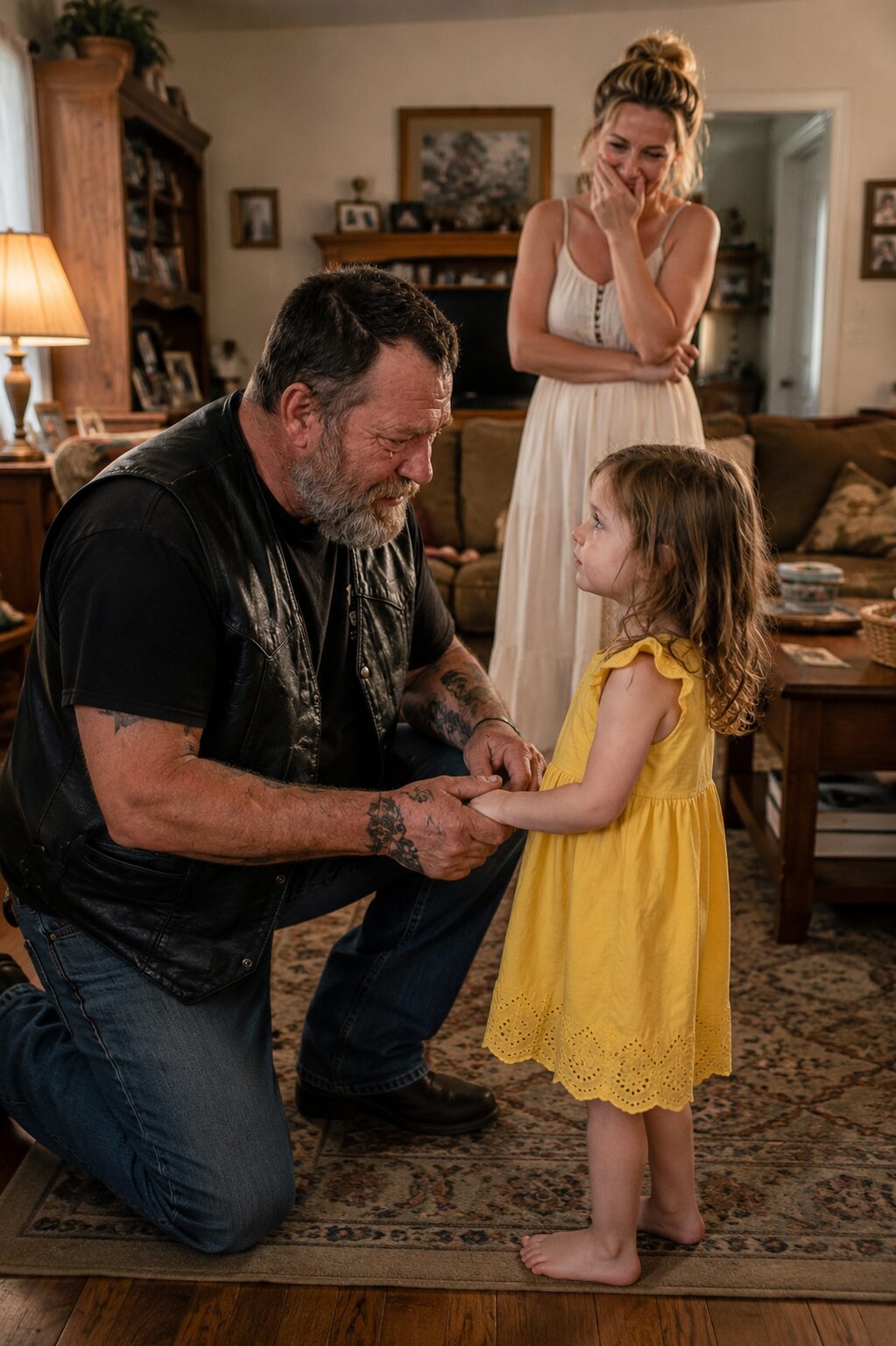
Graham didn’t answer right away. He set the bag down, lowered himself to the floor, and knelt in front of her so they were eye to eye. This big, rough-looking man made himself smaller than her fear.
“Willow,” he said softly.
She clutched the dress tighter.
He took a slow breath.
“I’d keep you in pajamas too.”
Willow blinked.
“You don’t have to look pretty for me to keep you,” he continued, voice steady. “You don’t have to wear a yellow dress. You don’t have to smile the right way or be perfect. You can be sleepy or grumpy or messy or loud or wearing those purple pajamas with the crooked button. You’re not staying here because of what you wear. You’re staying here because you belong here.”
Willow’s chin trembled. “Even if I spill things?”
“Even then.”
“Even if I get scared?”
“Especially then.”
“Even if I don’t know how to be good all the time?”
Graham’s eyes filled. “Nobody knows how to be good all the time, sweetheart. That’s not how families work.”
Willow stared at him like she was hearing a language she had almost forgotten. Then she stepped forward and leaned into his chest. Graham wrapped his arms around her while she cried the kind of tears that come when a child finally puts down a weight she has carried too long.
“You’re kept, little bird,” he whispered. “Dress or pajamas. Every single day.”
Later that night Willow asked if she could try the dress on. Maren helped with the buttons while Graham waited in the hallway, pretending not to be nervous.
When Willow stepped out, the house seemed to brighten with her.
She stood barefoot on the rug, looking down at the yellow fabric moving softly around her knees. For the first time since she had arrived, she didn’t look like a child preparing to leave. She looked like a child who had decided to stay.
Graham pressed a hand to his chest. “Well,” he said, voice rough, “there’s my sunshine.”
Willow smiled—a real smile—and twirled once. The dress lifted around her and she laughed, sudden and bright. Maren laughed too.
Graham took photos that night. Not perfect ones. Real ones. Willow laughing in the hallway. Willow spinning in the kitchen. Willow sitting on his motorcycle in the garage with one small hand resting on the handlebar. And the last one: Willow curled asleep on the couch beside him, one hand still holding the hem of the yellow dress, while Graham looked down at her with the kind of love that doesn’t need to announce itself.
Maren wrote on the back of that photograph: *The night she learned she did not have to earn staying.*
Months passed. Willow stopped asking if she should pack her toothbrush. She left crayons on the coffee table. She asked Graham to teach her how to check the air in a motorcycle tire. One morning she came downstairs in mismatched socks, messy hair, and the purple pajamas with the crooked button.
Graham looked up from his coffee. “Morning, sunshine.”
Willow climbed into the chair beside him. “I’m not wearing the dress.”
“I know.”
She studied him. “You still call me that?”
“Dress or pajamas,” he said. “Remember?”
She smiled and leaned against his arm.
The yellow dress still mattered. She wore it for her first real birthday party, standing beside a cake with yellow frosting and six candles. She wore it the day the adoption papers were signed. But over time the dress became less important than what it had taught her.
She did not need to shine to be loved.
She was loved on ordinary mornings. She was loved with tangled hair and spilled milk. She was loved when she asked hard questions and when she went quiet for no clear reason. She was loved when she made mistakes and when she needed extra reassurance.
Eventually Graham and Maren stopped being her foster parents. They simply became her parents.
On the day the judge made it official, Willow leaned toward Graham in her yellow dress and whispered, “So you really kept me.”
He pulled her close. “I told you I would.”
People in town still saw Graham on his motorcycle and made their quick judgments. They saw the beard, the tattoos, the heavy boots. They never saw the photograph he carried inside his vest pocket—the one of Willow twirling in the yellow dress, laughing like the world had finally become safe enough to trust.
On the back, in Maren’s handwriting, were the same words:
*The night she learned she did not have to earn staying.*
Graham never showed it to many people. But he carried it over his heart every day.
Because that little yellow dress had taught all of them something true.
Some children do not ask directly if they are loved. They ask through the small things they understand—a dress, a birthday cake, a place at the table. The adults who truly see them must learn to hear the deeper question underneath.
And sometimes the most powerful answer a child can receive is not a long speech or a grand gesture.
Sometimes it is simply this:
I’d keep you in pajamas too.