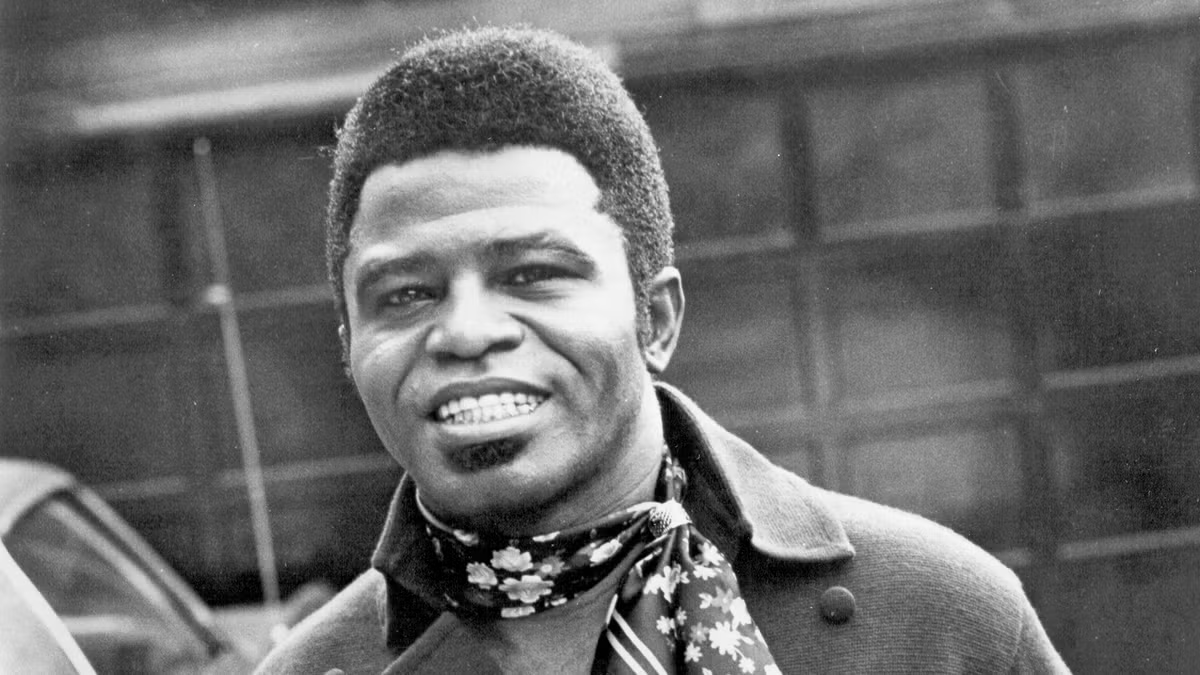
James Brown was the hardest working man in show business. He was also, by the consistent testimony of musicians who performed alongside him, worked for him, or simply encountered him professionally, the most terrifying. Not in the way that genuinely menacing people are terrifying — Brown was not a violent man in any public sense. He was terrifying in the way that absolute standards are terrifying. He demanded from everyone around him a level of preparation and commitment that most musicians, however gifted, found impossible to fully meet, and the gap between what he required and what people delivered was something he did not manage with patience.
1. Mick Jagger Jagger has spoken about James Brown with a reverence that is unusual for him — the reverence of a man who modeled his own stage performance significantly on what Brown demonstrated and who knows it. He has also spoken, more carefully, about the specific anxiety of performing on the same bill as Brown in the early years — of knowing that Brown’s show set a standard of physical performance and audience connection that the Stones were not yet equipped to match. He has said that watching Brown from the wings was simultaneously the most educational and most humbling experience of his early career.
2. Prince Prince idolized James Brown. He has said so clearly and repeatedly across interviews that span his entire career. He modeled his relationship with his band — the precision, the rehearsal standards, the performance demands — directly on Brown’s approach. The fear Prince felt was not of Brown as a person but of the standard Brown represented — a standard Prince spent his entire career trying to meet and that he measured himself against even when the measurement was uncomfortable.
3. Michael Jackson Jackson’s debt to Brown is structural — the footwork, the spins, the relationship between the music and the movement, the understanding that a performance is a complete physical event rather than a singer standing at a microphone. Jackson has described watching Brown perform as a child as the experience that clarified what he wanted to do with his life. He has also described the anxiety of knowing that his own performances would always be evaluated, by himself and by others, against what Brown had established. That anxiety, channeled productively, produced Thriller. That is a good return on anxiety.
4. Mick Fleetwood Fleetwood has described, in memoir and interviews, attending a James Brown concert in the early 1970s and experiencing the specific distress of a professional drummer watching a musical organization whose rhythmic precision exceeded anything he had encountered. Brown’s bands were rehearsed to standards that bordered on military — he fined musicians for missed cues, required specific dress codes, and maintained a level of show discipline that rock bands of the period, with their cultivated attitude toward looseness and spontaneity, found genuinely foreign. Fleetwood said he drove home and ran through his kit for three hours.
5. Little Richard The relationship between Little Richard and James Brown is one of competitive mutual admiration that both men expressed with the specific loudness of people who consider modesty a waste of breath. Richard has said Brown was the only performer alive who made him feel like he needed to try harder. Coming from a man who performed with the contained nuclear energy of Little Richard, this is not nothing.
6. Bootsy Collins Collins played bass for Brown in the early 1970s before leaving to join George Clinton’s Parliament-Funkadelic. He has described the Brown experience with the most specific and most honest account on this list — the fear was real, daily, and productive. Brown ran rehearsals that lasted until midnight or later. He stopped the band mid-song and made them start again if something was not correct. He fined musicians. He demanded. And Bootsy Collins, who went on to become one of the most celebrated bass players in funk history, has said that everything he learned about rhythm and commitment he learned in the terrifying discipline of James Brown’s organization. The fear, he said, made him.