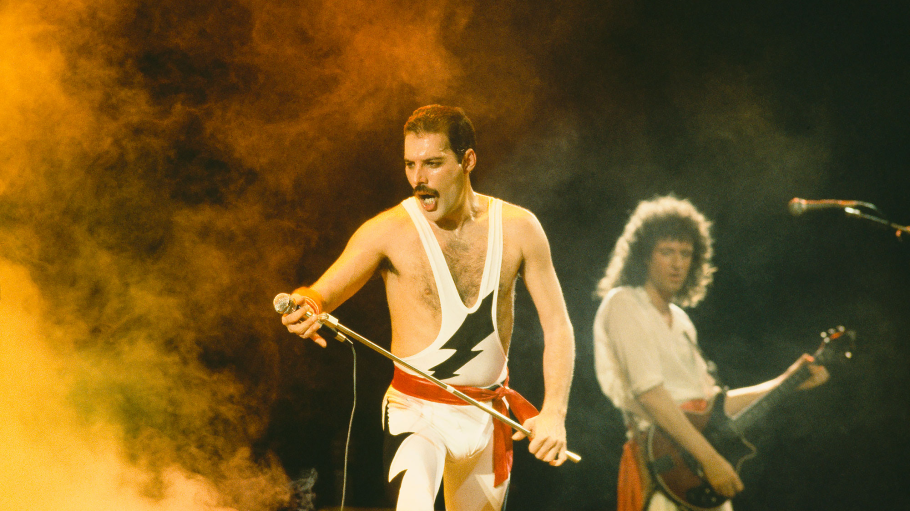
When Queen’s producer Roy Thomas Baker first heard Freddie Mercury sing in a proper recording studio, he stopped the session and asked him to do it again. Not because something had gone wrong. Because he needed to confirm with his own ears that what he had just heard was real. That a human being — standing in a booth, no effects, no studio tricks, no layering yet — had just done that.
This was 1973. The world had no idea what was coming.
Freddie Mercury possessed one of the most scientifically unusual voices ever documented. Researchers who studied recordings of his voice after his death found that he didn’t vibrate his vocal cords the standard way. He had a faster vibrato than almost any other singer on record — a natural, unlearned oscillation that gave his voice that specific, superhuman quality that nobody has ever successfully imitated. He could move between registers — chest voice, falsetto, operatic — with a speed and fluidity that most trained classical singers cannot manage.
And he did it while jumping around a stage in front of 70,000 people. While playing piano. While wearing increasingly extraordinary outfits. While making the whole thing look effortless.
Here are five moments where the voice did something that should not be possible:
1. The live version of “Bohemian Rhapsody” at Live Aid, 1985. Vocal coaches use this footage in classrooms. Not just the performance — the specific technical choices he makes, the way he lands notes, the breath control in a man who has been performing for over an hour.
2. “Who Wants to Live Forever” — the final sustained note. Listen to where it ends. Listen to how it ends. Then ask a professional singer to explain what they’re hearing.
3. The call-and-response section in “We Will Rock You” on the live album. He is manipulating a crowd of thousands like an instrument. This is not charisma. This is architecture.
4. “Love of My Life” at Rock in Rio, 1985. He barely sings it. The crowd sings it back to him in its entirety. He stands at the microphone and listens with an expression that is the closest a human face can come to pure disbelief at the thing they have built.
5. The isolated vocal track from “Somebody to Love.” Strip away the band. Strip away the production. Listen to just the voice. People who hear this for the first time often go very quiet.
Freddie Mercury died at 45. He had known he was seriously ill for years before the public was told. He kept recording. He kept showing up. The last vocals he ever laid down — barely able to stand, according to everyone in the studio — were indistinguishable from his earliest work.
Some voices don’t age. Some voices just are what they are, from the first note to the last.
His was one of them.