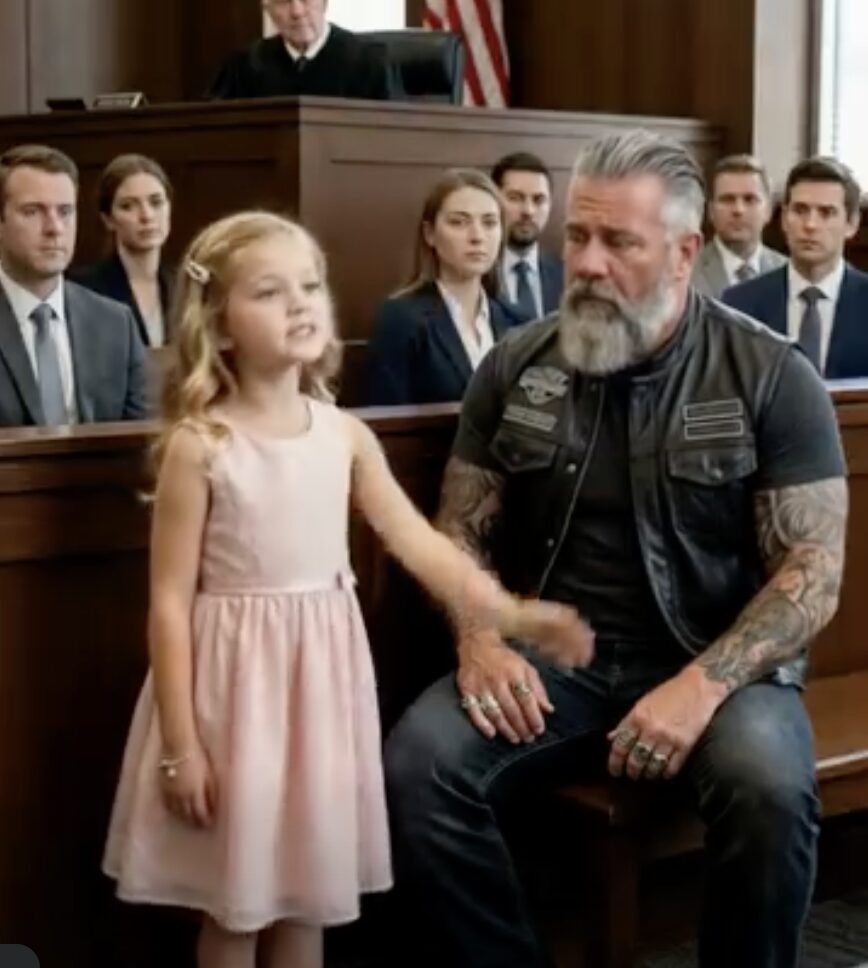
Wade Mercer had grown used to the weight of other people’s assumptions long before he ever spoke a word.
A leather jacket worn thin at the elbows, faded tattoos peeking from his sleeves, scuffed boots that had seen too many miles—people took one glance and filled in the rest of his story. They never glimpsed the man who rose before dawn to cut peanut-butter sandwiches into triangles because his daughter liked them that way. They never saw the father hunched over YouTube at midnight, practicing French braids on a doll so his little girl could feel pretty on picture day. They never met the man whose entire world had narrowed to one small voice that still called him “Daddy” after everything life had taken.
Yet on a damp Monday morning in a Knoxville courtroom, Wade sat at the defendant’s table with his calloused hands clasped so hard the knuckles shone white. Three rows back, his seven-year-old daughter Nora perched in a bright yellow sundress she had named her “courage dress.” He had pleaded with their neighbor, Mrs. Padgett, to keep her home. Nora had simply looked up at him and answered, “You never leave me when I’m afraid, Daddy. So I’m not leaving you.”
He had no reply that could touch that kind of love.
The whole mess had begun two weeks earlier at the sprawling home of Evelyn Hartwell, a well-to-do widow just outside Franklin. Wade had been called in to mend a warped pantry door and tighten some loose handles in her kitchen. He worked the same way he always did—thorough, quiet, and honest—because a man with little else still owned his reputation, and he guarded that reputation like treasure for the child waiting at home.
That same evening Evelyn reported a cherished heirloom necklace missing from the drawer beside the sink. No other contractors. No guests. No forced entry. Only Wade had been inside.
By sunrise the next day the rumor had hardened into fact: the rough-looking biker repairman had stolen from a helpless widow.
Inside the courtroom the air felt refrigerated and skeptical. Wade’s attorney fought gamely, but the prosecutor painted a picture so convincing that even Wade almost wondered if the man was describing someone else. When Evelyn took the stand she was the picture of graceful sorrow—pearls, soft voice, gentle sighs. She hated to point fingers, she said, but the facts left little room for doubt. Wade had been alone near that drawer. The necklace had never vanished before.
Wade stared at the grain of the wooden table. He had learned years ago that anger only convinced people they were right about you.
When his turn came he spoke plainly. Nora had been feverish that afternoon; he had rushed the job, scooped her off the living-room sofa, and driven straight to the pharmacy. Cash payment, no receipt—because when your child is burning up, paperwork is the last thing on your mind.
The jury’s faces stayed blank. Truth, he discovered, can sound very small when everyone else already believes the louder story.
But Nora had been listening.
She remembered the soft blanket on the couch, the way she had kept her eyes half-closed because her head hurt. She remembered Evelyn returning to the room once she thought the house was empty. She remembered the flash of gold as the woman lifted the necklace from the drawer and tucked it into a cream-colored handbag. She remembered the muttered words that had made no sense to a sick little girl at the time: “If he refuses, this will make him listen.”
Now, in the silent courtroom, those words finally clicked into place.
The judge was about to call the next witness when a small hand lifted in the third row. At first only a few people noticed. Then heads turned. The entire room hushed.
Nora rose beside the wooden bench, yellow dress trembling at her knees.
Wade’s heart lurched. “Nora, honey, sit down,” he whispered hoarsely.
But she didn’t sit.
The judge regarded her with kind surprise. “Young lady, do you know what’s happening here?”
“Yes, sir,” she answered, voice small but steady enough. “They’re saying my daddy stole something. But he didn’t.”
Evelyn’s composed mask flickered for a split second.
The judge leaned forward. “What would you like the court to know?”
Nora clutched the hem of her dress. “I was on the couch pretending to sleep. I saw her open the drawer. I saw her put the necklace in her purse. Then she said, ‘If he refuses, this will make him listen.’”
A stunned silence blanketed the room.
Evelyn’s lawyer began whispering urgently. The prosecutor suddenly found his notes fascinating. Wade forgot how to breathe.
The judge asked gently, “Are you very sure, sweetheart?”
Nora nodded hard enough that her pigtails bounced. “I’m sure. My daddy didn’t take it.”
Additional testimony followed quickly—a housekeeper who recalled Evelyn’s irritation over Wade declining unpaid extra work, and a neighbor’s security footage proving Wade and Nora had left far earlier than the widow claimed. The fragile lie collapsed like wet paper.
When the judge returned, his gavel struck once.
“Mr. Mercer, all charges against you are dismissed.”
For a heartbeat Wade couldn’t move. Then Nora’s small hand slipped into his.
“Daddy… can we go home now?”
He blinked back the burn in his eyes and smiled. “Yeah, baby. We’re going home.”
That night they curled together on the worn couch in their little apartment. Wade’s jacket hung on the chair like a faithful old friend. Nora rested her head against his chest.
After a long quiet minute she whispered, “Was my voice too wobbly?”
Wade pressed a kiss to her hair. “That was the strongest voice in the whole world.”
She yawned. “You always say the truth is still true even if nobody listens.”
He pulled her closer. “And today you showed everybody how right that is.”
Weeks afterward Nora taped a crayon drawing beside her bed. It pictured a tall man in a motorcycle jacket holding hands with a little girl in yellow. Across the top, in careful purple letters, she had written: “We told the truth.”
Every night before lights out Wade looked at that picture and felt his chest tighten with wonder.
He had once thought the open road had taught him all there was to know about being strong. He had been wrong.
Strength wasn’t always loud engines or scarred knuckles.
Sometimes it wore a yellow dress and spoke with shaking knees.
Wade had spent years building walls to protect Nora from a hard world.
Yet on the day the world turned against him, the bravest thing in it stood three rows back and saved him right back.
A few quiet truths stayed with him forever after:
The world may rush to judge a man by his jacket, his hands, or his history, but one honest voice can crack open even the coldest room.
Real courage doesn’t mean your hands stop trembling—it means you speak anyway.
Children notice everything adults assume they can hide.
A father’s truest legacy isn’t what he owns, but the honesty his child chooses to carry forward.
And love, when it runs deep enough, teaches the little ones not only how to be protected, but how to stand up and protect in return.
Sometimes the smallest hand in the room holds the loudest truth. And sometimes the strongest person isn’t the one with the biggest voice—it’s the one brave enough to use it when silence would be easier.