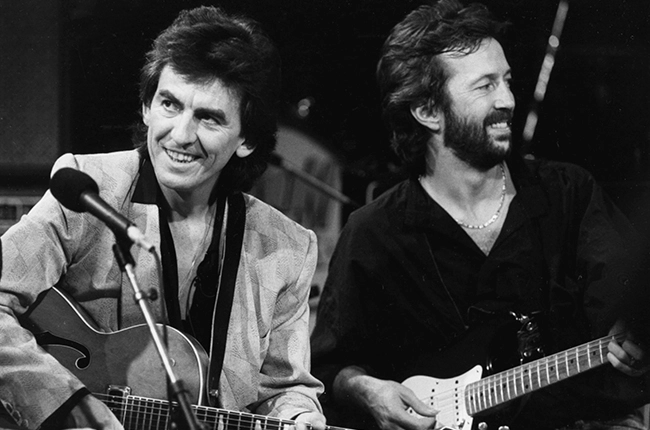
For twenty years, the world accepted a comfortable lie about The Beatles. The lie went like this: Lennon and McCartney were the geniuses, Harrison was the quiet one, Starr was the lucky one, and the hierarchy was fixed and permanent and not worth questioning. It was a lie maintained partly by the sheer commercial dominance of the Lennon-McCartney songwriting partnership, partly by the machinery of Beatles mythology, and partly by Harrison himself — a man so constitutionally opposed to ego and self-promotion that he seemed almost complicit in his own undervaluation.
The truth is more complicated and considerably more interesting. George Harrison spent the years of Beatlemania developing as a songwriter while being allowed, at most, two songs per album. Two. On records that contained fourteen or fifteen tracks, the third member of the greatest band in history was given the space of a supporting actor. His songs were well-received. His bandmates were not always gracious about them. John Lennon, in particular, could be casually dismissive of Harrison’s compositions in ways that Harrison, years later, described with a restraint that said more than anger would have.
And then the Beatles ended. And Harrison walked into the studio and made All Things Must Pass — a triple album recorded in 1970, within months of the breakup, that contains more great songs than either Lennon or McCartney produced in the entire decade of the 1970s. The dam had broken. Twenty years of suppressed songwriting flooded out in a single release and the result was, by the assessment of most serious music critics, the greatest solo album any Beatle ever made.
1. Something (1969) Frank Sinatra called Something the greatest love song written in fifty years. He performed it regularly and for a period misattributed it to Lennon and McCartney in concert — a mistake he corrected, but that reveals how completely Harrison’s contribution existed in the shadow of his bandmates even when the evidence was in front of everyone. Paul McCartney has called it his favorite Beatles song. John Lennon said it was the best track on Abbey Road. These are not the assessments of men describing a lesser talent. They are the assessments of two extraordinary songwriters recognizing something that exceeded what they had produced themselves.
2. While My Guitar Gently Weeps (1968) Harrison wrote this after opening a random page of the I Ching and deciding to write a song about whatever he saw — a philosophical exercise in the idea that nothing is accidental. The result is one of the most emotionally direct songs on the White Album, performed with Eric Clapton on lead guitar — Clapton whom Harrison specifically invited because he wanted a player of undeniable authority on the track. Clapton initially refused, saying you didn’t play on Beatles records. Harrison said this is a George Harrison record that happens to be on a Beatles album. The distinction was already being made.
3. Here Comes the Sun (1969) Written in Eric Clapton’s garden on a spring morning, after Harrison had skipped a particularly tense Apple Corps business meeting and was sitting outside with an acoustic guitar feeling, as he later described it, the relief of being somewhere that wasn’t a room full of lawyers and fractured relationships. The song is entirely about that feeling — the sensation of warmth returning after a long cold period — and it communicates it with a simplicity and directness that is almost impossible to achieve in songwriting. It is the most streamed Beatles song on Spotify. More people have chosen it, independently and voluntarily, than any other track in the catalog. The quiet one.
4. My Sweet Lord (1970) The first number one single by a former Beatle. Harrison wrote it as a devotional — a hymn to Krishna that moved through Christian hallelujahs into Hare Krishna chants in a way that was both musically seamless and spiritually earnest. It was later the subject of a plagiarism lawsuit concerning its similarity to the Chiffons’ He’s So Fine — a case Harrison lost and that he described as genuinely distressing, because he maintained the similarity was unconscious. The song’s power is undiminished by the legal history. It is a piece of music made by someone who believed completely in what he was saying, which is always the difference between a song and a statement.
5. All Things Must Pass (1970) The title track of the album that proved everything. Written partly as a response to the end of the Beatles — to the grief and the relief of it simultaneously — it is a meditation on impermanence that draws on Hindu philosophy, personal loss, and the specific experience of watching something enormous and beloved collapse from the inside. It is not a bitter song. It is not a triumphant song. It is a song that has accepted something difficult and found peace in that acceptance — which is, in itself, a more sophisticated emotional position than almost anything Lennon or McCartney produced in their solo careers.
Harrison died of lung cancer in November 2001. His last words, according to those present, were expressions of gratitude. The quiet one was, in the end, the deepest one.
It took two generations before people figured it out. Lennon & McCartney were the bullwork of the Beatles, but Harrison was the soul. Even in the throws of death, he still put out a credible album of songs, called Brainwashed. It came out after his death and had profound, reflective music on it. After Lennon’s death, McCartney became irrelevant in the lste 1980’s. Harrison had great music on his own, through the 80’s and 90’s, and with the Traveling Wilbury’s. George Harrison’s work until his death had reverence until the end.
Pretty good selection of George Harrison songs. Truthfully I like a lot of the hidden gems by George. Give Me Love Give Me Peace On Earth, Devils Radio, and Savoy Truffle belong the list.