13 bikers thundered into my quiet cul-de-sac like a storm front rolling off the horizon, and for one heart-stopping minute, I was sure I’d just signed my neighbor’s death warrant by reaching for the phone.
I live at 16 Maple Drive, a sleepy pocket of Dayton where the biggest excitement is usually the mailman’s late arrival or Mrs. Kowalski’s prize-winning roses. My name’s Elena Voss. Thirty-eight. Divorced. High-school history teacher who grades papers at 2 a.m. because sleep stopped being kind after my marriage imploded. I moved in nine years ago chasing cheap rent and silence. What I found instead were Harold and Ruth Wainwright—two old souls who turned their front porch into the neighborhood confessional.
Harold was ninety when the bikes came. Ninety, with two Purple Hearts pinned to a chest that had once carried a nineteen-year-old kid through the frozen hell of Korea. He stood six-foot-two in his prime; now the uniform jacket he still owned hung off him like a scarecrow’s coat, medals clinking softly against ribs that had grown brittle. Ruth had been his North Star for sixty-three years. She died twenty-three days earlier, pancreatic cancer eating her from the inside out in a brutal six-month sprint. After the funeral, Harold sealed himself inside 14 Maple Drive like a tomb. The tomatoes he and Ruth had babied every summer rotted on the vine until their stench drifted across the fence line. The mailbox overflowed. The peach tree she’d planted on their first anniversary dropped fruit that turned to mush on the sidewalk. I tried. God, I tried. I left casseroles on the step, rang the bell until my knuckles bled, even slipped notes under the door begging him to let me sit with him. Each time the door cracked open an inch, his voice came out dry as bone: “Thank you, sweetheart. I’m fine.” His eyes never watered. That emptiness terrified me more than tears ever could.
So when the roar split the Saturday-morning quiet, my first thought wasn’t kindness. It was danger.
The bikes—thirteen matte-black and chrome beasts—rolled in perfect formation, exhaust curling like dragon smoke against the pale October sky. Leather vests gleamed with the same patch on every back: an American flag stitched over a set of dog tags that looked battle-worn and real. No sloppy weekend riders. These men moved like they’d drilled this. Engines throttled down in unison, the sudden silence louder than the noise had been. Helmets came off. Grey hair, scars, eyes that had seen too much. My thumb hovered over the emergency call button on my phone, heart jackhammering so hard I tasted copper. Thirteen against one frail old man who could barely shuffle to the fridge for expired milk. I pictured robbery, intimidation, something ugly. My mind raced through every true-crime podcast I’d ever binged. I stepped onto my porch, phone raised like a weapon, ready to scream for the whole block to hear.
Then Harold’s front door creaked open.
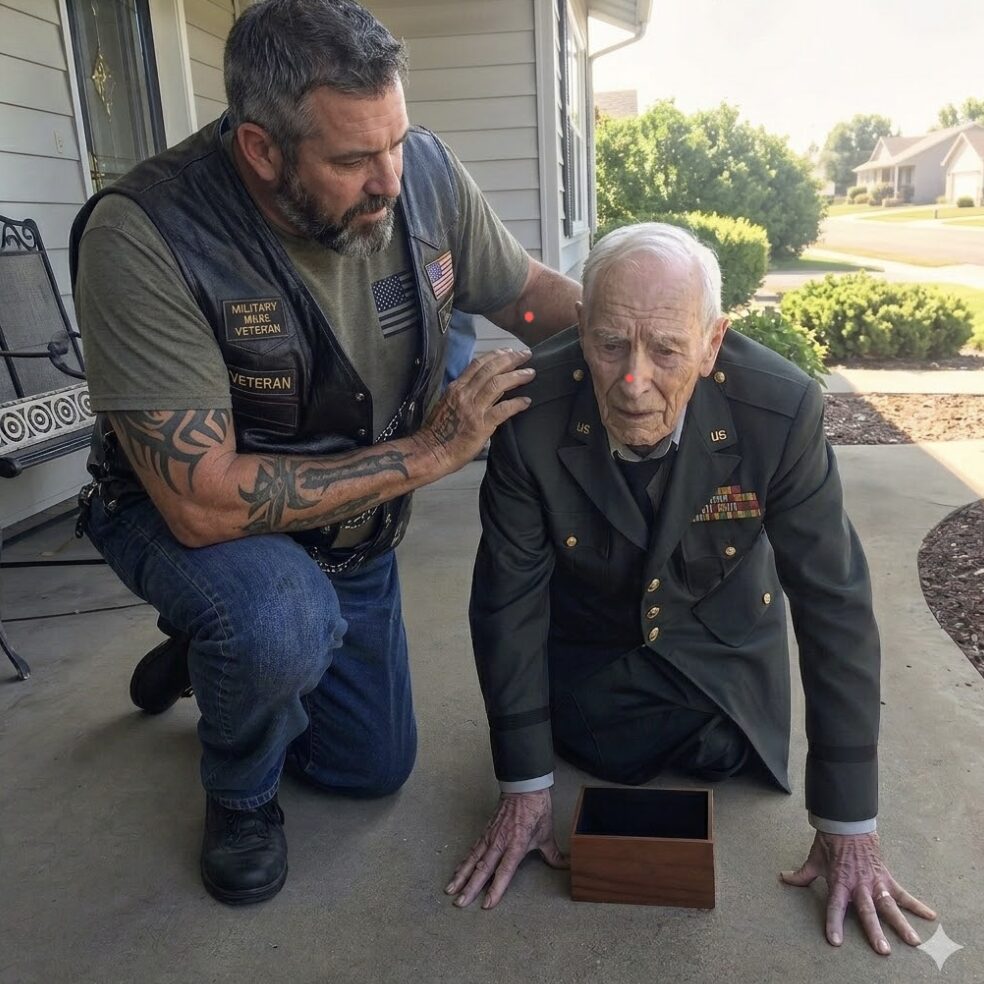
He stepped out in full dress uniform, medals polished to a mirror shine I hadn’t seen in years. His face—sunken, paper-thin skin stretched over sharp cheekbones—looked carved from grief itself. But his spine was straight, the way it must have been in 1951 when he lied about his age and shipped out. The lead biker dismounted first. Sixty-seven, maybe. Jaw scar twisting like a lightning bolt across weather-beaten skin. He reached into a scarred saddlebag and lifted out a small wooden box, simple as a soldier’s footlocker, bound in brass.
Harold saw the box and the world collapsed under him.
He dropped to his knees on the cold concrete with a sound like bone snapping. A raw, guttural sob tore out of him—animal, ancient, the kind that claws its way up from decades of swallowed pain. His shoulders heaved so violently I thought his ribs would crack. The biker—Garrett, I’d learn later—dropped beside him instantly, one massive hand on that frail shoulder, steady as an anchor in a typhoon. “Easy, brother,” he said, voice low and gravel-rough. “Ruth sent us. She wrote us a letter before she left. Asked us to bring you this and tell you she never stopped being proud. Not one damn day.”
I stood frozen at the edge of my yard, phone now limp in my hand, tears I didn’t know I had burning behind my eyes. The other twelve riders formed a silent phalanx behind Garrett—hands clasped, heads bowed, a living wall of leather and ink and shared ghosts. No phones. No whispers. Just presence. The kind of presence that says, *We’ve stood here before. We know what this weight feels like.*
I should back up. Way back.
Ruth had been the spark plug. Tiny, fierce, silver-haired dynamo who could pin you at the mailbox for an hour with stories that made you forget you had groceries melting in the car. She told me about Harold’s nightmares once—how he’d wake clawing at the air, whispering names I’d never heard. “He saw things over there that rewired his soul,” she’d say, eyes distant. Harold never spoke of Korea. Not the Inchon landing, not the brutal winter marches, not the friends who never came home. He planted tomatoes, fixed porch swings, argued with Ruth about the right way to hang the flag on Memorial Day. That was his language of survival.
When the cancer hit, it was merciless. Ruth fought like a lion—chemo that left her bald and defiant under colorful scarves, Harold driving her to every appointment at dawn in his ancient Buick, both of them dressed like they were going to church. I’d wave from my window; they’d wave back, her smile brave, his jaw set like he could will her better. After she was gone, the house went dark. I’d catch glimpses through the curtains: Harold staring at nothing, the TV flickering unwatched.
Unbeknownst to any of us, Ruth had been planning her final campaign from her hospital bed.
Eight months before the end—when she could still type without her hands shaking too badly—she hunted down Garrett’s veterans’ motorcycle club online. No fancy website, just a single page run from a garage: men who’d served in Vietnam, Desert Storm, Iraq, Afghanistan. Men who understood silence that kills. She wrote the letter on yellow legal paper, handwriting slanted and urgent, like the words were racing the reaper.
Garrett read it aloud to his club three weeks after Ruth’s funeral, voice thick. The garage smelled of motor oil and coffee. Twelve weathered faces listened as he recited her words:
“My Harold went to Korea at nineteen. Came home at twenty-one carrying ghosts he never named. I’ve slept beside him for sixty-three years and I still hear the war in his breathing. He keeps his medals and letters in a box behind the winter blankets. Never opens it where I can see. But every Sunday morning he checks it when he thinks I’m asleep. He’s going to be alone soon. The silence will swallow him whole unless someone who understands stands in front of him and says, ‘We know what you carried. It mattered.’ Bring him the box. Bring him the truth that he’s not forgotten. He likes black coffee, hates raisins, and will swear he’s fine. He is not fine. Please. From a dying wife who loves him more than life.”
The vote was unanimous. They didn’t ride the next day. Garrett insisted three weeks was the exact gap a man needs—long enough to feel the abyss, not long enough to disappear into it. They planned every detail: the formation, the box, the second letter Ruth had sealed just for Harold.
And now here they were.
Garrett opened the box for Harold when the old man’s hands trembled too violently. Inside: the medals, yellowed letters tied with twine, a photograph so old the edges curled like burning paper. Five boys in uniform, nineteen and invincible, standing in front of a snow-dusted tent. Harold on the left, skinny, smiling the way young men smile before war teaches them otherwise.
“Three didn’t come home,” Harold rasped, voice cracking like river ice. “Bobby Tran. Mitchell Avery. And Dill—Dillard Hayes. Seventeen. Lied about his age. He was my shadow.” His thumb traced their faces, tears cutting clean tracks through the dust on his cheeks.
The riders didn’t flinch. Garrett pulled out Ruth’s private letter—folded, sealed with a kiss of lipstick that had long since faded. Harold read it alone at first, then aloud in fragments, voice breaking like a dam finally giving way:
“I know about the nightmares, Harold. I know you dream of Dill’s last breath on that ridge. I know the guilt you’ve carried like shrapnel in your heart. You lived for him. Every sunrise, every tomato, every time you held me through my own storms—that was you honoring the boys who couldn’t come home. Let these men help you set the stone down. Not because you’re weak. Because you’ve carried it long enough. Dill wouldn’t want you walking alone anymore. I loved you before the war, through it, and beyond it. Your Ruth.”
For two hours they sat on the porch—Harold and Garrett, black coffee steaming between them. Harold talked. Real words. About the cold that froze rifles solid. About the night Dill took a bullet meant for him. About coming home to a parade and a mother’s hug that felt like another country. The other bikers moved like ghosts through the house: tossing expired milk, fixing the faucet Ruth had nagged about for a decade, mowing the lawn in perfect stripes, harvesting the last stubborn tomatoes. One rider—tattooed forearms like tree trunks—raked under the peach tree for an hour, gathering the salvageable fruit into a bowl he placed on the kitchen counter like an offering.
When they finally throttled up to leave, Garrett pressed a plain white card into Harold’s palm. “Any hour. Day or night. One of us answers.”
Harold looked at the card, then at the empty street, and said the truest thing he’d spoken in sixty years: “Ruth always was smarter than me.”
Garrett grinned. “Yes, sir. She damn well was.”
I retreated to my kitchen after they left, slid down the cabinets to the floor, and cried until my ribs ached. Not just for Harold. For every casserole I’d left and walked away from. For every closed door I’d respected instead of kicking in. Ruth hadn’t respected doors. She’d built bridges across them with nothing but ink and desperation and ferocious love.
Harold is ninety-one now. Every other Saturday the bikes return—two, sometimes three—engines purring low like old friends. They drink coffee on the porch. Harold talks more each time: stories of Korea, of Ruth, of the life he almost lost to silence. Last week I brought over a fresh peach cobbler—no raisins—and he opened the door wide. His eyes had light in them again. “That better not have raisins,” he said, and for the first time in forever, the corner of his mouth twitched toward a smile.
The peach tree bloomed early this spring, heavy with pink promise. I watched from my window as Harold stood beneath it at dawn, hand resting on a low branch like he was touching Ruth’s cheek. His lips moved. I couldn’t hear the words, but I knew.
She heard him too.
And somewhere, thirteen bikers with dog tags on their vests are already saddling up for the next call, the next letter from a wife or mother or brother who refuses to let silence win. Because that’s what love does when the clock is running out—it doesn’t whisper goodbye from the porch. It roars in on thirteen engines, carrying hope in a wooden box and the promise that no one carries the war alone. Not anymore.