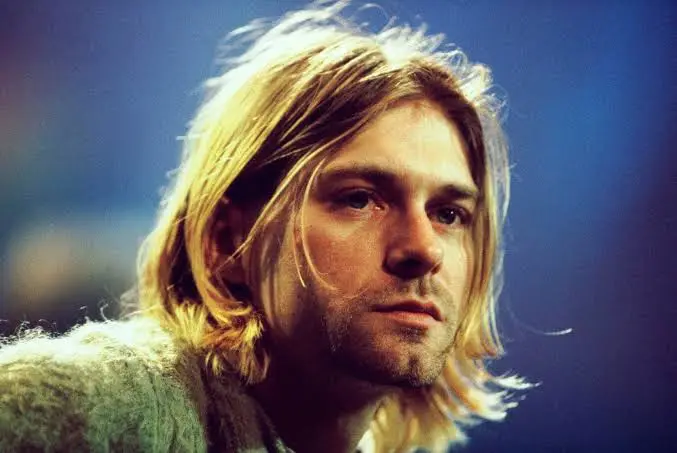
There is a specific kind of terror that arrives not with failure but with success beyond any manageable scale — the moment when the thing you built becomes something you can no longer recognize or control. Kurt Cobain experienced this in the autumn of 1991, within weeks of Nevermind being released, and he spent the remaining two and a half years of his life trying to reconcile it with everything he believed about music, authenticity, and what he had intended when he picked up a guitar as a teenager in Aberdeen, Washington.
Cobain had not expected Nevermind to do what it did. Geffen Records expected it to sell perhaps 250,000 copies — a solid independent-crossover performance that would establish the band commercially without threatening mainstream radio. Instead it sold 400,000 copies in its first week, displaced Michael Jackson’s Dangerous from number one on the Billboard chart in January 1992, and within months had sold millions of copies worldwide and fundamentally altered the direction of popular music. Grunge did not merely become popular. It replaced what had been popular. Hairspray rock evaporated almost immediately. Radio programmers scrambled to find the next Nirvana.
Cobain watched this happen with a mixture of gratification and horror that he was not equipped to separate. He had wanted people to hear the music. He had specifically not wanted to become the voice of a generation — a phrase he rejected publicly and repeatedly, with increasing frustration, because it attached a representational weight to his work that he felt was both inaccurate and suffocating. He wrote songs about his own interior experience, his own pain, his own confusion. The fact that millions of people recognized themselves in those songs was moving to him. The fact that those millions then turned to him for answers was not.
His journals, published posthumously, reveal a man who was trying to maintain a sense of self inside a circumstance that was relentlessly dissolving it. He wrote about feeling like a fraud when playing to 50,000 people, about the distance between what Nirvana meant in a small club in 1989 and what it meant in an arena in 1992. He wrote about people at concerts who he felt were there for the wrong reasons — who had arrived through the commercial wave rather than through the music itself and who represented, to him, everything he had been trying to escape from when he formed the band.
The escape planning was musical before it was anything else. In Utero (1993) was a deliberate act of commercial sabotage — or an attempt at one. Recorded with Steve Albini in a style that was abrasive and difficult and as far from the polished sound of Nevermind as Cobain could get, it was his way of telling the people who had arrived late that this was who Nirvana actually were. Radio programmers initially refused to play it. Geffen was alarmed. The album still debuted at number one, because by 1993 Cobain’s audience would have followed him anywhere, which was precisely the problem.
He died on April 5, 1994. He was 27. He left a note that quoted Neil Young — “it’s better to burn out than to fade away” — which Young has since said fills him with grief whenever he thinks about it. The thing Cobain could not live with was the thing that kept him alive in the memory of everyone who heard him. That is the specific cruelty of his story, and it does not get easier with time.