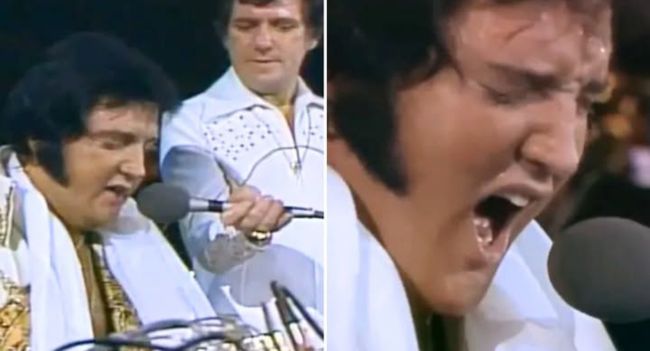
There is a version of Elvis Presley that the world accepted and repeated for decades — the King, the icon, the rhinestone-suited performer who owned every stage he ever walked onto with a confidence so complete it bordered on supernatural. That version is real. It is also incomplete. Because behind the mythology, behind the management machinery that Colonel Tom Parker ran with the precision of a corporation and the secrecy of a military operation, there was a man who felt things with a depth that the public image was specifically designed to conceal.
The night in question was August 16, 1977 — the night Elvis died. But the story that almost no one tells begins several hours before that, in the early morning, when Elvis had returned from a late-night dentist appointment and was in the private quarters of Graceland with a small group of people who had been around him for years. He was 42 years old. He weighed considerably more than he had at his peak. His health had been declining for years in ways that the people closest to him understood but that the public was never permitted to see. He had cancelled concert dates. He had performed shows in states that alarmed the people watching from the wings.
What the people around him that night have described — carefully, partially, in memoirs and interviews released over the following decades — is a man who was not the King that evening. Who was frightened and tired and aware, on some level, that the distance between who he had been and who he was had become unbridgeable. His former wife Priscilla has spoken about Elvis in his final years with a grief that goes beyond loss — the grief of watching someone disappear while still being present.
Elvis had spent the last years of his life in a prison of his own mythology. Colonel Parker had kept him from touring internationally — a decision that has never been fully explained but that many believe related to Parker’s own immigration status — meaning Elvis never performed in Europe, never performed in Asia, never played for the global audience that adored him. He played Las Vegas residencies. He played American arenas. And he came home to Graceland, which was simultaneously a sanctuary and a gilded cage.
The musicians who played with Elvis in his final tours have spoken about the moments backstage when the performance mask came down. About a man who was deeply lonely despite being surrounded by people at all times. The Memphis Mafia — the entourage that travelled everywhere with him — provided company but also insulation, and over time the insulation became a wall.
What the public got was the performance. What the people behind the curtain saw was the cost of it.
When news broke on August 16, 1977 that Elvis had been found unresponsive at Graceland, the world reacted with a disbelief that reflected how complete the mythology had been. Kings are not supposed to die at 42, exhausted and alone on a bathroom floor. But men do. And Elvis, behind everything that had been built around him, was always just a man — one who had carried more than any person should carry for longer than any person sustainably could.
The tears backstage, on whatever night they fell, were the truest thing about him.