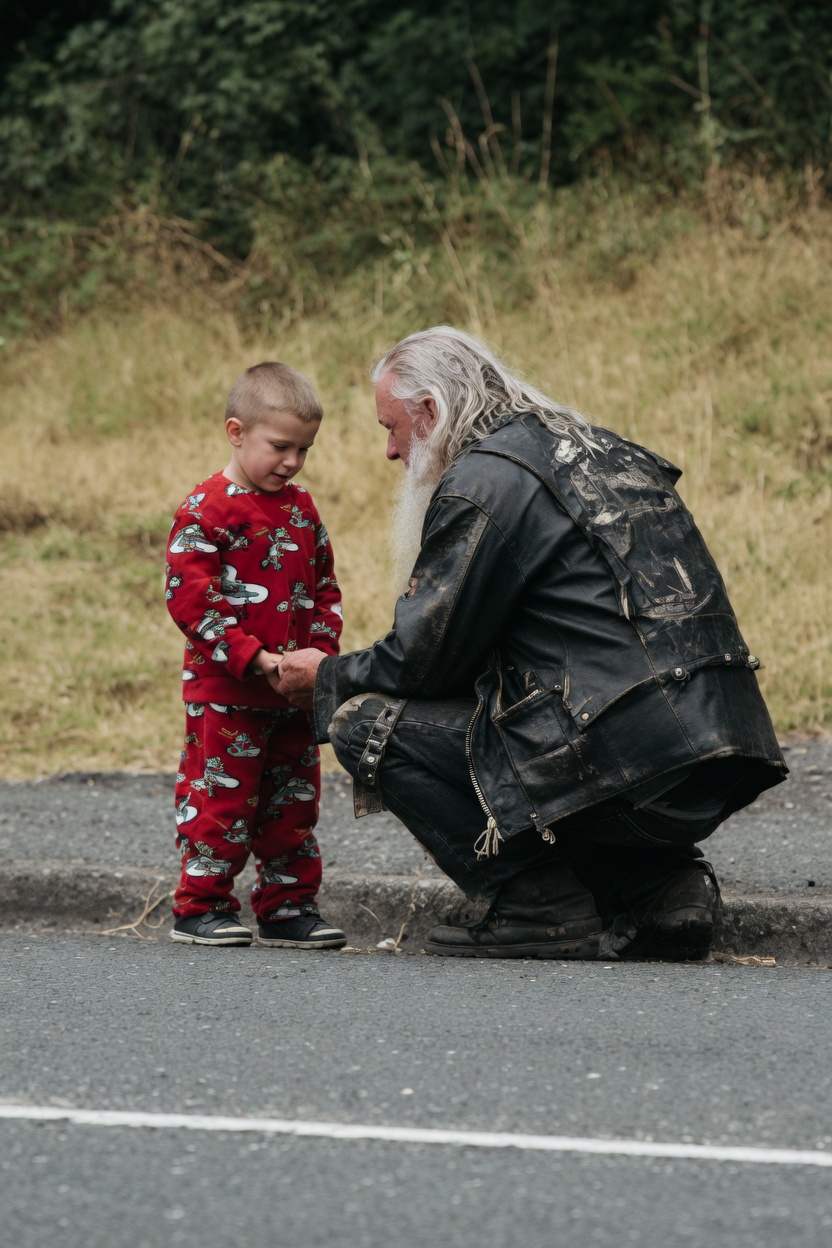
The gas station smelled of diesel and hot asphalt that warm Sunday morning when the little boy changed my life forever. I had just killed the engine on my old Harley when this scrawny seven-year-old with faded bruises on his arms walked right up and ran his small, trembling fingers across the fuel tank like it was sacred.
“My mom loved motorcycles,” he whispered, tears carving clean paths down his dirty cheeks. “Before the cancer took her, she told me angels ride them to heaven. Are you an angel, mister?”
I’m Harlan Whitaker—Hank to anyone who’s known me longer than five minutes—a 68-year-old retired mechanic with more scars on my body than miles left in my bones. I’ve buried friends, survived two tours in Vietnam, and laid my wife Maggie to rest five years ago. But nothing prepared me for the raw, desperate hope in that child’s eyes.
I knelt on the oil-stained concrete, my knees protesting, and looked at him properly. “No, son. I’m not an angel. But maybe my bike and I can help you feel a little closer to one.”
His name was Connor James Reilly. He’d been hanging around Pete’s Gas & Go for months, a ghost in a foster system that had already forgotten him. Mrs. Langley ran the overcrowded home two blocks away—eleven kids, too little money, and even less patience. Connor never begged. He just watched the bikes come and go, chasing the sound of his mother’s memory.
That first day, I let him sit on Bella—my Harley, named after my Maggie, whose full name had been Isabella. He gripped the handlebars like they were a lifeline.
“You can name bikes?” he asked in wonder.
“You can name anything you love enough,” I told him, my voice thick.
He asked again if Bella could take him to heaven. I swallowed the lump in my throat and made him a careful promise instead: a short ride around the block, if his foster mom agreed.
Mrs. Langley barely looked up from the laundry when I explained who I was. Exhausted lines etched her face. “Just bring him back by dinner,” she muttered. She didn’t ask for references. She didn’t care enough to worry.
That single ride around the block became every Sunday morning ritual. I bought him a proper child helmet—matte black with crimson flames—because he said it made him feel fast and brave. We’d ride to the ice cream stand, then sit on the curb while he told me about his mom. How she drew crayon pictures of motorcycles and promised they’d ride all the way to the ocean someday. How she’d whisper that every Harley he heard was her waving hello from heaven.
One morning he leaned against my shoulder and said, “When I hear engines, it doesn’t hurt so much anymore.” I had to turn away and pretend to check Bella’s chain so he wouldn’t see an old man crying like a child.
The bruises on his arms weren’t from the foster home—they came from school, where kids called him “foster trash” and proved it with fists. The home wasn’t cruel, just indifferent. Connor had food, clothes, and a bed, but no one to see him. He was invisible, and that invisibility was slowly killing the light in him.
I started keeping him longer on Sundays. We worked on small projects in my garage—nothing dangerous, just learning how to clean spark plugs and check oil. He called it “mechanic school.” For the first time in years, my quiet house felt alive.
Then one Sunday, he didn’t show.
I waited two hours at the gas station before riding to the foster home. Mrs. Langley opened the door with red eyes. “They moved him Friday. Some accusation from another kid. Social services yanked him out. I don’t know where.”
I spent weeks calling every number I could find, driving to offices, begging for information. “You’re not family,” they kept saying. The system had swallowed Connor whole.
I rode alone on Sundays after that, the empty seat behind me heavier than any passenger. The silence on Bella felt like failure.
Until 2:17 a.m. one rainy night, my phone rang from an unknown number.
“Hank? It’s Connor. I’m scared.”
He’d run away from a nightmare placement. The new “father” had been violent. Connor remembered the license plate number I’d made him memorize months earlier and used a payphone at a gas station forty miles away.
I broke every speed limit in the dark. When I found him huddled behind a dumpster—shivering, fresh bruises blooming on his cheek, blood crusted under his nose—I dropped to my knees and pulled him into my arms. He clung to me like I was the only solid thing left in his world, sobbing so hard his whole body shook.
“I knew you’d come,” he kept repeating. “I knew Bella would bring you.”
I should have taken him straight to the police. Instead, I looked into those terrified eyes and chose him. “We’re going home, son. My home.”
That night, Connor slept on my couch clutching his flame helmet like a teddy bear. I sat in my old recliner watching him breathe, terrified and certain at the same time.
The next morning I called my late wife’s cousin, a sharp family law attorney. What followed was six brutal weeks of emergency hearings, home studies, background checks, and tense courtroom battles. I reported the abuse. Connor bravely testified, his small voice steady even when it shook. Bella became his anchor—we rode after every hearing, after therapy, after the nights when nightmares woke him screaming for his mom.
One golden afternoon by the lake, he looked up at me and said, “I asked if you could take me to heaven. But you brought heaven here instead.”
I had no words. I just held him while the sun set and the engines cooled.
On a crisp December morning, the judge finalized the adoption. Connor James Reilly became Connor James Whitaker. A lonely old biker who thought his life was winding down suddenly had a son.
We celebrated the only way we knew how: a long ride with half a dozen friends from the motorcycle club I’d ridden with for decades. They showed up with gifts and rough hugs, calling Connor “Little Brother” and promising to teach him everything they knew. We stopped at Pete’s Gas & Go, where Pete came running out with tears in his eyes and a free root beer float. We rode past the old foster home, where Connor waved quietly at the kids still trapped inside. And we ended at the cemetery.
I watched my boy carefully place flowers on Maggie’s grave.
“She would’ve loved you something fierce,” I told him, voice cracking. “Always wanted kids. Said if we couldn’t have our own, we’d find the one who needed us most.”
Connor looked up, eyes shining. “Did you find one who needed you, Dad?”
The word “Dad” hit me like a freight train. I pulled him close, leather jacket creaking, and whispered against his hair, “Yeah, kiddo. I found exactly the right one.”
Three years have passed. Connor is ten now—tall, bright-eyed, and full of fire. He’s thriving in school, has real friends, and already talks about the custom bike he wants to build when he’s sixteen. Some nights I catch him polishing Bella in the garage, talking to her like she can hear him.
He still carries my old business card in his wallet, laminated and worn soft at the edges. The one with my number that he memorized from Bella’s plate.
“Why keep that old thing?” I asked him last month. “You know my number better than I do.”
He gave me that serious look only kids can master. “Because it’s proof, Dad. Proof that sometimes when you ask for an angel, one shows up. Even if he’s old, grumpy, and smells like motor oil.”
I laughed until I cried.
People see an old biker in faded denim and think they know the story. They don’t see the nights I still wake up reaching for Maggie, or the way Connor’s laugh has filled every empty corner of my house. They don’t see two broken souls who found each other at a dusty gas station and slowly pieced one another back together, one ride at a time.
Motorcycles don’t just eat miles and spit out freedom. Sometimes they carry lost boys to the exact place they were always meant to be.
And sometimes, if you’re very lucky, an old man who stopped for gas ends up finding heaven right here on earth—in the small arms of a boy who once asked if his bike could take him there.