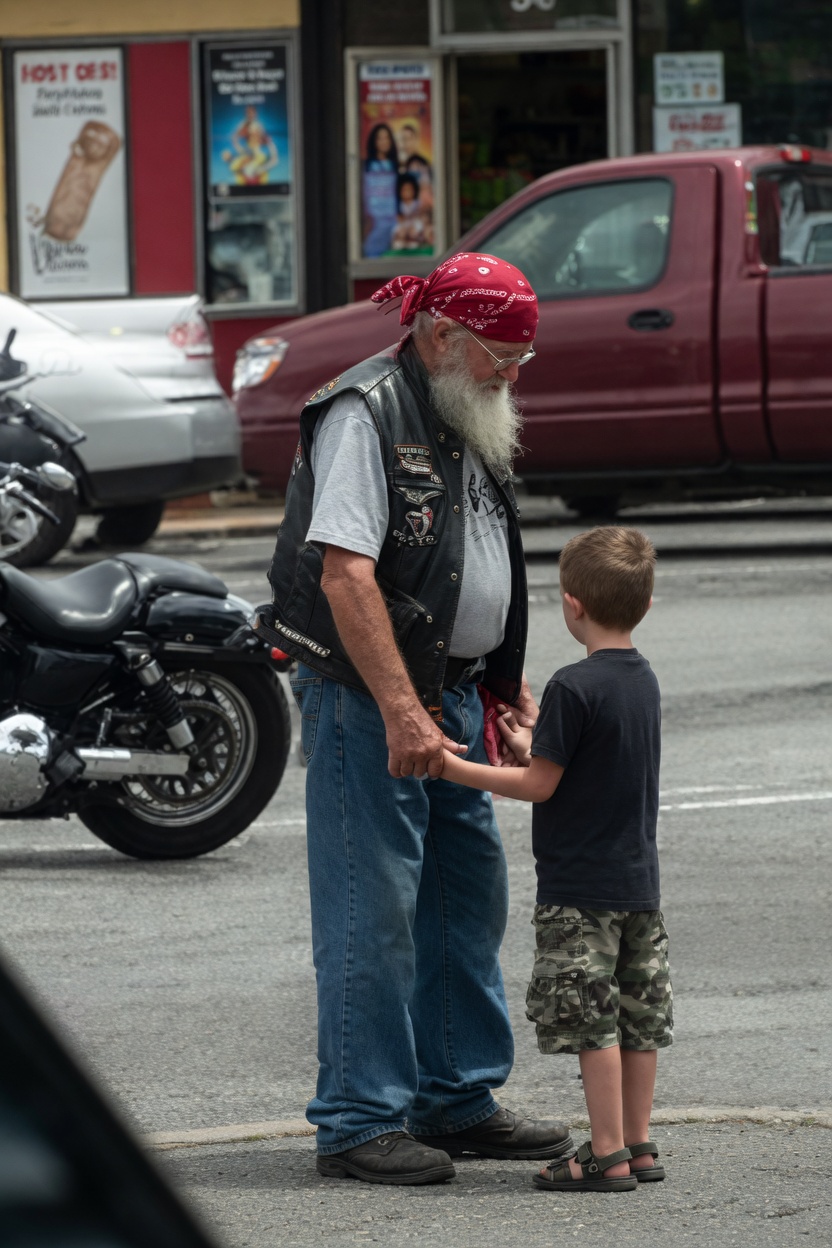
The parking lot hummed with the usual afternoon chaos when my son Noah did the unthinkable. Without a word, he bolted straight toward the most intimidating man I’d ever seen—a towering biker with a thick beard, skull tattoos snaking up his arms, and a leather cut covered in patches. Noah grabbed the stranger’s massive, ring-heavy hand and tugged him toward the playground.
For three years, Noah had only let me touch him. He hadn’t spoken to anyone outside our tiny circle in over a year. Yet here he was, leading this mountain of a man like it was the most natural thing in the world.
Every recess, Noah carefully arranged wood chips into intricate Fibonacci spirals—1, 1, 2, 3, 5, 8—his private sanctuary of order in a chaotic world. And every day, a group of older boys kicked them apart while teachers shrugged it off as “boys being boys.”
Today, Noah had chosen his defender.
“Please restore the sequence,” Noah said in his flat, precise voice, pointing at the scattered chips. “They destroyed it again.”
The biker—clearly caught off guard—crouched down slowly, his leather creaking. “What’s your name, kid?”
“Noah. You smell like exhaust and onion rings. I like onion rings.”
I should have intervened. Instead, I stayed frozen in the car, watching something I couldn’t explain unfold.
The man didn’t pull away. He didn’t laugh or look uncomfortable. When Noah began flapping his hands in excitement, the biker simply waited, patient as stone. I later learned his name was Jax, and he had a daughter on the spectrum. But in that moment, he was just a giant choosing kindness.
“You his mom?” Jax asked when I finally approached, his voice surprisingly gentle.
“Yes. I’m so sorry—he has autism and doesn’t usually—”
“No apology needed,” Jax said, eyes on Noah. “I get it.”
Noah tugged his hand again. “Fix it. Eighteen minutes until the bell.”
Jax looked at me for permission. I nodded.
What followed was pure magic. Jax lowered his huge frame into the wood chips and listened intently as Noah explained the golden ratio and spiral patterns. Other parents stared. Some whispered. The bullies sauntered over, smirking.
“Hey, freak, who’s your bodyguard?” one sneered.
Jax kept working, voice calm but carrying. “You know what’s beautiful about building a motorcycle? Every piece has to fit perfectly. One mistake and the whole thing falls apart. Same with patterns. Same with people.”
The boys edged closer. “This retard—”
Jax rose slowly. The playground seemed to shrink around him. “That word doesn’t belong here,” he said quietly. “This boy is a scientist. An artist. And he’s under my protection now.”
The principal arrived in a flurry. “Sir, you cannot be here—”
“He’s my friend!” Noah shouted—actually shouted. “Jax is fixing my sequence!”
But Jax had already made a call. Ten minutes later, the thunder of engines rolled in. Not ten bikes. Not twenty. Over two hundred veterans from the Iron Guardians MC filled the lot in disciplined formation. They wore leather and patches, yes—but also military honors, autism awareness ribbons, and quiet dignity.
They didn’t storm the playground. They walked.
And then they sat.
Dozens of tough, battle-hardened men and women settled into the wood chips beside my son. They followed his instructions with solemn focus. One former Marine with neck tattoos carefully placed chips according to Noah’s measurements. A woman with a long silver braid asked thoughtful questions about the math. Noah moved among them like a general inspecting his troops, correcting spacing, explaining concepts, completely at ease.
The bullies vanished.
The principal tried to protest, but Noah’s pediatrician—himself a club member in a suit—stepped forward with several other professionals and community leaders who just happened to ride. Documentation was mentioned. Lawsuits were implied. The school suddenly discovered its backbone.
That day changed everything.
Every Friday afterward, a rotating crew of Guardians showed up at recess. Rain or shine, they helped Noah build ever more elaborate patterns. Other children started joining in. Parents who once avoided us began smiling. The boy once mocked as “weird” was now teaching grown adults about mathematics, and they listened with respect.
Six months later, on Noah’s ninth birthday, our quiet backyard party was interrupted by the roar of engines. Forty bikers arrived, each bearing gifts—mathematical puzzles, building sets, books. Jax presented the greatest treasure: a miniature leather vest with “Professor Noah – Iron Guardians Honorary Member” stitched on the back.
Noah wore that vest like armor. To school. To therapy. Everywhere.
When strangers stared, he’d declare, “I’m a Guardian. Guardians protect patterns.”
The bullying evaporated—not just for Noah, but school-wide. It’s difficult to harass the kid whose extended family includes two hundred motorcycle-riding veterans who show up in formation.
Jax still visits. He’s teaching Noah basic bike maintenance, explaining how every system follows its own beautiful logic. Noah absorbs it all, thriving in ways I once only dreamed about.
The boy who once came home crying now walks taller. And when one of his former tormentors finally approached with a mumbled apology, Noah replied in classic fashion: “Your remorse aligns with expected social repair protocols. I accept it.”
Jax translated with a grin: “He says thank you.”
People see the leather, the tattoos, the loud pipes and assume danger. They miss the combat veterans seeking peace on two wheels. They miss the parents who’ve fought their own battles. They miss the quiet heroes who understand that sometimes the strongest protection comes wrapped in the most unexpected package.
Noah still builds his spirals every recess. But now he’s surrounded by friends—real ones. Bikers, classmates, teachers who finally stepped up. And every time I watch him confidently directing his crew, vest proudly worn, explaining the beauty of order to anyone who’ll listen, I remember that ordinary afternoon.
A frightened little boy reached for a stranger’s hand.
And that stranger—along with an entire brotherhood—chose to hold on.
Not all saviors ride white horses. Some ride chrome stallions, smell like engines and onion rings, and answer the call of a child who simply needed someone to see his patterns.