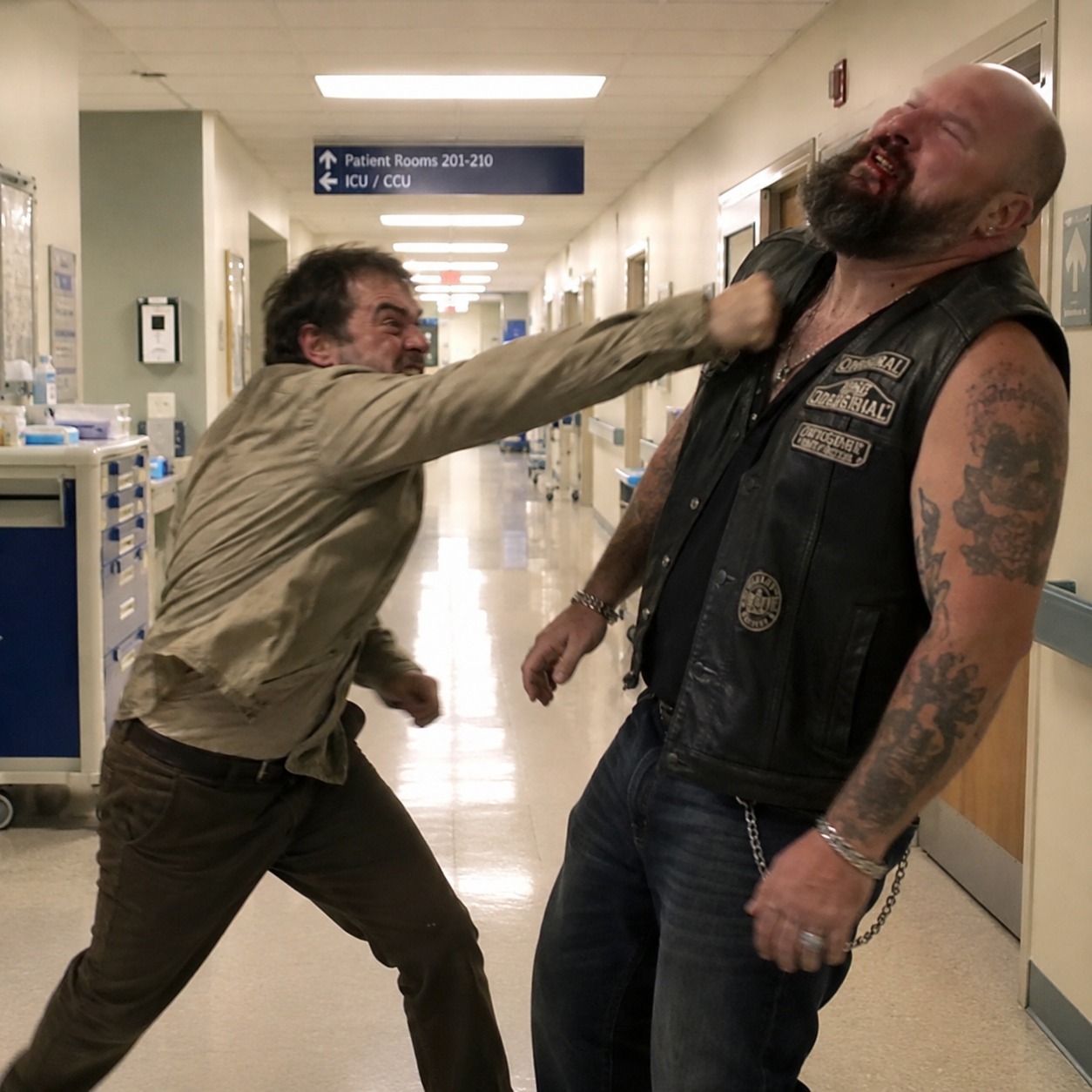
I drove my fist into a biker’s face in the ICU hallway and told myself I’d do it again without hesitation. For about ten minutes, I meant it. Then he lifted his shirt, and the world collapsed around me.
Angela had been gone for eleven days, even if the machines refused to admit it. A drunk truck driver blew through a red light on Route 9, slammed into her side, and sent her car tumbling into the guardrail. It burst into flames. Someone pulled her out before the fire trucks arrived. That was all the police would tell me.
She survived the fire, but the impact had already stolen her. Brain death on arrival, the doctors said. I spent eleven days refusing to believe them, holding her hand, whispering promises, begging her to squeeze back.
Then the biker walked in.
Heavy boots echoed down the sterile corridor. He was a big man—leather vest worn soft from years on the road, thick beard, faded tattoos crawling up his arms. Road dust still clung to his jeans. He stopped at the doorway, eyes moving from Angela’s still face to the ventilator, then to me.
“You’re her husband,” he said, voice low and rough.
“Who the hell are you?”
“I need to tell you something about that day.”
“Get out.”
He took another step forward. I didn’t think. I just swung. My knuckles connected hard with his jaw. He staggered but stayed on his feet. Blood trickled from his split lip. He didn’t hit back. He just looked at me with eyes that were already shattered.
“I had that coming,” he said quietly.
“Leave before I finish the job.”
He didn’t move. Instead, he grabbed the hem of his shirt and pulled it up.
His torso was a horror of fresh burns—raw, pink, weeping skin stretched across his chest and stomach. Deep lacerations ran down his arms, still healing. The smell of ointment and pain hung in the air.
“I’m the one who pulled her out,” he said. “The car was already burning when I got there.”
His name was Glen.
He’d been riding home from a welding job when he saw the crash. No hesitation. He dropped his bike and sprinted toward the flames. The driver’s door was crushed. He smashed the rear window with his bare fists, glass slicing his arms. Inside, the dashboard was melting, smoke so thick he could barely see. He cut the seatbelt, dragged Angela through the broken glass, and hauled her fifty yards across the pavement while his own clothes caught fire. He rolled in the dirt to extinguish the flames on his body.
Then he sat there, burning, refusing help until the paramedics told him she still had a pulse.
“I felt her heart beating against me,” he whispered, voice cracking. “For those few seconds… she was alive.”
But the impact had been too brutal. By the time he reached her, she was already gone. The fire never got the chance to claim her—death had arrived first.
Glen had come to the hospital every single day since. He sat in the parking lot on his motorcycle, waiting for news, too afraid to come inside until he overheard the doctor preparing the end-of-life talk.
“I couldn’t let you do this alone,” he said. “Not when I was the last person who held her while her heart was still beating.”
That broke me.
Eleven days of rage, denial, and exhaustion poured out in ugly sobs. Glen stood there like a silent wall, letting me fall apart without offering empty words or awkward pats. Just presence.
Later, he told me about Connie—his wife who had died of ovarian cancer six years earlier. She had lingered on machines for three weeks while he clung to false hope. Three weeks of watching her body exist while her soul had already left.
“I kept her trapped because I was scared,” he said. “Don’t make my mistake. She wouldn’t want this for you.”
I knew he was right. Angela had always been clear. During a sad movie once, she’d joked, “If I ever end up like that, unplug me. Don’t leave me as a fancy houseplant.”
Glen left quietly that night.
I stayed with Angela until dawn, talking to her, laughing through tears at old memories. At 11:23 the next morning, we let her go. The room fell silent as the machines powered down. Her hand grew cold in mine.
When I finally stepped into the hallway, Glen was waiting in a plastic chair, head bowed. He looked up, eyes red.
“It’s done,” I told him.
“I’m so sorry.”
“You walked into fire for a stranger. Don’t be sorry.”
At the funeral, his lone motorcycle rumbled at the very back of the procession. He stood at the edge of the graveside, head bowed in respect. After everyone left, he approached the headstone and placed a small white button on it.
“It came off her jacket when I pulled her out,” he said. “Been carrying it every day since. Figured it belonged back with her.”
I couldn’t find words. I just gripped his shoulder, two broken men standing in the grass.
Three months have passed.
Every Thursday we meet at the same corner diner. Glen drinks his coffee black. I order whatever ridiculous sweet thing Angela would have chosen. We talk about her—the time she flooded the entire kitchen trying to fix the sink, the night she got lost on a hike and texted me that she was adopting the forest. He laughs like he knew her. In a way, he did.
Last week, he slid a small box across the table. Inside was a delicate silver bracelet with a single angel wing charm.
“Melted down a piece of the guardrail from Route 9,” he explained. “They were replacing it. Seemed right.”
I put it on immediately. I haven’t taken it off since.
People notice the bracelet. They ask why I regularly meet a rough-looking biker for coffee. I tell them the truth:
I once punched this man in the face because I thought he was intruding on my grief. Then I learned he had run into a burning car for my wife. He destroyed his own body trying to save a woman he didn’t know. He carried burns, scars, guilt, and a tiny button from her jacket for months.
He didn’t save her life. The crash had already taken her. But he showed up anyway. He went into the flames when most people would have driven past. He sat in a hospital parking lot every day carrying pain that wasn’t even his to bear.
That kind of love—raw, selfless, and hopeless—deserves more than anger.
Glen didn’t just pull Angela from the fire.
He pulled me out of mine too.