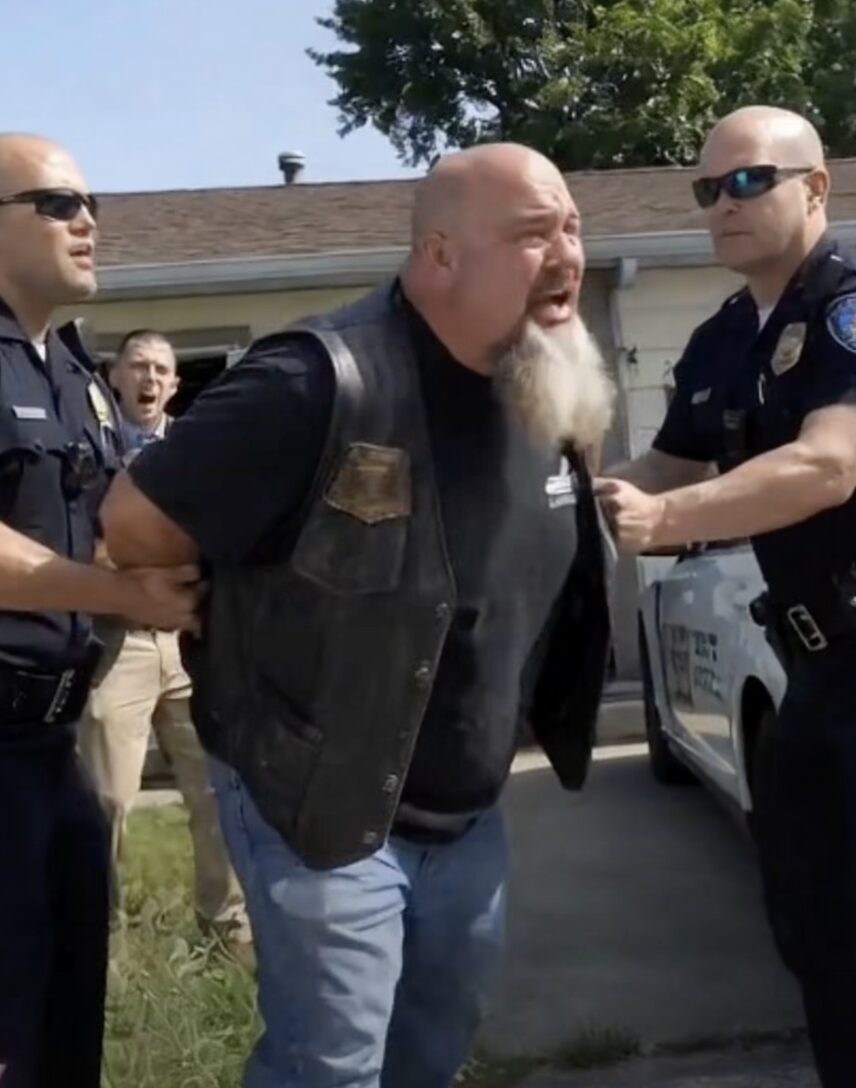
The wind howled through the pine trees behind my house like a grieving widow as I stood on the back porch for the third time that day, staring at the empty yard. My leather vest creaked against my shoulders, the faded patches from twenty years riding with the Iron Sons feeling heavier than ever. At sixty-five, my arms were a roadmap of ink—skulls, roses, the names of brothers lost to the road—and my graying beard hid the tremble in my jaw. But none of that mattered. Not the stares from the cops. Not the whispers from the neighbors. Only one thing did.
Tommy. My eleven-year-old boy. Nonverbal, severely autistic, and the center of my entire broken world.
He had vanished seventy-two hours ago.
I could still see the pinwheel spinning lazily in the afternoon light that Tuesday, its bright colors blurring into a hypnotic whirl. Tommy loved that thing. He’d sit cross-legged in the grass for hours, humming the same three-note melody under his breath, his small hands guiding the spin with surgical precision. He never spoke. Never made eye contact. Dressing himself was a battle that often ended in tears—his or mine. The world called him “severe.” I just called him mine.
His mother, Margaret, had walked out two years earlier, suitcase in hand, eyes red but voice steady. “I can’t do this anymore, Frank. I’m drowning.” She left the divorce papers on the kitchen table and never asked for custody. Tommy hadn’t seemed to notice. But I did. Every single day.
That Tuesday, I’d been in the kitchen, cutting chicken nuggets into perfect eighths and arranging them in the exact four-by-four grid he required. Ten minutes. That’s all it took. I glanced out the window, and the yard was empty. The gate was still padlocked. The six-foot wooden fence showed no damage. His tiny sneakers sat neatly by the back door like silent accusations.
Panic clawed up my throat. I tore through the shed, ripping open boxes, shoving aside lawnmower parts. I dropped to my knees and looked under the porch, dirt staining my jeans. “Tommy!” I shouted, even though I knew he wouldn’t answer. My voice cracked on the third yell. Forty-five minutes later, hands shaking so badly I could barely dial, I called 911.
That delay became my noose.
Detective Morrison arrived in a crisp suit, eyes like flint. He took one look at me—tattooed biker, single dad, fresh concrete pad poured last week for a new shed foundation—and his mind snapped shut. “Why wait forty-five minutes, Mr. Patterson?”
“I was searching,” I growled, voice raw. “He’s my son. I thought he was hiding.”
Morrison’s gaze kept drifting to that concrete slab. To him, it wasn’t a foundation. It was a grave.
They brought cadaver dogs. They tore through my house, flipping mattresses, emptying drawers, shining flashlights into corners where Tommy used to line up bottle caps in perfect rows. Neighbors gathered on the sidewalk. News vans lined the street like vultures. My club brothers—fifteen hardened men in cuts and boots—showed up ready to search every ditch and ravine. Morrison turned them away cold. “Can’t have civilians contaminating evidence.”
“Evidence of what?” Jake, my VP, snarled. “That boy is out there alone!”
Morrison just stared at me. “If he’s out there.”
Day two blurred into a nightmare of flashing cameras and headlines: “Biker Father Last Seen with Missing Autistic Son.” “Fresh Concrete Raises Questions in Patterson Case.” Old CPS complaints—dismissed years ago—were dragged into the light. I sat on the porch steps at 3 a.m., chain-smoking, staring at Tommy’s empty pinwheel now lying still in the grass. My chest felt like it was caving in. I whispered to the dark, “Come back to me, kid. Please.”
On the third day, Morrison returned with a ground-penetrating radar team. They scanned the concrete like they expected to find my boy buried beneath it. I stood there, fists clenched so tight my knuckles bled, watching machines do what my heart already knew was pointless.
Then Officer Chen’s voice crackled over the radio. “Detective… you need to see this.”
Security footage from Mrs. Rodriguez’s camera, two houses down, timestamped 12:04 p.m. There was Tommy. Barefoot. Blue shirt fluttering. Walking down the sidewalk with a strange, purposeful gait I’d never seen. Another camera caught the impossible: at 12:02, he had somehow stacked flower pots like stairs against the fence, climbed six feet of wood he’d never scaled before, and dropped to the other side.
“He’s never done anything like that,” I whispered, tears burning my eyes. “Not once in eleven years.”
They traced him through the city—gas station, strip mall, past Riverside Park. Then the trail vanished near the fast-moving river. My knees buckled when they told me. Divers went in. I sat on the bank, imagining his small body in that cold water, and I broke inside in ways no man should have to.
Seventy-two hours. Hope was a dying ember.
Until my phone rang at 9 p.m.
“Mr. Patterson? This is Karen from Henderson Medical Center. We have a boy…”
I don’t remember driving. Only the screech of tires and my heart hammering like a war drum.
He was in a quiet room, rocking gently on the bed, humming that familiar three-note tune. His clothes were dirty. His feet were blistered and raw. But he was alive.
“Tommy,” I choked out.
His humming grew louder—his happy hum. The one that used to fill our kitchen when I got the nugget pattern just right.
A priest, Father Rodriguez, had found him in the sanctuary of St. Mary’s Church, ten miles away. For three days, Tommy had slept in the basement, eaten quietly from the pantry, and sat motionless in the same pew. The pew with the small brass plaque:
*In Memory of Margaret Patterson. Beloved Wife and Mother.*
The church where Margaret and I had married. Where we’d brought baby Tommy before the diagnosis shattered everything. Before she left.
His neurologist called it “extraordinary spatial memory.” I called it love. Pure, wordless, ferocious love that had driven my silent boy across an unfamiliar city, over fences, through streets, straight to the only place that still held his mother’s ghost.
I called Margaret that night, voice cracking. “He walked ten miles to your memorial, Maggie. Sat there three days. He remembers you.”
Sobs. Long, wrenching sobs. Then, softly: “I’m coming.”
She arrived a week later, trembling in the doorway of Tommy’s room. He was spinning his pinwheel, lost in his rhythm. She stepped inside.
Tommy looked up.
For the first time in eleven years, my son met another person’s gaze. He looked straight into his mother’s eyes… and smiled. A small, tentative, radiant thing that lit up the whole broken world.
Margaret sank to her knees, weeping. “He knows me. Oh God, he knows me.”
Then Tommy stood. Walked to her. Took her hand in his small, calloused one, and placed it gently on his head—the way he had as a toddler when he wanted her fingers in his hair.
She stroked it, tears streaming. His humming swelled, warm and content, filling the room like sunlight after endless rain.
Margaret moved back in last month. Not as my wife. As Tommy’s mother. Two flawed people learning, finally, how to hold the miracle we’d been given.
And last week, something shifted again.
Tommy walked to me in the kitchen. Took my rough, tattooed hand. Placed it on his head.
I froze. Then the dam broke. I dropped to the floor, sobbing into his shoulder like a child, while my boy—my beautiful, silent boy—hummed softly against my chest.
Love doesn’t always need words. Sometimes it’s a ten-mile journey on bare feet. Sometimes it’s a hand on a head. Sometimes it’s a hum that says, *I’ve been loving you all along. You just had to learn how to hear it.*
Tommy is teaching me his language, one quiet miracle at a time.
And I am finally, gratefully, learning to speak it back.