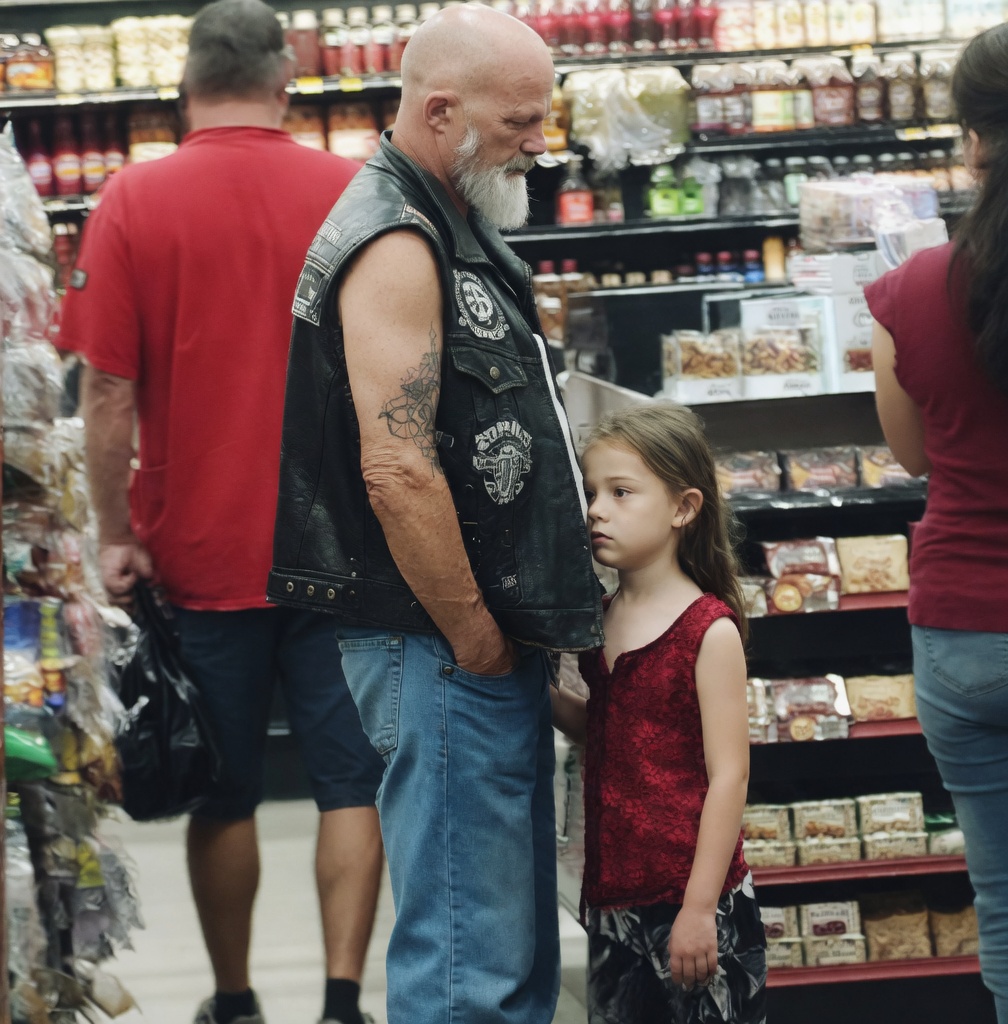
The first time I noticed her, it wasn’t her face that caught me—it was the bruises.
Faint, fading marks on her small arms. Half-hidden, half-revealed as her mother yanked her through the store aisle like she was trying to erase her presence from the world.
I saw it. I clocked it. And like most people who’ve lived long enough to learn what trouble looks like, I told myself it wasn’t my business.
I went back to the coffee aisle.
But the little girl had other plans.
She followed me.
Not running. Not talking. Just… there. A small shadow trailing behind my boots and leather cut, gripping the back of my jacket like it was the only solid thing in the world.
Her eyes were wrong for her age. Too still. Too aware.
Her mother’s voice cut through the store behind us—sharp, controlled panic disguised as discipline.
“Let go of him. Stop bothering people.”
People stared. Phones came out. Judgment followed like smoke. The usual story wrote itself in their heads: big biker, small child, something must be wrong.
They were already deciding what I was before I even had a chance to move.
Then the girl slipped something into my jacket pocket.
A small pink notebook covered in worn unicorn stickers.
I didn’t open it immediately. Something about the way her fingers shook made my chest tighten.
When I finally did, the air changed.
Inside, in uneven crayon strokes, were four words:
He hurts us. Help.
Below it was a drawing. A man with a raised hand. A woman on the floor. A child crying beside her. A house that looked too small to escape from.
And then, in smaller writing:
Not Mommy. Mom’s boyfriend. Please.
I looked up slowly.
Her mother was still performing. Still loud. Still furious. But now I could see it—this wasn’t anger at me.
It was fear. Carefully controlled. Practiced. Like someone acting on instructions they had to follow to survive.
The girl wasn’t clinging to me because I looked safe.
She was clinging because I didn’t look like I could be controlled.
A man like me didn’t belong in polite spaces.
Which meant, in her mind, I might be the only one who couldn’t be scared away.
Her mother grabbed her again.
“We’re leaving. Now.”
The girl resisted just enough to slip behind me, pressing her face into my jacket like it was shelter.
Then she whispered.
So softly I almost missed it.
“Please… can you follow us home? He’s waiting.”
Everything narrowed after that.
Noise. People. The store. All of it faded into something distant and unimportant.
I met the mother’s eyes.
There was no relief there. Only terror. Not of me—but of what was coming if I acted.
I understood that look.
That was the look of someone already trapped.
I turned slightly, pulled my phone out, and hit a single contact.
“Prez. Bear. Code Nightingale.”
A pause.
Then: “Location?”
“Grand Union, Fifth Street. Blue sedan. Child involved. Immediate danger at destination. I need quiet tail, not attention. And call Tina.”
No questions. Just: “On it.”
That was the thing about my world. We didn’t ask why when a child was involved.
We moved.
I bought a candy bar I didn’t want just to have an excuse to stay normal, walked out, and watched the blue sedan pull away with her inside.
I followed.
On my bike, I kept distance. Controlled. Invisible as a man like me could be.
Then I saw them in my mirrors.
Two bikes behind me.
Then three.
No formation. No noise.
Just presence.
My brothers had heard the call.
The house was too normal.
That was the first thing that felt wrong.
Neat lawn. Clean windows. Soft suburban light. The kind of place people assume nothing bad ever happens inside.
We parked across the street.
No words. No signals.
We just waited.
Ten minutes later, something inside shattered the silence.
A scream followed.
That was enough.
We moved.
Four men walked up a driveway like we belonged there more than anything else in the world.
I didn’t knock.
I hit the door once.
It broke like it had been waiting for it.
Inside, everything was exactly as the drawing had warned us.
A man stood over a woman, hand raised mid-strike, face twisted in rage. The child was in the corner, curled into herself like she was trying to disappear completely.
He turned.
“Who the hell are you?”
I stepped forward.
“We’re the ones she called.”
He laughed once—short, ugly.
But it died quickly when he saw us fully.
Not aggression.
Not shouting.
Just four men who had already decided he wasn’t the scariest thing in the room.
His hand dropped.
The woman fell back, gasping.
The silence that followed was heavier than the shouting had been.
Sirens came later. Not fast enough to matter to him anymore.
By the time law enforcement arrived, we were already gone—engines fading into the night like we had never been there at all.
A month passed before I saw her again.
The letter came first.
A small handwritten invitation to a “tea party.” New address. Clean apartment. Safe place.
When I arrived, she opened the door before I could knock.
And she ran straight into my legs like she’d been waiting her whole life for that exact moment.
No hesitation. No fear.
Just trust.
Her mother stood behind her, different now. Lighter somehow. Like someone had finally cut something heavy off her shoulders.
“The therapist said she started speaking again,” she said quietly. “After that night. You were the first person she spoke to in years.”
I didn’t know what to say to that.
The girl pulled me toward a tiny table covered in plastic cups and pretend tea.
Then she handed me a drawing.
This one was different.
No fear. No darkness.
Just a small girl holding her mother’s hand under a bright sun.
And beside them, drawn in thick crayon strokes, stood a large biker in a leather vest—watching over them like a guard who never asked for thanks.
I sat down carefully, far too big for the chair, and accepted the imaginary tea anyway.
People think they know what men like me are.
Most of them are wrong.
But sitting there, listening to a child laugh again, I realized something simple:
Sometimes you don’t become a hero.
Sometimes you’re just the first person who stops walking away.