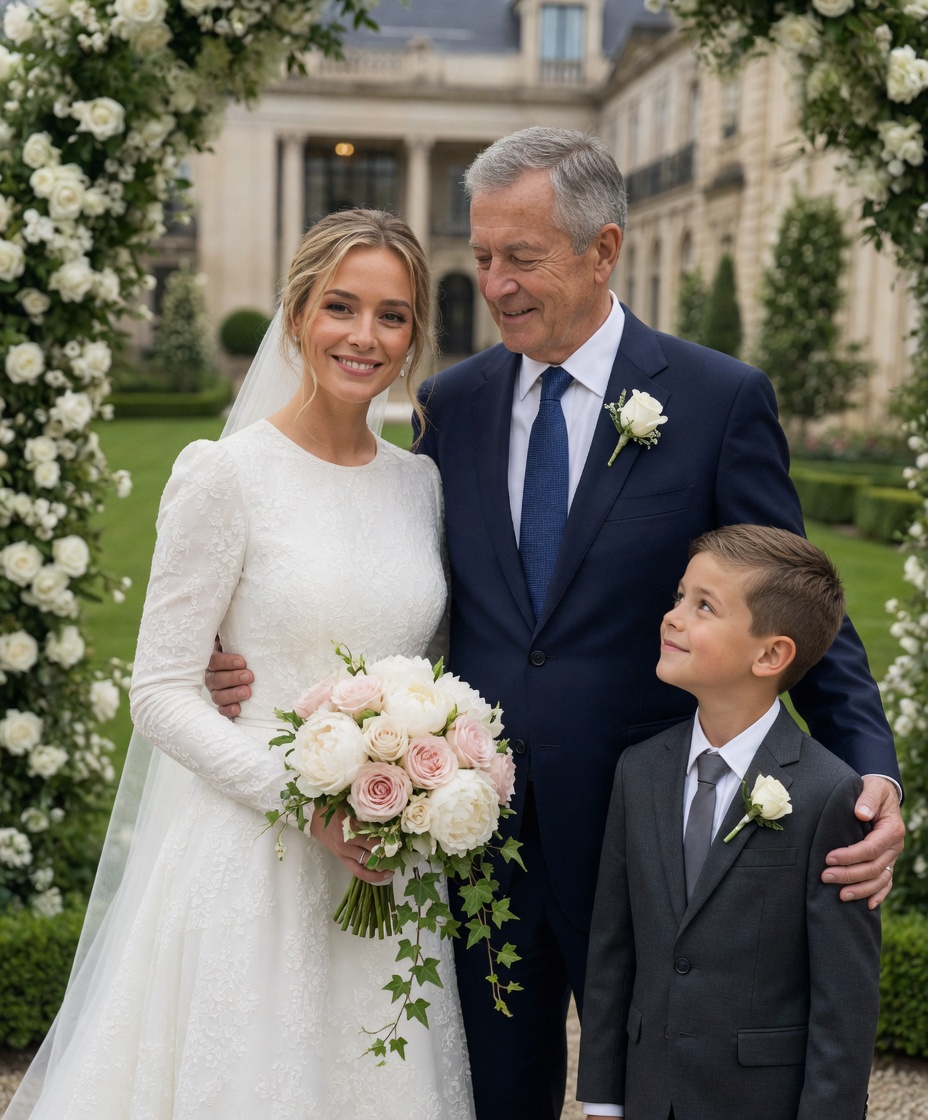
I used to believe I understood sacrifice.
I was wrong.
And it started the day I agreed to marry an eighty-one-year-old millionaire to save my son’s life.
Noah was eight. Small for his age, quiet, the kind of child who never complained even when something was wrong. His father had left before he was born, and I had raised him alone—working double shifts, cleaning offices at night, caring for strangers during the day, always telling myself that love was enough to compensate for everything else we didn’t have.
Until doctors said it wasn’t.
The diagnosis came like a collapse, not a warning.
A serious heart condition. Worsening fast.
“Surgery is the only option,” the doctor told me gently. “But it has to be done within six months.”
I asked the number even though I already knew I shouldn’t.
Two hundred thousand dollars.
The room tilted slightly when I heard it.
“I don’t have that,” I whispered. “I don’t know anyone who has that.”
The doctor didn’t respond. He didn’t need to.
Noah came home with medication, restrictions, and a clock that felt like it was counting down in my chest.
Three weeks later, I took a job caring for an elderly woman in a wealthy estate.
That’s where I met Arthur W.
He was eighty-one, widowed, sharp-eyed, and far more aware of everything around him than people assumed. He moved slowly with a cane, but his mind missed nothing.
The house itself felt like a battlefield dressed as luxury.
His daughter, Vivien, came often—too often—always polished, always smiling in a way that never reached her eyes.
“Father, this arrangement isn’t practical anymore,” she would say. “We should relocate Aunt Eleanor to a facility that better fits her condition.”
Arthur never agreed.
“Eleanor stays here,” he would answer every time.
And just like that, I learned where the real tension lived: not in illness, but in inheritance.
One afternoon, I got the call.
“Noah needs immediate pre-op preparation,” the hospital said. “We’re moving the surgery up.”
My hands went cold.
“I can’t pay yet,” I said. “I just need more time—”
“There is no more time.”
When I hung up, I didn’t even realize I was shaking until Arthur’s voice came from behind me.
“You look like you’ve seen something final,” he said quietly.
I told him everything.
For a long moment, he said nothing.
Then, almost calmly, he said:
“Marry me.”
I laughed once, thinking I had misheard him.
“I’m serious,” he continued. “You get the money your son needs. I get someone in this house my daughter cannot control.”
My breath caught.
“That’s not a proposal. That’s a transaction.”
“Yes,” he said. “It is.”
I said yes two days later.
The hospital received payment the same afternoon.
Noah was scheduled immediately for pre-op treatment.
And for the first time in weeks, I saw color return to his face.
I told myself I would endure anything for him.
I just didn’t know what “anything” meant yet.
The wedding was small in attendance but loud in consequence.
Arthur’s estate turned it into spectacle anyway—photographers at the gates, whispers in every hallway, judgment disguised as curiosity.
I wore a simple ivory dress.
Noah stood beside me in a small suit, smiling like it was a celebration instead of a compromise he didn’t understand.
Arthur’s daughter did not hide her disgust.
She left early.
That night, after Noah was settled back in the hospital for observation, Arthur led me into his study and closed the door.
His voice was calm.
“Now you can learn what you agreed to.”
My stomach tightened.
He placed a thick folder on the desk.
“Open it.”
Inside were legal documents.
My name. Eleanor’s name. Terms I didn’t understand at first.
Then I saw it.
Guardianship papers.
Estate restructuring.
My inheritance designation.
I looked up sharply.
“What is this?”
Arthur leaned back slightly.
“You are now Eleanor’s legal guardian,” he said. “And the primary executor of my estate.”
I shook my head. “I never agreed to that.”
“You agreed to trust me,” he corrected. “That’s different.”
The door slammed open before I could respond.
Vivien.
Two lawyers behind her.
“I knew it,” she said immediately, eyes locked on me. “You manipulated him.”
Arthur straightened sharply. “Vivien, get out.”
“No.” She stepped inside. “She married you for your money. And I’m stopping it before she ruins this family completely.”
One lawyer held up documents.
“We’re filing for elder financial exploitation,” he said.
My pulse spiked.
“You don’t even know me,” I said.
Vivien smiled faintly. “I know enough. Women like you always have a story. A sick child. A tragedy. Convenient timing.”
Arthur’s breathing changed.
“Enough.”
But she didn’t stop.
“And your son,” she added softly, turning toward me. “I hope you understand how fragile custody arrangements can become when someone questions your stability.”
That was the first time I felt real fear.
Not for me.
For Noah.
Arthur took a step forward—but stopped mid-motion.
His hand pressed to his chest.
His face went pale.
“Arthur?” I moved toward him instantly. “Arthur, sit down—”
He collapsed before I reached him.
Chaos broke instantly.
“Call an ambulance!” I screamed.
Vivien stood frozen for half a second—then snapped at her lawyers.
“Get the documents. Now.”
That was when something in me changed.
I stepped between them and the desk.
“No,” I said.
Vivien looked at me coldly. “Move.”
“No.”
For the first time, I wasn’t asking.
I was standing.
Arthur survived that night, but only barely.
ICU monitors. Quiet rooms. Waiting that stretched like punishment.
One week later, the court hearing began.
Vivien came prepared—statements, accusations, polished confidence.
“Your Honor,” she said smoothly, “this woman married my father under false pretenses.”
My lawyer, Mr. Hensley, stood quietly until it was his turn.
Then he placed a sealed envelope on the desk.
“Before you proceed,” he said, “Mr. Arthur W. left this.”
The judge opened it.
Silence followed.
Then more documents appeared.
Handwritten letters from Eleanor.
Medical consent forms.
Witness statements.
Emails.
Proof that Vivien had attempted to transfer Eleanor to the lowest-cost facility available—against her explicit wishes.
Vivien’s confidence began to crack.
“That’s not relevant,” she snapped.
Hensley added another file.
“Then perhaps this is.”
Bank records. Timing. Requests submitted before Arthur’s hospitalization.
The judge read everything slowly.
When he finally spoke, his voice was firm.
“There is no evidence of manipulation by Mrs. W.”
He paused.
“There is, however, evidence of attempted financial exploitation by Ms. Vivien W.”
The gavel struck.
And just like that, it ended.
Three weeks later, Noah walked out of the hospital holding my hand.
Surgery successful.
Recovery stable.
Alive.
He looked up at me quietly.
“Mom… are we okay now?”
I knelt down and held him close.
“Yes,” I whispered. “We are.”
Arthur passed away that winter.
Eleanor stayed with me until the end of her life, surrounded by care she had fought to keep.
And in the years that followed, I built something in their name—a foundation that pays for children’s heart surgeries for mothers who stand exactly where I once stood.
Afraid.
Cornered.
Out of options.
Because I learned something I never expected:
Sometimes survival doesn’t come from doing what feels right.
Sometimes it comes from accepting help in forms you never imagined… and standing firm long enough to turn sacrifice into something that saves more than just one life.