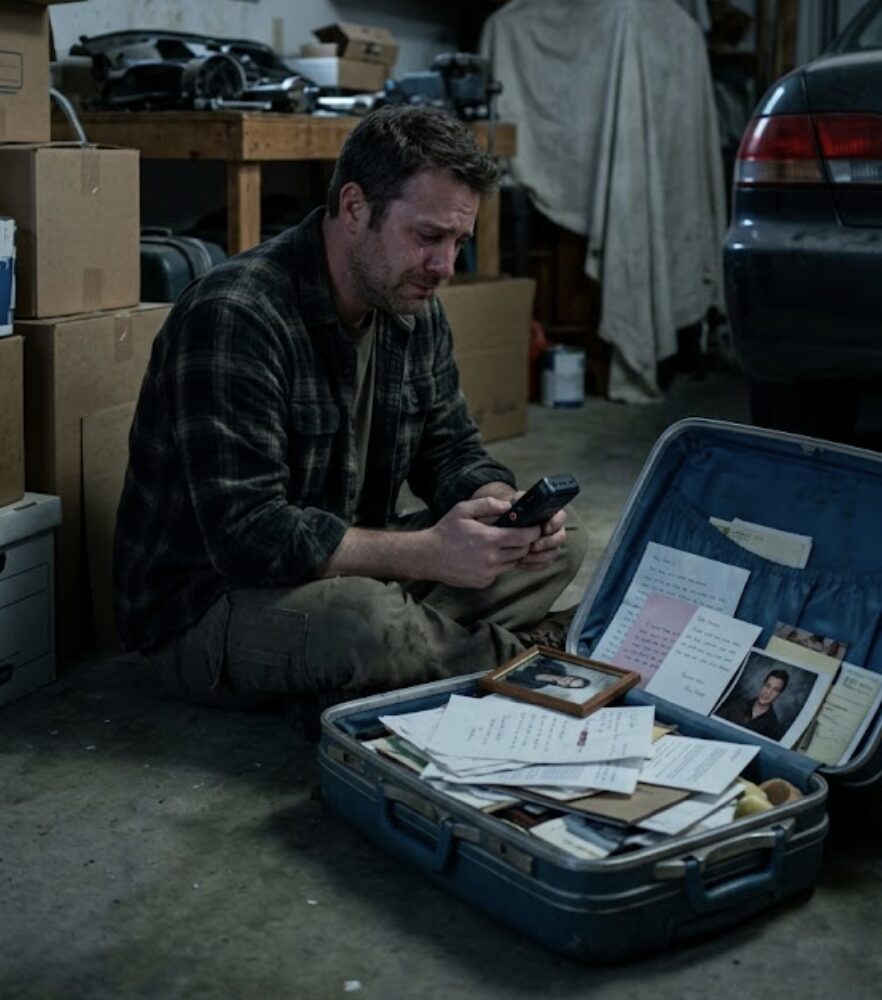
I used to believe the worst thing that could happen to a man was losing his wife.
Then Sarah died.
And I learned something even crueler than grief:
Sometimes you lose the person you love long before they’re actually gone.
And sometimes…
it’s your own fault.
Six months have passed since Sarah died, but the house still feels like it’s holding its breath.
Every morning, for one stupid, painful second, I forget.
I wake up expecting to hear her moving around downstairs — the soft clink of coffee mugs, cabinet doors opening carefully so she wouldn’t wake the kids, her quiet humming drifting through the hallway.
Then reality settles in again.
The silence.
The emptiness.
The truth.
She’s gone.
The kids feel it too.
Especially at night.
Sometimes I catch them staring at the front door when headlights pass the house, like part of them still believes she might walk back in carrying groceries and smiling like nothing ever happened.
Five kids.
Five broken hearts.
And me standing in the middle of all of it pretending I knew how to keep everyone together.
I didn’t.
I barely remembered to feed myself most days.
Laundry piled up in corners. Bills covered the kitchen counter. The sink stayed full no matter how often I emptied it.
People told me grief came in waves.
For me, it felt more like drowning slowly.
The day Sarah died didn’t feel tragic at first.
That’s the part that haunts me most.
It was ordinary.
Warm sunlight filled the backyard while the kids played tag near the fence. My mother sat under the patio umbrella sipping iced tea while Sarah laughed at something our youngest said.
I was standing at the grill burning hamburgers because I never learned how to cook anything without supervision.
Sarah teased me about it.
“You’re ruining dinner,” she laughed.
“I’m adding flavor,” I argued.
She rolled her eyes.
God… I can still see that smile.
Then, maybe twenty minutes later, everything changed.
Sarah pressed a hand against the table.
“You okay?” I asked.
She nodded weakly. “Just dizzy.”
But her face had gone pale.
A few minutes later she tried standing up and collapsed before she even took two steps.
The ambulance came fast.
Just not fast enough.
And after that…
life stopped making sense.
I don’t remember entire weeks after the funeral.
Only flashes.
My oldest son crying in the bathroom when he thought nobody could hear him.
Lucy refusing to sleep in Sarah’s room because it still smelled like her perfume.
My youngest asking when Mommy was coming home.
Questions I couldn’t answer.
Pain I couldn’t fix.
Through all of it, my mother took control.
At the time, I thought she was saving us.
She organized the funeral. Paid bills. Cooked meals. Took the kids whenever I completely shut down.
“You need rest,” she kept telling me.
“You need help.”
And she was right.
I did.
So I stopped questioning things.
Stopped paying attention.
Stopped noticing how often Sarah’s name disappeared from conversations.
How quickly my mother rearranged the house.
How naturally she slipped into spaces that used to belong to Sarah.
Six months later, I finally realized I couldn’t keep living like a ghost.
The house looked abandoned. I looked worse.
So one Friday afternoon, I asked my mother if she could take the kids for the weekend while I tried to get things under control.
She agreed immediately.
Too quickly.
The kids packed bags upstairs while I cleaned the kitchen.
Then Lucy appeared beside me.
She was eleven, but grief had aged her somehow.
Kids shouldn’t have eyes that tired.
“You ready?” I asked softly.
She didn’t answer.
Instead, she stood there twisting the sleeve of her sweater around her fingers over and over.
Something was wrong.
“I don’t want to go to Grandma’s,” she whispered.
I frowned.
That wasn’t like Lucy.
“She’s just helping for the weekend.”
Lucy looked toward the hallway nervously before lowering her voice even more.
“Before Mom died… she told me not to trust Grandma.”
My entire body went still.
“What?”
Lucy swallowed hard.
“She said… one day you’d understand when you found the blue suitcase.”
A cold feeling spread through my chest instantly.
Sarah had never talked like that.
Never filled the kids with suspicion or drama.
Especially not about family.
But Lucy wasn’t lying.
I could see fear in her face.
Real fear.
“Where’s the suitcase?” I asked quietly.
“In the garage.”
I didn’t say another word.
I walked straight outside.
The garage smelled like dust, gasoline, and old cardboard. I hadn’t stepped inside since Sarah got sick.
For months I avoided it without realizing why.
Maybe because too much of her was still in there.
Her gardening tools.
Old holiday decorations she labeled in neat handwriting.
The bicycle she kept promising to fix.
I searched for almost twenty minutes before I finally saw it shoved behind storage bins near the back wall.
A small blue suitcase.
Hidden carefully.
Like she never intended anyone to find it unless they absolutely had to.
My hands shook carrying it into the light.
The zipper stuck halfway.
When I finally forced it open, papers spilled everywhere.
At first, anger hit me so hard I nearly stood up.
Printed screenshots.
Messages.
Photos.
The same nightmare that almost destroyed our marriage months earlier.
I remembered every second of it.
Anonymous screenshots sent to my phone late one night.
Sarah talking to another man.
Late-night conversations.
Flirting.
Meeting plans.
I remembered confronting her.
The way her face completely collapsed when she realized what I believed.
“It isn’t real,” she cried.
“You have to trust me.”
But I didn’t.
God help me, I didn’t.
I wanted to believe her.
But the messages looked real.
Detailed.
Convincing.
And once doubt enters a marriage, it spreads like poison.
For months afterward, we argued constantly.
I became cold.
Suspicious.
Distant.
I started questioning everything she did.
Every late errand.
Every text notification.
Every smile that seemed slightly forced.
And Sarah…
Sarah stopped looking at me the same way.
Not angry.
Just heartbroken.
Sitting in that garage now, staring at those same printed conversations, I felt all that rage rising again—
until I noticed something strange.
The messages didn’t sound consistent.
The personality shifted between screenshots.
Different writing styles.
Different tones.
Like multiple people pretending to be one woman.
Underneath the papers sat another folder.
On the front, written in Sarah’s handwriting:
“Please read everything.”
Inside were screenshots of fake social media profiles using Sarah’s photos.
Editing software.
Draft messages.
Step-by-step instructions.
Proof.
So much proof.
And one detail appeared again and again in every screenshot.
My mother’s email address.
I stopped breathing.
No.
No, no, no.
I kept reading desperately, hoping I misunderstood.
But every page made it clearer.
This wasn’t random.
This wasn’t confusion.
Someone had built this carefully.
Deliberately.
Patiently.
To destroy my marriage.
And the person who did it…
was my own mother.
I sat there on the garage floor for what felt like hours.
Not crying.
Not moving.
Just empty.
Like my brain refused to process something that evil.
Then I noticed a small recorder tucked into the corner of the suitcase.
A sticky note sat on top.
“For Daniel.”
My stomach twisted.
I almost couldn’t press play.
Part of me already knew hearing her voice would destroy me.
But I needed to know.
Static crackled softly.
Then Sarah spoke.
Weak.
Tired.
“If you’re listening to this… I probably ran out of time.”
My chest shattered instantly.
She explained everything slowly.
How she discovered fake profiles pretending to be her.
How she realized someone was sending messages from those accounts to create fake evidence.
How she confronted my mother privately.
How my mother denied everything while quietly continuing.
Then Sarah started crying softly on the recording.
“I tried to make you believe me,” she whispered.
“I tried so hard.”
I covered my mouth with my hand.
Because suddenly I remembered every moment clearly.
Her begging me to trust her.
Her reaching for me during arguments while I pulled away.
The nights she cried alone in bed because I wouldn’t even look at her.
And still…
I chose the evidence over the woman I loved.
Then Sarah said the words that broke me completely.
“She doesn’t want to lose you,” she said weakly.
“She wants to replace me.”
Everything suddenly made sense.
Every argument my mother started between us.
Every criticism disguised as concern.
Every subtle comment about Sarah not being “good enough.”
Control disguised as love.
Manipulation disguised as protection.
And I let it happen.
I helped it happen.
Because I doubted my wife instead of defending her.
I called my mother immediately.
My hands were shaking so badly I nearly dropped the phone.
She answered calmly.
“Hello, sweetheart.”
Sweetheart.
I could barely speak.
“What did you do?”
Silence.
Long enough to confirm everything.
Then she sighed quietly.
“You weren’t supposed to find that.”
No denial.
No confusion.
Nothing.
My knees almost gave out.
“You destroyed my marriage,” I whispered.
“I protected you,” she replied calmly.
That was the worst part.
She believed it.
Completely.
To her, Sarah was an obstacle.
And destroying her marriage was an act of love.
I hung up without another word.
Later that night, she came to the house.
She knocked softly like nothing had changed.
“I can explain,” she said when I opened the door.
But there was nothing left to explain.
Not after Sarah died believing her husband no longer trusted her.
Not after months of pain I could never undo.
My mother started crying.
“I only wanted what was best for you.”
I looked at her for a long moment.
Then I said the only truth left.
“I needed you to be my mother.”
My voice cracked.
“Not the reason I lost my wife.”
And then I closed the door.
Not angrily.
Not dramatically.
Quietly.
Because grief changes you.
And guilt changes you even more.
That night, for the first time since Sarah died, I finally understood something unbearable.
I didn’t lose her in the hospital.
I lost her months earlier—
the moment she looked me in the eyes, told me the truth…
and I chose not to believe her.