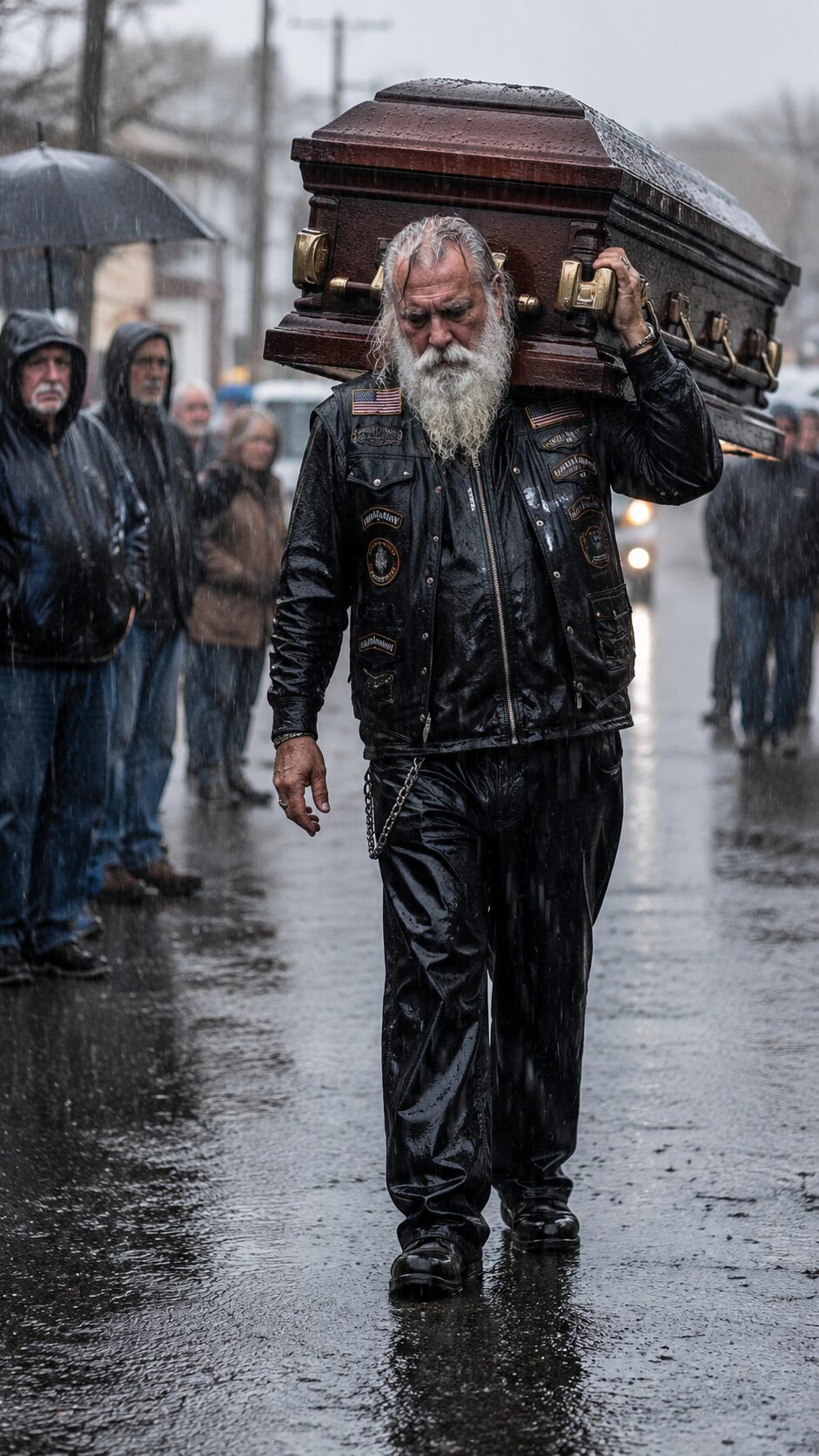
The rain started before sunrise and never stopped.
By noon, the streets of Blackwater County looked like rivers of broken glass, reflecting gray skies and flickering traffic lights. People hurried beneath umbrellas, heads down, trying not to get soaked. Nobody noticed the old biker at first.
Until they saw what he was carrying.
The man looked to be in his late sixties, maybe older. His long white beard hung heavy with rainwater, dripping onto the cracked leather vest stretched across his broad shoulders. Tattoos faded by time wrapped around his weathered arms. His boots hit the pavement with slow, painful steps.
And balanced across one shoulder was a coffin.
Not carried by pallbearers.
Not loaded into a hearse.
Just one old outlaw biker walking alone through the storm with a casket on his back.
Cars slowed beside him.
Pedestrians stopped under storefront awnings.
A woman near a coffee shop whispered to her husband, “What is this guy doing?”
Another man laughed nervously. “Probably drunk.”
A teenager pulled out his phone and started recording.
But the biker never looked at any of them.
He just kept walking.
Rain poured down his face like tears.
Three miles away, at the edge of town, Saint Matthew’s Cemetery sat empty beneath swaying trees and rolling thunder. The funeral had been scheduled for eleven o’clock that morning.
No one came.
No family.
No friends.
No priest.
Nobody except the funeral director and the old biker.
The man carrying the coffin was named Frank Delaney, president of the Steel Saints Motorcycle Club. Twenty-five years earlier, people in town feared men like him. Newspapers called them criminals, drifters, violent outlaws.
But nobody knew the truth about Frank.
Or the man inside the casket.
The dead man’s name was Walter “Doc” Grayson.
A Vietnam veteran.
Combat medic.
Purple Heart recipient.
A man who had once run through gunfire to save wounded soldiers barely older than children.
For thirty years after the war, Doc worked night shifts as a paramedic while raising two kids with his wife, Elaine. By all accounts, he was a decent man. Quiet. Hardworking. The kind of person who fixed neighbors’ fences without being asked.
Then life broke him slowly.
Elaine died from cancer.
His son moved away and stopped calling.
His daughter blamed him for selling the family house after medical bills swallowed everything they owned.
Doc eventually ended up living in a rusted camper outside town.
Alone.
The VA checks barely covered food.
People forgot him.
Until Frank found him one winter night.
It happened outside Rosie’s Diner during a snowstorm. Frank had stopped for coffee after a late motorcycle run when he noticed an old man shivering beside a broken camper.
Most people walked past.
Frank didn’t.
He brought Doc inside.
Bought him coffee.
Then another.
The two men talked until nearly sunrise.
Frank learned about the war.
About the ambulance years.
About the wife Doc still missed every single day.
But one story stayed with him forever.
Doc admitted he carried guilt from Vietnam because he couldn’t save everyone.
“I still see their faces,” he whispered quietly. “Boys calling for their mothers.”
Frank never forgot that sentence.
From then on, the biker club checked on Doc regularly. They repaired his camper roof. Brought groceries. Sat with him during holidays so he wouldn’t eat alone.
They became the family he lost.
Then, two weeks ago, Doc suffered a stroke.
He died alone in a county hospital bed.
The hospital contacted his children.
Neither wanted responsibility.
His son reportedly said, “I already buried him years ago.”
His daughter refused to pay funeral expenses.
So the state arranged a direct cremation with no ceremony.
No honor guard.
No flag.
Nothing.
Until funeral director Martha Greene made one final phone call.
Frank answered immediately.
And now here he was.
Walking through the rain alone with Doc’s coffin on his shoulder because the hearse driver had refused to cross flooded streets leading to the old cemetery hill.
The funeral company suggested postponing.
Frank refused.
“A soldier waited long enough,” he said.
So he carried Doc himself.
Every painful step.
Every flooded block.
People watched from sidewalks in stunned silence as realization slowly spread.
This wasn’t some publicity stunt.
This wasn’t madness.
This was loyalty.
Halfway to the cemetery, a young reporter approached carefully beneath an umbrella.
“Sir,” she called out, struggling to keep pace beside him, “why are you doing this?”
Frank kept walking.
Then finally answered.
“Because no man who served his country deserves to leave this world alone.”
The reporter lowered her microphone.
For several seconds, only rain could be heard.
Then something unexpected happened.
An older man standing beneath a hardware store awning removed his hat and stepped into the rain.
Silently, he fell in behind the biker.
A woman from the diner joined next.
Then two construction workers.
Then the teenager who had been recording earlier tucked away his phone and walked quietly beside the coffin instead.
By the time Frank reached the final road leading uphill toward Saint Matthew’s Cemetery, nearly forty strangers followed behind him in complete silence.
Rain soaked every one of them.
Nobody cared.
At the cemetery gates, Frank’s legs nearly gave out from exhaustion. The coffin slipped slightly on his shoulder before three men rushed forward to help steady it.
One was the teenager.
Another was the man who had laughed earlier.
“I’m sorry,” the man muttered quietly.
Frank nodded once.
Together, they carried Doc the rest of the way.
At the grave site, thunder echoed across the hills as Martha Greene stood waiting beneath a small canopy, tears running down her face.
She had expected one biker.
Instead, nearly fifty people crowded the muddy cemetery.
Some held umbrellas.
Others stood uncovered in the pouring rain.
Frank gently placed the coffin above the grave.
Then he reached inside his vest and removed a folded American flag.
“I figured somebody should bring this,” he said softly.
A military veteran standing near the back stepped forward trembling.
“I served in Da Nang,” the old veteran whispered. “Mind if I help?”
Frank handed him the flag without hesitation.
Together, the two old men folded it carefully atop the casket while rain hammered the earth around them.
No preacher spoke.
No rehearsed ceremony followed.
Just silence.
And respect.
Finally, Frank stepped forward one last time.
“Doc spent his whole life carrying people,” he said, voice cracking. “Today, we carried him.”
Several grown men openly cried.
Even the reporter wiped tears from her eyes.
Then, from somewhere in the crowd, a hand slowly rose into a salute.
Another followed.
Then another.
Until nearly everyone standing there saluted the forgotten veteran abandoned by his own blood but honored by strangers who refused to let him disappear alone.
And for the first time in many years…
Walter “Doc” Grayson was no longer forgotten.