My name is Leah Corbin. I am thirty-one years old. I live in Springfield, Missouri. I am a high school art teacher. I have been teaching for six years. I am not a motorcycle person — I want to be upfront about that. I did not grow up wanting to ride. I grew up watching my father ride, which is a different thing.
My father’s name was Dennis Corbin. He was fifty-seven years old when he died of a heart attack on a Sunday morning in June of last year. He was in the garage when it happened. He was working on the bike.
The bike was a 1978 Harley-Davidson Shovelhead that my father had bought in pieces from an estate sale in 2019. It had been sitting disassembled in the garage of a man who had intended to restore it and had run out of time in the way that men run out of time for the projects they love — not all at once, but slowly, year by year, until the project is still there and the years are not. My father paid $3,200 for the crates of parts. He said it was the best $3,200 he had ever spent. My mother said it was the most delusional $3,200 she had ever witnessed and she meant it with love.
He had been working on it for four years when he died.
He had made real progress. The frame was straight. The engine had been rebuilt — he had done it himself over the course of two winters. The primary was done. He had the tank and fenders media blasted and was in the process of deciding on paint. He had borrowed $14,000 from a credit union to fund the parts and the machine work, and at the time of his death there was $11,200 remaining on that loan.
There was also a motorcycle in pieces in the garage that was maybe sixty percent complete.
My mother, whose name is Diane, is not a motorcycle person either. She loved my father completely and tolerated the Shovelhead with the specific patient exasperation of a woman who has made peace with the fact that her husband keeps expensive unfinished things in the garage. She had no idea what to do with it. She did not know what the parts were worth or what it would take to finish it or whether finishing it was even worth considering given the loan balance and the complexity of what remained.
My father’s chapter president, a man named Hal Brewer, called her three days after the funeral.
He said, “Diane. I want to ask you something and I want you to think about it before you answer.”
She said, “Okay.”
He said, “The brothers want to finish Dennis’s bike. We want to come on Saturdays. We’ll bring our own tools. We’ll cover any remaining parts out of club funds — don’t argue with me about this. We want to finish it.”
My mother was quiet for a moment.
She said, “Why?”
Hal said, “Because Dennis spent four years on that machine and he deserved to see it done. And because we can do that for him even if we can’t do the other thing.”
My mother said she needed to think about it.
She called me that evening. She told me what Hal had said. She asked me what I thought.
I said, “Mom. Let them come.”
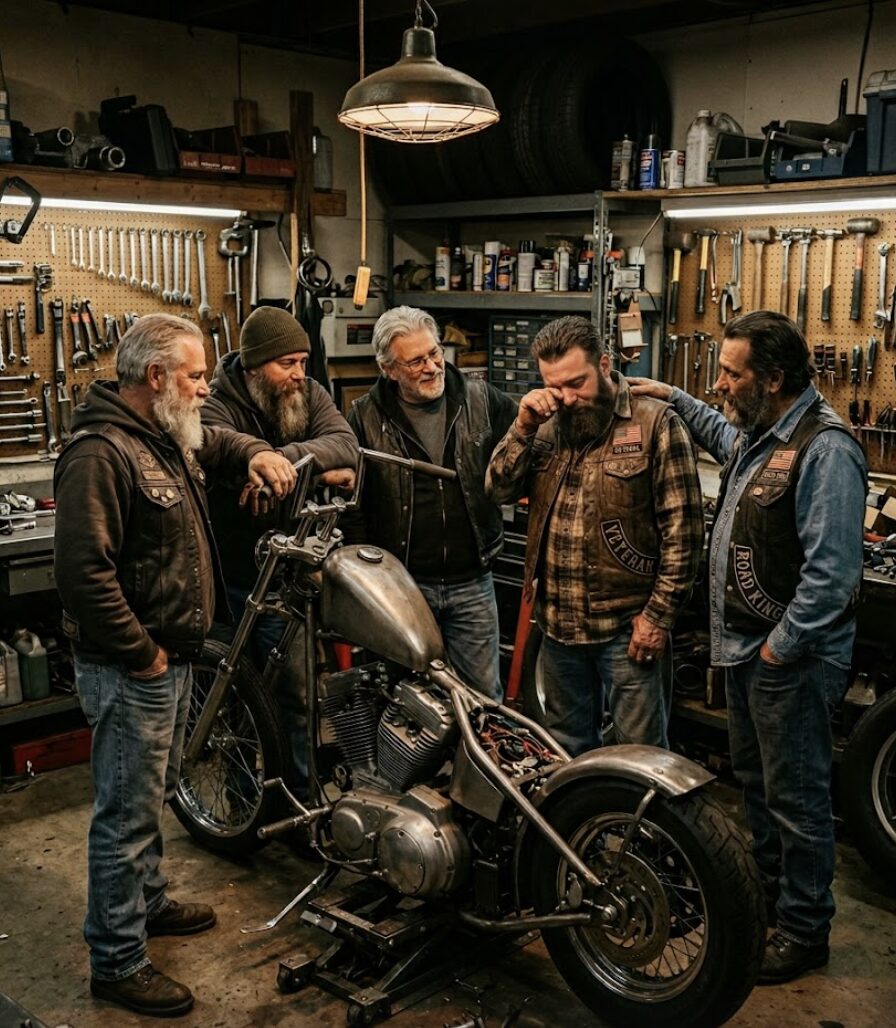
The first Saturday was three weeks after the funeral. Five men showed up at eight in the morning. My mother made coffee and set it on the workbench and went back inside because she said she did not want to be in the way, but I know her well enough to know that she stood at the kitchen window for most of that first morning watching through the glass.
I came down from Leah that first Saturday too. I sat in the corner of the garage on a folding chair and I watched.
I want to tell you what I saw.
I saw five men who were not young — mid-fifties to mid-sixties, all of them, men who had their own aches and their own Saturdays to spend — go through my father’s notes and his parts inventory and his assembly records with the focus of people who understood exactly what they were looking at. My father had kept meticulous records. Notebooks, labeled bags, a binder of parts diagrams with his handwritten annotations. They went through it all.
By noon they had a plan.
They came back the following Saturday. And the one after that. Eight months of Saturdays, most weeks three to five men, sometimes more. They did not miss a Saturday except twice — once for a funeral and once for a wedding — and both weeks they made it up on a Sunday.
They sourced the remaining parts. Hal paid for most of it out of his own pocket — I found this out later, not from Hal, from another member who told me without meaning to. He did not tell my mother. He told the club funds story and paid the difference himself.
They settled on paint after a long debate that apparently took four Saturdays to resolve. They chose what my father had been leaning toward — a deep burgundy, almost black in low light, with hand-painted pinstripes in cream. There is a man in the chapter named Curtis who does pinstriping as a side trade and he did it for nothing and he did it perfectly.
My father’s birthday is — was — March 14th.
On March 14th of this year, Hal called my mother and asked her to be at the house at noon.
She called me. I drove down.
At noon, eleven motorcycles turned onto my parents’ street. Eleven bikes, riding in formation, and at the front of the formation was the Shovelhead. Running. Complete. The burgundy paint catching the March light in a way that made it look like something my father had only imagined and they had made real.
Hal rode it. He cut the engine in front of the house and pushed it to the end of the driveway.
My mother came out.
She stood on the porch and looked at it.
Hal walked up to her. He held out the key.
He said, “Dennis built this. We just finished it for him.”
My mother took the key. She looked at it in her palm.
She said, “I can’t ride.”
Hal said, “I know. It’s not for riding. It’s for keeping.”
She looked at the bike. She walked down the porch steps slowly. She walked up to it. She put her hand on the tank — the burgundy paint, the cream pinstripes.
She stood like that for a while.
Then she said, to the bike, to my father, to whatever version of a conversation you have with the dead: “He would have loved it.”
Hal said, “Yes ma’am. He would have.”
The loan is paid off. I don’t know exactly how — when I asked Hal directly he said the chapter had held a fundraiser, which is true because I found the Facebook post, but the fundraiser raised about $4,000 and the loan was $11,200, and the math is the math, and I have not pushed further because some things are not mine to excavate.
The Shovelhead is in the garage. My mother starts it once a week to keep it running, the way Hal showed her. She does not ride it. It is not for riding.
It is for keeping.
It is for the fact that eleven men gave up eight months of Saturdays for a machine that belonged to a man who deserved to see it done.
My father built it. They finished it.
That is the whole sentence.